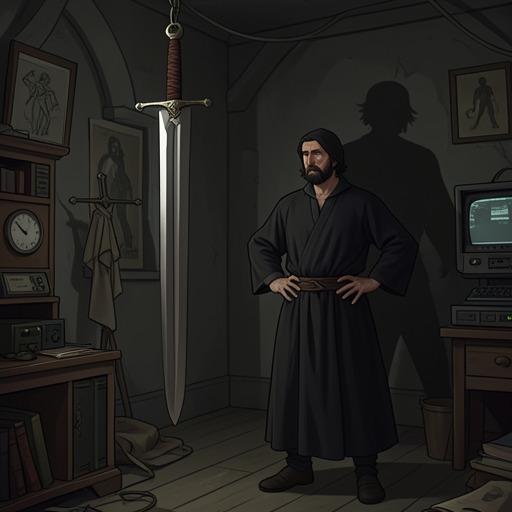
Lu Ting-Pin’s Punishment and Conditions for Atonement
MulanLu Ting-Pin’s Punishment and Conditions for Atonement bind the Immortal’s restoration to both accountability for his treatment of Yellow Peony and a measurable act of service: his peach-wood sword must destroy ten thousand demons. The terms restrict his powers and his contact with Yellow Peony, while making the sword’s tally—not Lu Ting-Pin’s personal hand—the stated measure of completion.
Cause and Judgment
Lu Ting-Pin’s punishment follows the discovery of his secret life with Yellow Peony. He had made a home for them in the middle of a lake, using the water to keep others from reaching her and imagining that he could conceal her from the world. When his seven fellow Mighty Immortals searched for him during one of his absences, they noticed the lake, investigated, and uncovered his deception. Their judgment was swift: they restrained him with their talismans, removed many of his powers, set his penance, and forbade him ever to see Yellow Peony or interfere in her life again.
The separation was not presented merely as a penalty imposed by higher authorities. Lu Ting-Pin recognizes why the restriction was necessary: he had no right to remove Yellow Peony from the world and treat her as though she were an object kept for his own pleasure. She was a woman with thoughts and a destiny of her own, and his actions had injured that destiny. The ban on seeing or influencing her therefore directly addresses the harm at the center of his offense, rather than serving only as a general loss of privilege.
The consequences continued after the couple’s separation. Yellow Peony gave birth to their daughter amid disgrace; the Immortals later dissolved the marriage and arranged for Yellow Peony to establish a different identity in another town, where she remarried and began a new life. She could not bear the sight of her eldest daughter, who reminded her of the betrayal and shame surrounding the relationship. The child, later known as the Unwanted Girl, endured her mother’s anger. Lu Ting-Pin regards this rejection as his gravest transgression: fulfilling his penance could not undo the pain his actions had caused his daughter.
Restrictions and the Peach-Wood Sword
The judgment altered both what Lu Ting-Pin could do and what his weapon could do. His fellow Immortals took away his fly whisk so that he could no longer fly great distances. They also changed his two-edged sword into one made of peach wood. These are concrete restraints: one limits his ability to travel, while the other turns a familiar weapon into the instrument through which he must work toward atonement.
The choice of material gives the sword its particular function. Peach wood has the power to kill noxious beasts and demons, so the transformed blade is suited to the task assigned to Lu Ting-Pin. The terms require the sword to destroy ten thousand demons. The requirement is attached to the weapon, not explicitly to Lu Ting-Pin as its wielder. That distinction is crucial: the punishment sets a demanding count, but its wording leaves open who may deliver the blows.
The Count and the White Fox
By the time Lu Ting-Pin explains the condition to Mulan, he has killed 9,999 demons and needs one more. He has chosen the White Fox as the intended final target, not simply because she is another demon, but because she controls his daughter. He hopes that killing the White Fox will free Xianniang from serving her. The proposed final act thus joins the arithmetic of the penance to an immediate purpose: ending the power the White Fox holds over his daughter.
The plan also tests the limit of the belief that no man can kill the White Fox. Mulan raises that claim, and Lu Ting-Pin answers that its not having happened yet does not prove it impossible. His response does not erase the danger or establish that he can succeed; it shows instead that the claim is not part of the stated terms of his punishment. The rule demands the destruction of ten thousand demons, while the White Fox is Lu Ting-Pin’s chosen means of reaching the total and rescuing Xianniang.
Completion and Meaning
The condition is fulfilled when the sword reaches the required count, even though Lu Ting-Pin is not the one wielding it for the final qualifying act. As the Jade Rabbit regains his strength, Lu Ting-Pin cleans soot and grime from the blade; it is now gleaming metal rather than peach wood. When the Jade Rabbit asks whether the act counted, Lu Ting-Pin explains that the terms required the sword to kill ten thousand demons and did not say that he had to wield it himself. The rule’s precise wording allows the count to stand without requiring that he personally strike the last blow.
The sword’s return to metal is the visible sign that the penance has been completed. Lu Ting-Pin appears changed as well: the pallor has left him, his features seem more vivid, and his robes have brightened. Yet the story keeps completion distinct from repair. The terms can end the imposed punishment, but they cannot reverse the harm done to Yellow Peony or remove the pain suffered by the Unwanted Girl. The rule therefore has a double edge: it offers a finite condition for atonement while insisting, through Lu Ting-Pin’s own account, that meeting that condition cannot make every consequence disappear.