FPMR's use of the Queen's home for secret meetings and storing supplies
My Tender MatadorThe Queen of the Corner’s home serves as a discreet base for Carlos and his associates: a place to store materials and hold meetings beyond the notice of the surrounding neighborhood. What begins with boxes presented as censored books develops into repeated clandestine gatherings and the delivery of a metal cylinder. The arrangement changes as the Queen learns that Carlos is an alias and that he belongs to the Manuel Rodríguez Patriotic Front; her home is not merely a convenient address but part of a political network, with consequences for her safety and her attachment to the house.
A Home Made into Cover
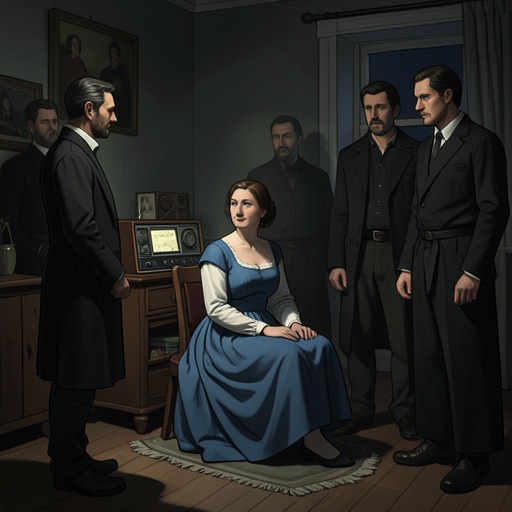
The house is the Queen’s most carefully fashioned private space. She decorates its walls and cornices with birds, fans, flowering vines, and lace, while fringed scarves, nets, and other fabrics cover the boxes she uses as furniture. Against this elaborate domestic setting, Carlos’s request that she keep heavy boxes seems almost casual. He describes their contents as censored books, and the Queen accepts the explanation without pressing him for details. Her attraction to Carlos and her willingness to help make the request feel personal before she understands its political purpose.
The concealment is built into ordinary objects and household arrangements. Boxes that look like furniture can hide what is inside; the decorated rooms and the Queen’s routines give the house an appearance quite unlike a formal political meeting place. The first explanation, that the boxes hold books, allows her to shelter them without knowing exactly what their storage means. That limited understanding is important: the operation is already using her home before she is given access to its full purpose.
Meetings Behind Closed Doors
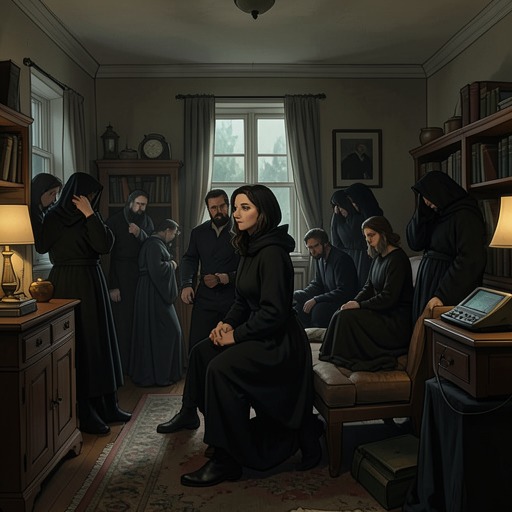
The use of the house expands from storage to meetings. Carlos’s friends arrive at midnight or dawn, sometimes in heavy rain, and gather in the room on the roof while a companion remains outside on the corner. The Queen serves coffee and wants to welcome the visitors, but Carlos sometimes keeps her from going upstairs. He explains that even he is excluded from some meetings and treats their privacy as a matter of how men conduct their studies. His reassurance protects the secrecy of the gatherings while leaving the homeowner herself outside the conversations taking place under her roof.
As the visitors become a more frequent presence, their movement up and down the rickety staircase becomes a recurring feature of life in the house. The Queen notices the growing urgency of their comings and goings, and Carlos sometimes works to keep her from seeing the cloaked visitors. Neighbors also take note of the boxes and packages being carried in and out, and gossip about what may be happening. The house’s usefulness as cover therefore rests on a precarious balance: the activity can be explained away as books and private visitors, but it is increasingly visible to the people around it.
One morning, Carlos arrives with two friends carrying a heavy metal tube. They bring it into the house without first asking permission. The Queen is told that it contains valuable manuscripts and jokes that the unfamiliar object could become a column in her living room. Carlos leaves in haste, postponing an explanation. The episode makes the disparity between her domestic interpretation and the associates’ urgency especially clear: she is expected to receive and accommodate an important object before she knows what it is or why it matters.
From Partial Knowledge to Complicity
The Queen’s questions grow as the meetings and stored materials accumulate. She resents being told repeatedly that Carlos will explain later and says he has treated her as though she could not keep a secret. Carlos answers that fuller knowledge would put her in danger, not that she is incapable of understanding. He recognizes that she has helped the group while arguing that restricting what she knows is a security measure. Their exchange exposes a conflict at the center of the arrangement: her home and assistance are needed, yet secrecy also requires keeping her at a distance.
Carlos eventually tells her that Carlos is an alias and identifies himself as a clandestine member of the Manuel Rodríguez Patriotic Front. The Queen produces his identity card, which she had found and kept. The card gives a concrete sign of the hidden identity she has suspected, and Carlos confirms the political meaning of the name he uses with her. For the first time, the domestic favor and the secret meetings are explicitly connected to an organized opposition group.
The disclosure also changes the terms of her participation. Carlos proposes that they use a code word or phrase if they need to communicate clandestinely. The Queen welcomes the idea and suggests making the password the title of a song, bringing her familiar, expressive world into the group’s security practices. The suggestion does not erase the danger or give her access to every detail, but it marks a shift from unknowingly keeping boxes to accepting a role in confidential communication.
Exposure, Repression, and Departure
The risks surrounding the house become harder to separate from the wider political emergency. After reports of arrests among students and warnings of an alleged subversive plan, the Queen listens to Radio Cooperativa and worries about Carlos’s safety. She hears accounts of families searching for detained and disappeared relatives; what had been a pattern of boxes, visits, and evasive explanations now sits within a public climate of state repression. Neighbors’ curiosity, once something she could dismiss, is also a reminder that people are watching who enters and leaves her home.
After the September 1986 ambush on Augusto Pinochet’s motorcade, the crackdown reaches the city through house-to-house searches, roadblocks, and military checks. The Queen stays awake with a kettle ready in case Carlos or his friends arrive and the radio turned low for news. The possibility that the house could be searched gives its earlier use as a meeting place and storehouse a new consequence: traces of the clandestine activity may endanger the Queen as well as the people who used the rooms.
At dawn, she prepares to leave by destroying papers with telephone numbers and addresses, cleaning surfaces, and sweeping away signs that someone has been in the house. She packs her dearest possessions into two bags and looks out from the roof at the horizon, facing the loss of the home she had made her own. The evacuation is the final consequence of the house’s dual life. The same rooms that once offered shelter to Carlos and his associates have become an exposure risk in a city under military search, and the Queen must abandon them without the reassurance of seeing Carlos again.
Significance of the Safe House
The clandestine use of the Queen’s home turns domestic hospitality into a form of political support. Coffee, furniture, boxes, a rooftop room, and a metal cylinder are not incidental scenery: they show how covert activity is fitted into daily life and how secrecy depends on ordinary spaces and trusted relationships. At first, the Queen’s willingness to help is bound to her feelings for Carlos and to the explanations he gives her. Later, knowledge and a proposed code word make her participation more deliberate, even as the restrictions on what she may know remain.
The house is both refuge and liability. It protects meetings from immediate public view, but repeated visitors draw neighborhood attention, and the state’s search operations turn concealment into a matter of urgent survival. Its eventual abandonment does not undo the assistance already given; instead, it reveals the cost of making a private home part of a clandestine network. Through this change, the safe house links the Queen’s intimate life with organized resistance and the political violence that forces her to flee.