Verity Hunt's murder and concealment
NemesisVerity Hunt's murder and concealment is the hidden crime that organizes the novel’s apparent evidence against Michael Rafiel. Clotilde Bradbury-Scott kills Verity because Verity’s love for Michael threatens the possessive bond between the two women; she then turns the garden at The Old Manor House into a private grave, while using Nora Broad’s mutilated body to manufacture a public explanation that sends Michael toward conviction.
Causes and Background
Verity’s death follows her decision to escape a life controlled by Clotilde Bradbury-Scott. Verity and Michael Rafiel had fallen genuinely in love and intended to marry, despite Michael’s criminal record and the doubts surrounding his character. Archdeacon Brabazon believed that their love was real and that Michael meant to reform, while Verity wanted marriage, children, and the ordinary life that Clotilde’s devotion had made impossible. The wedding was arranged secretly, and Verity was expected to meet Michael at a rendezvous after separately making her way there.
Clotilde could not accept Verity’s departure. Her attachment had become a form of possession: she loved Verity, but would not allow Verity to choose another life or another person. Miss Marple therefore identifies love itself as the frightening force behind the crime. Clotilde’s suffering was not presented as remorse. She endured the continuing agony of having destroyed the person she most wanted to keep, while preserving Verity’s presence in the only way left to her.
The Murder and the Hidden Grave
Verity never reached the meeting with Michael. Miss Marple reconstructs the decisive act as a killing by overdose rather than the strangulation and brutal disfigurement attributed to the supposed murderer. Clotilde probably gave Verity coffee or milk containing a painless overdose of sleeping medication, a method consistent with her inability to attack the beloved girl’s face or body in the manner later described by the authorities.
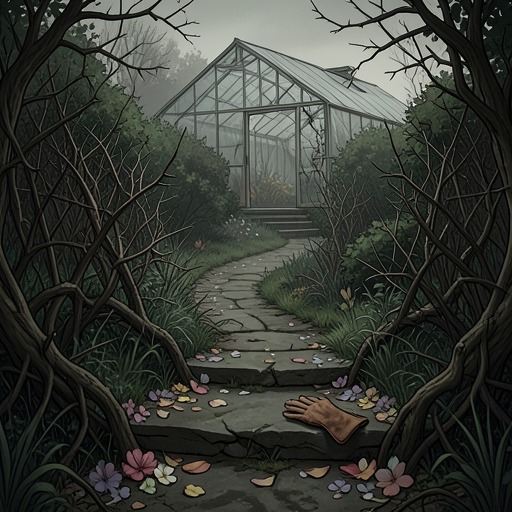
After Verity died, Clotilde moved her body into the garden. The collapsed greenhouse provided a ready-made structure: its fallen bricks were rearranged into a vault, and earth and turf were piled over the remains. The site was then covered by Polygonum baldschuanicum, a fast-growing creeper that spreads over ugly or ruined structures and suppresses whatever lies beneath it. The plant’s beauty and aggressiveness make the grave both concealed and symbolically persistent: it hides the evidence while allowing Verity to remain at The Old Manor House, where Clotilde never has to relinquish her.
The physical setting had already registered the crime before anyone understood it. The Old Manor House was neglected, its garden overgrown and its former greenhouse reduced to a mound. When Anthea Bradbury-Scott spoke nostalgically of the greenhouse’s grapes and expressed a wish to rebuild it, she also showed fear of the mound. Miss Marple sensed in her a despairing awareness of something that remained behind the surface. The ruin thus functions as both a family relic and a crime scene, while Polygonum becomes a natural-looking mechanism for concealment and the delayed return of the past.
The Substitution of Nora Broad’s Body
Clotilde needed more than a hidden grave. She needed Michael to appear responsible for Verity’s death. She therefore exploited the disappearance of Nora Broad, a young village girl, taking her to a remote place perhaps thirty or forty miles away under the pretext of a picnic or expedition. There she strangled Nora, disfigured her face, and buried the body beneath turned earth, leaves, and branches.
The mutilated corpse was then converted into false evidence. Clotilde dressed it in Verity’s clothes or arranged Verity’s possessions beside it, including her handbag, a letter or two, a bangle, and a small cross on a chain. She ensured that the face was too damaged for ordinary recognition and then identified the body as Verity’s herself, precisely because she was the person most likely to be trusted as an intimate authority on Verity’s appearance. The murder therefore depended on two contrasting treatments of bodies: Verity was killed quietly and hidden lovingly beneath the garden, while Nora was violently disfigured and displayed as a substitute victim.
Clotilde also spread rumors that Nora had been seen in Michael’s car and had been involved with him. She could suggest that Verity had broken off the engagement because of Michael’s infidelity, creating a story in which Michael had both a motive and an opportunity. The substitution transformed Michael’s relationship with Verity into apparent proof of murder, while concealing the actual victim and preserving Clotilde’s private secret.
Discovery and Reinterpretation
The case initially seemed to point overwhelmingly toward Michael. His record included an earlier conviction involving assault against a young woman, and the later discovery of a strangled, disfigured girl appeared to confirm the worst interpretation of his character. Yet Miss Marple recognizes that the body’s treatment does not fit a lover who truly intended to marry Verity. Archdeacon Brabazon’s testimony strengthens that contradiction: he had known both young people, believed their love genuine, and thought Michael was prepared to reform.
Elizabeth Temple supplied the crucial interpretive clue by calling love a frightening word. Miss Marple first considered whether Verity might have died by suicide after discovering something disturbing about Michael, but she rejects that explanation. The evidence instead points to a crime committed in the name of an overpowering love. Once Elizabeth Temple’s death establishes that the past is still active and dangerous, Miss Marple concludes that there have been three killings rather than one: Verity’s murder, Nora Broad’s murder, and Elizabeth Temple’s later killing.
The final confrontation makes the reversal explicit. Clotilde admits killing Nora but denies having killed the girl she loved, insisting that a person who loved Verity could not have strangled and crushed her. Miss Marple accepts the distinction while turning it against her: Clotilde did not perform the violence attributed to the alleged killer, but she caused Verity’s death by giving her the fatal drink and burying her under the greenhouse mound. The apparent weakness of the accusation becomes its strength, because the difference between the two bodies reveals the logic of the substitution.
Significance and Aftermath
Verity’s murder is both an act of possession and an act of narrative fabrication. Clotilde refuses to let Verity leave, then constructs a second death that directs suspicion toward the man Verity loved. The crime destroys Verity’s freedom, Nora’s identity, and Michael’s future at once; it also turns the family garden into a memorial that Clotilde cannot openly acknowledge.
The concealment ultimately fails because repression has left visible traces: Anthea’s fear, the peculiar mound, the collapsed greenhouse, the relentless spread of Polygonum, and the mismatch between the lovers’ reported intentions and the violence done to the substitute corpse. What Clotilde meant to preserve as an eternal private possession becomes the material evidence of her crime. Verity remains at The Old Manor House, but not as the living beloved Clotilde imagined she could keep; she remains as the buried truth that finally returns to expose the destructive union of love, fear, and control.