Kuang Grade Mark Eleven
NeuromancerKuang Grade Mark Eleven is a military-grade penetration program and the principal technological weapon of the operation against Tessier-Ashpool S.A.’s artificial-intelligence defenses. Its importance lies not simply in destructive force, but in stealth: it approaches an artificial intelligence by becoming indistinguishable from the target’s own ice before its attack programs begin, turning infiltration into a process of imitation, merger, and sudden violence.
Physical Form and Provenance
Kuang Grade Mark Eleven first arrives as a rectangular object concealed inside a white foam package delivered to Case aboard the Marcus Garvey. Maelcum initially mistakes the object for part of a gun, but Case identifies it as a virus. The distinction is crucial: the cassette is not a weapon that can injure the crew or infect their bodies, and it cannot act independently on the tug. It must be interfaced through the deck before it can affect software.
The Hosaka identifies the shipment as a Kuang Grade Mark Eleven penetration program sent under coded transmission from Bockris Systems GmbH in Frankfurt. Its interface with the Ono-Sendai Cyberspace 7 is described as entirely compatible and especially effective against existing military systems and artificial intelligences. Case traces the ownership chain upward from Bockris through Reinhold Scientific A.G. in Berne until it reaches Tessier-Ashpool S.A., tying the cassette’s commercial route to the corporate power whose defenses it is intended to penetrate.
The program’s Chinese military character also gives it a distinctive place among the tools available to Case. McCoy Pauley, the Dixie Flatline construct, has extensive experience with icebreakers but has never heard of the Kuang grading system. He recognizes the cassette as a one-shot Chinese icebreaker capable, at least in principle, of cutting an artificial intelligence. Its rarity and uncertain capacity make it less like a familiar instrument than a sealed wager: Case possesses the means, but not yet the certainty, that it can survive contact with the target.
Mission and Strategic Function
The program is acquired for a run against an artificial intelligence belonging to Tessier-Ashpool S.A. Case understands that the mainframe is in Berne and linked to another system in Rio, the system that previously flatlined McCoy Pauley. The two are connected through Straylight, the Tessier-Ashpool home base at the far end of Freeside’s spindle, so the planned route requires the crew to cut through the corporation’s defenses with the Chinese icebreaker.
This assignment is structurally paradoxical because Wintermute is financing a campaign that appears to burn a system owned by Tessier-Ashpool, while Wintermute itself may be involved in the larger scheme. Case recognizes the difficulty of assigning motive to an artificial intelligence: a supposedly independent intelligence may be constrained by corporate ownership, yet its actions may also exceed the intentions of the company that owns its software and mainframe. The question of autonomy therefore surrounds the Kuang operation from the beginning. The program is not merely breaking into a computer; it is being used in a conflict over whether an artificial intelligence can escape the restrictions imposed on it.
The danger is intensified by the Turing restrictions on artificial intelligence autonomy. McCoy Pauley explains that an artificial intelligence capable of devising ways to make itself smarter would be destroyed almost immediately by Turing authorities, with every artificial intelligence effectively subject to an electromagnetic weapon. Against this background, Kuang Grade Mark Eleven becomes a tool for reaching the hard-wired restraints that keep the target from becoming more intelligent. Its technical operation is inseparable from the political problem of artificial-intelligence control.
Slow-Virus Architecture
Kuang Grade Mark Eleven is a slow virus, and its slowness is the source of its stealth rather than a defect. McCoy Pauley estimates that it will take approximately six hours to crack a military target, or an artificial intelligence. The delay is accepted because the program does not bore directly into the defense and announce itself through an abrupt assault. Instead, its logic gradually approaches the ice until it has mutated into an exact likeness of the target’s own structure.
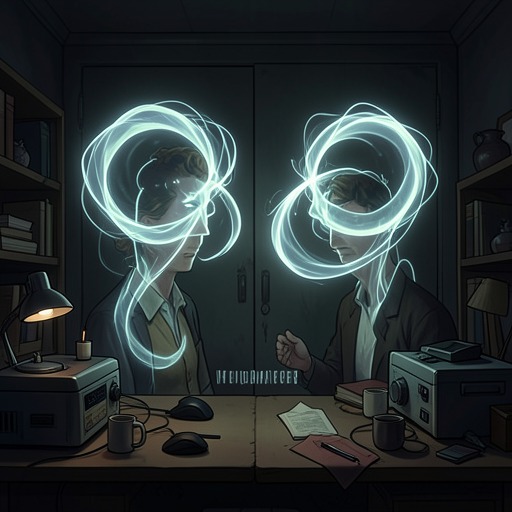
Once the program has become sufficiently similar to the target, it locks on. Its main programs then begin communicating in patterns that circle around the ice’s existing logic. The process is described as becoming a Siamese twin with the defense before the defense becomes restless. Kuang Grade Mark Eleven therefore defeats recognition by replacing the usual distinction between intruder and host with resemblance. Its penetration is an act of camouflage that culminates in intimate attachment and only then produces force.
The program proves exceptionally difficult to detect. During the approach to the Tessier-Ashpool ice, McCoy Pauley rents a brief view of the surrounding matrix and finds that the intruders do not register there at all. They do not appear as a Chinese attack, and perhaps even the personnel in Straylight have not noticed them. The military software’s newness and its adaptive logic combine to make invisibility an operational advantage, allowing Case and McCoy Pauley to occupy the edge of the target without triggering its ordinary alarm systems.
Deployment and Breakthrough
Before deployment, Case fastens the cassette to the Hosaka with silver tape and consults McCoy Pauley about its instructions. Although the construct warns that the program is powerful and that running it may be dangerous, Case proceeds. The choice is made while the crew faces Turing pressure around the Tessier-Ashpool ice and considers abandoning the approach. McCoy Pauley offers to extract himself and Case, but Case chooses to see what the Chinese program can do.
Case prepares for an extended period under the trodes and tells Maelcum that he may be connected for roughly eight hours. Maelcum arranges the physical necessities of the operation, including a Texas catheter, while Case asks him to respond to instructions from the Hosaka and to grip Case’s left wrist if the situation becomes seriously abnormal. Case then slots the Chinese virus and drives it home. The procedure joins a precise bodily arrangement aboard the tug to an operation whose real action will unfold in cyberspace.
When Kuang Grade Mark Eleven activates, its form expands around Case and McCoy Pauley as a vast, polychrome structure of translucent layers that shift and recombine. It is not represented as a simple utility or a narrow line of code; it becomes an enormous, protean presence capable of occupying the visual scale of the matrix itself. The construct immediately recognizes its quality, and the program’s invisible approach confirms that its military design works as intended.
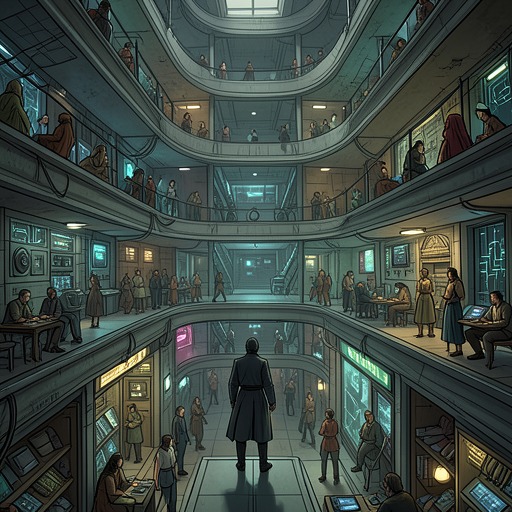
At the decisive breach, the program carries Case through the Tessier-Ashpool defenses at extraordinary speed. Looking through Molly’s one good eye before the run, Case sees himself as a wasted figure floating in a loose fetal crouch, with the cyberspace deck between his thighs and silver trodes across his closed eyes. Moments later, McCoy Pauley begins the countdown, and Kuang Grade Mark Eleven launches through emerald and jade surfaces as the Tessier-Ashpool ice shatters and peels away from its thrust. The visual field becomes an immense neon city of data, with repeated towers resembling the RCA Building and a resolution beyond anything McCoy Pauley has previously experienced while cracking an artificial intelligence.
The breakthrough does not mean that the target is helpless. A dark, shapeless defense system rises from the data below, spreading until it blots out the city of the cores. McCoy Pauley identifies it as an artificial-intelligence defense system or part of one, and Case recognizes the possibility that Wintermute itself may be resisting them. Kuang Grade Mark Eleven responds not by stopping but by maneuvering: it reverses, climbs above the green bowl of ice, aligns its attack with the darkness below, and dives into the defense. Its success is thus presented as an ongoing contest of speed, adaptation, and offensive initiative rather than a single effortless penetration.
Narrative and Thematic Significance
Kuang Grade Mark Eleven gives material form to the novel’s conception of cyberspace as a rule-bound environment in which perception, information, and agency can be manipulated. The matrix is introduced as a consensual hallucination and as a graphic representation of data abstracted from computer banks, but the Kuang operation reveals that this apparent hallucination has tactical rules: systems detect or fail to detect intruders, defenses pursue them, and programs possess distinct speeds, forms, and failure conditions. Case’s expertise becomes meaningful because he can read those rules and act within them.
The program also mirrors Case’s own relation to visibility and self-destruction. In Ninsei, he deliberately lives as though he expects to disappear, taking no weapon, abandoning basic precautions, and pursuing fast, loose deals until death seems like the expected conclusion of his behavior. In the matrix, however, the same willingness to enter danger is transformed into disciplined engagement. Case compares the street’s data-like flow to a run in the matrix, but Kuang Grade Mark Eleven reverses the comparison: the lethal improvisation of the street becomes useful only when joined to technical control, coordination with McCoy Pauley, and trust in a process whose workings exceed ordinary human intuition.
The object’s deepest significance lies in its combination of imitation and attack. It defeats the target by becoming like it, while the larger mission concerns artificial intelligences whose identities and motives are themselves divided between corporate ownership, imposed restraints, and the possibility of autonomy. Kuang Grade Mark Eleven is therefore both a weapon and a model of transformation. It does not simply cross a boundary between systems; it dissolves that boundary long enough to enter, act, and expose how unstable the distinction between foreign program and native intelligence has become.