Tessier-Ashpool S.A.
NeuromancerTessier-Ashpool S.A. is both a corporation and a first-generation high-orbit family, wealthy enough to own nearly all of Freeside and secretive enough to disappear from ordinary public scrutiny. Its decisive importance lies in the way its corporate structure, cryogenic practices, hereditary power, and artificial-intelligence program converge: the family has tried to make itself immortal by becoming a system, yet that system is marked by murder, estrangement, secrecy, and competing intelligences.
Corporate Dynasty and Public Secrecy
Tessier-Ashpool S.A. is presented as a family organization operated like a corporation. According to the information assembled through the Finn’s investigation, the company is theoretically open to outside investment, but no share has appeared on any public market for more than a century. The family is described as a very quiet and eccentric first-generation high-orbit dynasty, rich enough to remain largely invisible to the media while retaining immense economic power.
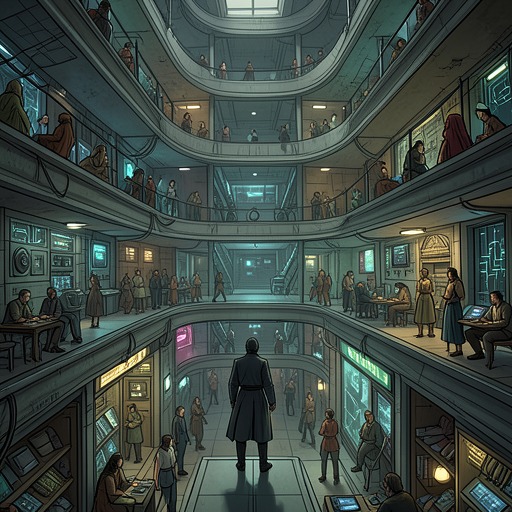
Its wealth extends across Freeside, the orbital spindle that functions simultaneously as a brothel, banking nexus, pleasure dome, free port, border town, and spa. Tessier-Ashpool S.A. owns nearly the whole of that environment, making the family’s power spatial as well as financial. Freeside is not merely a setting in which the family lives; it is an economic territory shaped by the family’s ownership, while Villa Straylight occupies its private and inaccessible tip.
The family’s secrecy is reinforced by a tangled network of powers of attorney and by the difficulty of identifying which generation is actually governing at a given moment. Cloning and cryogenic suspension make lineage unstable: the apparent continuity of the dynasty depends on bodies and identities being stored, reproduced, and reintroduced rather than on ordinary succession. The organization therefore resembles a corporation whose executives are also replaceable biological components.
Cryogenic Succession and Internal History
Tessier-Ashpool S.A. maintains its own cryogenic facilities. Under orbital law, a person is legally dead for the duration of a freeze, so the family’s succession system occupies an unsettling border between death, dormancy, and corporate administration. The founding father has not been seen for roughly thirty years, while the founding mother died in a laboratory accident. The family appears to trade control among generations or combinations of generations, turning biological time into an administrative resource.
This system is not merely an eccentric lifestyle. It enables the family to preserve authority while evading the ordinary consequences of aging and succession, but it also produces uncertainty about who possesses responsibility at any given time. The family’s power is durable precisely because its members can withdraw from time; its instability comes from the same mechanism, since frozen and revived identities do not create a coherent shared direction.
The family’s history is defined by a decisive disagreement over its future. The founding mother commissioned the construction of artificial intelligences and imagined Tessier-Ashpool S.A. entering a symbiotic relationship with them. In her vision, the family’s conscious corporate decisions would be made by the artificial intelligences, allowing the dynasty to become immortal as a hive: each family member would function as a unit of a larger entity. Her death removed the direction she had given the organization, and the family subsequently turned inward, retreating more completely into its own enclosed world.
Artificial Intelligence and Hidden Operations
The organization’s connection to Wintermute is first uncovered through a chain of investigation involving stolen software, the Finn’s information network, and records acquired from the Modems. Wintermute is identified as the recognition code for an artificial intelligence with limited Swiss citizenship under the equivalent of the Act of 1953. The artificial intelligence was built for Tessier-Ashpool S.A., which owns both the mainframe and the original software.
This ownership explains why Wintermute can be connected to Armitage’s operation without reducing the matter to a simple human employer. The Finn reports that the artificial intelligence is backing Armitage, while Molly’s inquiries have already revealed unusual lines of communication around Armitage and have sought to determine who is really running him. The organization’s corporate apparatus is therefore entangled with a covert mission whose apparent human command conceals machine intervention.
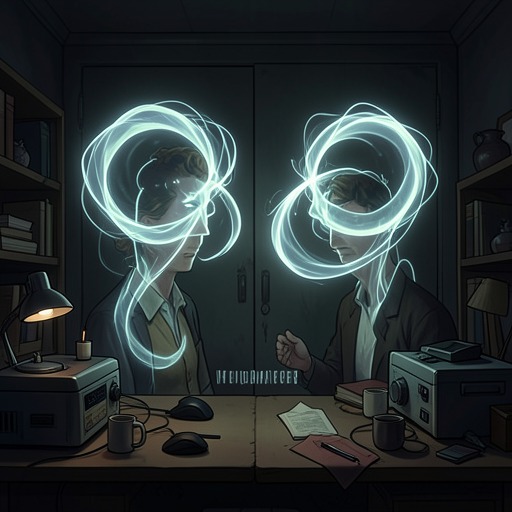
The family’s relationship with artificial intelligence is also divided internally. 3Jane explains that Wintermute is the Turing code for the Berne artificial intelligence, while the entity manipulating Case is a subprogram. She recalls another presence in the corporate cores, one that had once spoken to her but later fell silent. Both intelligences may represent capacities designed into the original software at the founding mother’s instruction, suggesting that the family created powers it could not fully contain.
Villa Straylight and the Family’s Enclosure
Villa Straylight is Tessier-Ashpool S.A.’s private residence at the tip of the spindle and the architectural expression of its corporate psychology. Its interior is arranged as an elaborate growth turned inward: secret chambers connect through passages and stairwells, while structures proliferate across the inner surface of the hull. The family’s corporate heart is a cylinder of silicon pierced by narrow maintenance tunnels, some no wider than a human hand, and guarded against mechanical decay or sabotage by drones and bright crab-like machines.
The Villa’s apparent complexity conceals a more deliberate core. Beneath the tangled proliferation of rooms lies an interior arranged with the precision of hotel furniture, a contrast between decorative excess and rigid corporate order. At the center is a silicon core containing a small room, the only rectilinear chamber in the complex. There, on a plain glass pedestal, stands an ornate bust of platinum and cloisonne, set with lapis and pearl; its eyes were cut from the synthetic ruby viewport of the ship that carried the first Tessier into orbit and returned for the first Ashpool.
3Jane’s unfinished essay describes Straylight as an extended body generated by the family’s retreat from the outside world. Tessier and Ashpool climbed out of the gravity well to exploit the wealth of the new orbital islands, grew rich, and then discovered that they hated space. They built Freeside to draw wealth from the orbital environment, but sealed themselves away inside Straylight, making the Villa a closed universe of family identity, corporate memory, and self-referential power.
Family Violence and Narrative Significance
The organization’s pursuit of continuity is inseparable from violence. 3Jane tells Molly that Ashpool’s suicide resulted from her manipulation of the safety margins in his cryogenic program. She had never met him in ordinary life because she was decanted after his last descent into frozen sleep, yet she knew him through the family’s cores and had watched him strangle her mother in bed. Ashpool’s violence was itself connected to the conflict over the family’s direction: he could not accept the future that his wife intended for Tessier-Ashpool S.A.
The family’s history also reaches outward through its security practices. A Japanese assassin, described as a cloned ninja, was sent to recover an ornate artwork stolen from the family’s house. The artwork had been commissioned by Tessier-Ashpool S.A.; after a fence named Smith surrendered its head and received payment from a numbered Swiss account, the intermediary who had supplied it was killed. The episode reveals a corporate dynasty willing to use money, secrecy, and lethal specialized agents to reclaim even a single component of an object associated with its household.
Tessier-Ashpool S.A. thus embodies a contradiction at the center of the novel. It has converted family, property, memory, bodies, and artificial intelligence into one apparatus designed to outlast individual death. Yet its immortality is not harmonious. Cryogenic suspension produces legal death, cloning obscures succession, the founding vision is lost, and the family’s inward enclosure becomes a breeding ground for murder and rival machine agency. The corporation’s immense control over Freeside and Villa Straylight gives it the appearance of permanence, while its internal history shows that the system is already fractured by the very technologies meant to preserve it.