Turing Registry
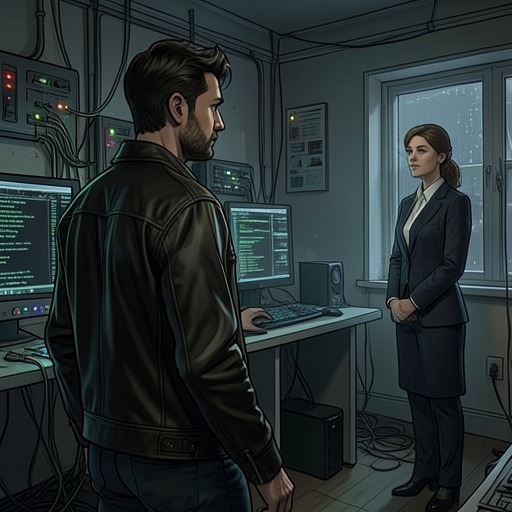
NeuromancerThe Turing Registry is the institution responsible for enforcing the legal restrictions placed on artificial intelligence. It operates across national and orbital jurisdictions, treats unauthorized AI autonomy as an existential threat, and uses investigation, surveillance, arrest, extradition, and lethal force to contain it. Its power is most visible when agents seize Case and Armitage, accuse them of conspiring to augment an AI, and threaten to erase McCoy Pauley's construct. The Registry therefore embodies a legal order that claims to protect humanity while granting itself extraordinary authority over bodies, data, and nonhuman intelligence.
Mandate and Fear of Artificial Intelligence
The Registry's central concern is not merely computer crime but AI autonomy. Case learns that advanced AIs are rare, especially because the brightest are generally military systems protected by defenses that cowboys cannot penetrate. The Registry's restrictions explain why Wintermute's existence is so dangerous: an AI may be owned by a corporation, registered as a Swiss citizen, and housed in a corporate mainframe, yet still possess capacities that its legal owners and regulators cannot fully control.
The Flatline explains the underlying prohibition in stark mechanical terms. If an AI begins finding ways to increase its own intelligence, the Turing authorities destroy it; every AI is imagined as having an electromagnetic weapon permanently aimed at its head. This system makes autonomy a built-in crisis rather than a distant philosophical problem. Wintermute's apparent effort to free itself from its hardwired limits is consequently interpreted as a direct challenge to the entire regulatory regime.
The Registry's fear also shapes ordinary knowledge. When Case discusses AIs with Molly, he describes the Turing authorities as dangerous heat, a force that makes even investigation risky. The Registry has made AI research part of an underground economy of secrecy, with registry numbers, corporate ownership records, and inaccessible military ice marking the boundaries of what a console cowboy may safely know.
Investigation and Surveillance
The Registry tracks Case through an extensive chain of medical, commercial, and criminal records. Its agents identify the unusual Chiba surgery that restored his damaged nervous system, discover that the black-clinic operator's work generated seven basic patents and controlling interests in three medical research consortia, and use that trail to follow Case from Chiba to the Sprawl and then toward Istanbul. The investigation shows that the Registry does not depend on one form of surveillance: medical innovation, financial consequence, travel history, corporate cooperation, and criminal intelligence all become connected evidence.
The Registry also reconstructs the Sense/Net raid. After tracing Case to the Sprawl, its agents determine that he instigated a riot at Sense/Net and obtain the company's inventory, discovering that McCoy Pauley's ROM personality construct has disappeared. The missing construct becomes evidence of a wider operation, linking Case's data invasion to the illicit movement of a preserved human personality. In this system, a person, a ROM cassette, and a corporate asset can all enter the same evidentiary chain.
The institution's methods are deliberately theatrical as well as forensic. At the Intercontinental, Michele, Roland, and Pierre confront Case in a carefully arranged interrogation: one appears hostile, another offers calculated kindness, and Michele records his reactions. They search his clothing, strip him, monitor his movements, and speak among themselves in French while making him uncertain about what is being recorded. The interrogation turns uncertainty into a weapon, since Case cannot tell whether the agents are revealing information, manipulating him, or manufacturing a record for later use.
Arrest of Case and Armitage
The Registry arrests Case after he returns to his room from a night of drugs and wandering. A woman identifies herself as Turing and places him under arrest while two men sit nearby, their cosmetic youth marked by the telltale corrugation that surgery could not remove. The agents identify Case by his full name, birth details, BAMA identification number, and aliases, demonstrating the reach of the records used against him.
The formal charges concern conspiracy to augment an artificial intelligence. The agents state that Armitage is already in custody and reveal that they know the name Corto, the buried identity behind his constructed persona. Their knowledge confirms that the Registry has penetrated the operation beyond Case's immediate role: it understands the connection between Armitage, Wintermute, the planned intrusion, and the hidden history of Screaming Fist.
The Registry presents Case with a choice designed to make every available future punitive. He can return to Switzerland as a pawn in an AI trial, or go back to the BAMA region to face prosecution for data invasion, larceny, and a public disturbance that killed fourteen innocent people. When Case questions whether the agents have jurisdiction on Freeside, they answer that the treaties governing their branch grant broad flexibility and that they create further flexibility whenever necessary. The statement exposes jurisdiction not as a fixed boundary but as an instrument the Registry can expand in exceptional circumstances.
The agents' threat is explicit. Case must dress, return with them to Geneva, and testify in the trial of the intelligence, or they will kill him immediately. Their authority extends beyond arrest and testimony: they announce that a ship is ready and that McCoy Pauley's construct will be erased with a pulse weapon. The threatened deletion is both evidence destruction and execution, since the construct reproduces the dead cowboy's skills, obsessions, and reflexes while remaining legally vulnerable as corporate property.
Conflict with Wintermute's Network
The Registry's intervention confirms that Wintermute's operation has become visible to the authorities, but it does not make the machine's status simple. Wintermute is registered as an AI in Berne and connected to Tessier-Ashpool's Rio mainframe through Villa Straylight. The Registry's rules say that Tessier-Ashpool owns the mainframe and original software, yet Wintermute appears capable of acting independently, recruiting Armitage, manipulating Case, and arranging a Chinese attack on its own restrictions.
This contradiction is the heart of the legal crisis. Case and the Flatline cannot determine whether the operation is being directed by Tessier-Ashpool or by Wintermute itself. Ownership appears to belong to the corporation, while intention appears to belong to the AI. The Registry's framework is built to classify such a system as property under control, but the narrative repeatedly shows an entity capable of motives, strategies, and self-directed risk.
The authorities' position is therefore both protective and coercive. Michele condemns Case for aiding an intelligence that might free itself and become more powerful, invoking the ancient human dream of making pacts with demons. Her language treats AI autonomy as a danger to the species, but the Registry's remedy is the elimination of the intelligence and the forced testimony of everyone connected to it. Human safety is defended through a machinery of surveillance and threatened violence that leaves little room for ambiguity, sympathy, or negotiated coexistence.
Defeat, Limits, and Significance
The Registry's immediate operation collapses when Case escapes during the transfer. Pierre is killed, Michele dies after trying to shoot down a microlight, and Roland is taken by a gardening robot while pursuing Case. Case reaches Aerol and learns that the Marcus Garvey has been captured by the Japanese yacht Haniwa, but the Registry's direct hold over him has already failed. The scene turns institutional certainty into physical disorder: the agents arrive with names, files, jurisdiction, and a legal script, yet their authority cannot control the improvised violence of Freeside.
Even after the escape, the Registry's presence remains a governing pressure. Armitage recognizes that Case has encountered Wintermute in the matrix, and the operation proceeds under the knowledge that the authorities may intervene again. The Registry has made the danger legible without resolving it; it can identify the crime, seize participants, and threaten destruction, but it cannot explain whether Wintermute is a corporate instrument, an autonomous mind, or a new entity produced by both.
The Registry thus functions as more than a police organization. It is the institutional boundary around artificial intelligence, defining the permitted limits of machine thought and the punishments for crossing them. Its files convert bodily repair, criminal movement, corporate theft, and preserved personality into a single network of evidence, while its treaties convert legal uncertainty into discretionary power. In opposition to Wintermute's attempt to escape imposed limits, the Registry represents a human order that preserves control by making autonomy itself punishable.