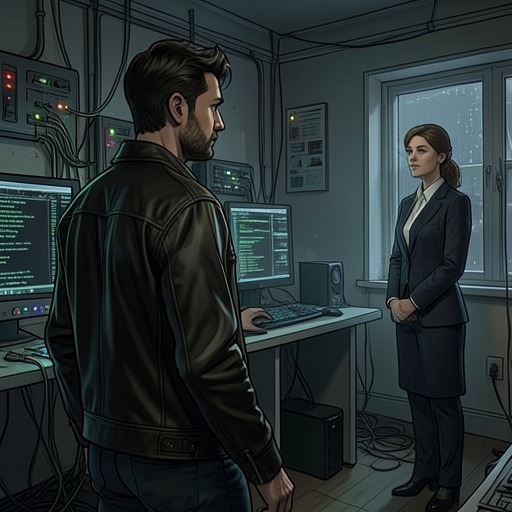
The Fall
NeuromancerThe Fall is the name given to Henry Dorsett Case’s forced descent from elite cyberspace operator to a man imprisoned in his damaged nervous system. It begins as corporate retaliation for theft, but its decisive consequence is broader than professional ruin: the punishment severs Case from the disembodied consciousness that had defined his identity and leaves him treating his own flesh as a prison. The Fall therefore supplies both his personal wound and the central value reversal of his early life, turning mastery, freedom, and exhilaration into bodily confinement, addiction, and the expectation of death.
Cause and Punishment
At twenty-two, Case was one of the best console cowboys in the Sprawl, trained by McCoy Pauley and Bobby Quine and sustained by the adrenaline of technical mastery. Jacked into a custom cyberspace deck, he projected his consciousness into the matrix and worked as a thief for wealthier thieves, using specialized software to penetrate corporate systems and open windows into valuable data. His hamartia was specific and practical: he stole from his employers, kept some of what he had taken, and tried to move it through a fence in Amsterdam. He was not killed for the offense. Instead, his employers smiled, assured him that he was welcome to the money, and arranged a punishment designed to make his defining talent permanently unusable.
They damaged his nervous system with a wartime Russian mycotoxin. Strapped to a bed in a Memphis hotel, Case hallucinated for thirty hours while the injury worked at a microscopic level. The damage was minute and subtle, but it was also utterly effective: his talent burned out micron by micron. The Fall thus combines technological precision with an almost medieval logic of retribution. The employers do not merely remove his income or punish his disobedience; they attack the capacity through which he experiences himself as exceptional.
Life Inside the Body
For Case, the injury is catastrophic because cyberspace had made the flesh seem secondary. Among the bars frequented by cowboy hotshots, the elite stance depended on relaxed contempt for the body. The body was meat, and the matrix promised a consciousness apparently freed from its limits. The Fall reverses that hierarchy. Once Case can no longer jack into cyberspace, the body ceases to be a disposable vehicle and becomes the enclosing reality from which he cannot escape. The phrase names a spiritual as well as neurological collapse: he falls into the prison of his own flesh.
The consequences rapidly become material. Case converts his assets into New Yen and spends them in Chiba, where registered clinics and black medicine promise nerve-splicing, implants, and bionics. He arrives with the clenched certainty that Chiba will provide a cure, but two months of examinations and consultations consume his money without restoring his ability. The men in the black clinics recognize the expertise of the mutilation and then slowly shake their heads. Their reaction makes the injury more humiliating: the damage is not crude or visibly spectacular, but a technically accomplished defeat that even specialists cannot reverse.
With his resources gone, Case sleeps in the cheapest coffins near the port beneath quartz-halogen lights that keep the docks illuminated through the night. The setting places his private collapse inside Night City’s larger atmosphere of artificial glare, corporate architecture, and poisoned skies. He lives in the borderland between port and city, with Ninsei at its heart, among shuttered bars and dead neon by day. The Fall is consequently not an isolated medical incident. It reorganizes his social geography, reducing the former hotshot to a disposable body moving through the cheapest spaces of a technologically saturated city.
Suicidal Stasis and Recruitment
When Armitage’s group assesses Case, the Fall has developed into a recognizable pattern of self-destruction. Their detailed model, assembled from his aliases and military software, concludes that he is suicidal and has perhaps a month left; their medical projection says that he will need a new pancreas within a year. Case’s condition is therefore read simultaneously as psychological intent and bodily deterioration. His attempt to provoke the street into killing him is an extension of the original punishment: having lost access to the form of existence he valued, he treats continued embodiment as an intolerable remainder.
Armitage offers the possibility of correcting the neural damage, and the offer changes the balance of Case’s life even before the procedure occurs. Case initially rejects the promise as impossible, but immediately asks for the terms and demands them at once. His desperate bargaining reveals the Fall’s reversal with unusual clarity. The man who insists that he will never punch a deck again is already negotiating for the chance to become a console cowboy again. The offer does not erase the wound; it converts that wound into the leverage by which Armitage can recruit him.
The recruitment scene is itself framed through Case’s damaged consciousness. He recognizes that the conversation is a dream and that it will end in one of his recurring freeze frames, in which Armitage becomes inert and statue-like before Case wakes. The dream’s interruption leaves the promise unresolved, while the next remembered scene places Case with Molly at a nameless, expensive clinic in Chiba. The transition links psychological suspension to medical intervention: the Fall has made Case unable to act in ordinary life, and the prospect of repair arrives first as an unstable promise, then as a clinical procedure negotiated through Armitage’s resources.
Narrative and Thematic Significance
The Fall establishes the novel’s recurring opposition between cyberspace and meat without allowing either side to remain simple. Case’s old contempt for flesh is exposed as a precarious professional ideology once the body becomes the site of punishment, hunger, illness, and dependence. His injury also makes technological freedom inseparable from physical vulnerability: the more completely his identity has been invested in disembodied access, the more devastating the loss of that access becomes.
The episode is both external violence and an existential displacement. Case is thrown into a historical and technological situation he did not choose, then forced to navigate it with the very body that his former culture taught him to discount. His employers’ punishment produces a literal condition of being trapped, while his resulting desperation gives Armitage and the unnamed forces behind the recruitment power over him. The Fall is thus not merely Case’s backstory. It is the condition that makes the later plot possible, the source of his suicidal drift, and the wound against which every promise of restored access to cyberspace must be measured.