Civilian Evacuation and Defense Arrangements During an Attack on Navon
NeverthelessCivilian Evacuation and Defense Arrangements During an Attack on Navon are the kingdom’s hurried response to an invasion expected to reach the village: Navi orders civilians moved to the castle, while the men are told to stand and fight. The plan joins advance warning, shelter, and military mobilization, but its division of people into those to protect and those to expose to battle immediately becomes a test of Mabel’s understanding of duty.
Threat and Preparation
Navon has little recent experience defending itself against an invasion. Its earlier battles were fought on behalf of other kingdoms, and many men became deserters rather than fight wars they considered unrelated to their own land. Now Tzara threatens Navon directly, while the kingdom has lost both soldiers and the protection of an ally unwilling to risk Tzara’s wrath. The defensive problem is therefore not simply how to repel an approaching army: Navon must gather its remaining forces and protect residents who are vulnerable before a battle can begin.
Navi’s response has two linked parts. He first insists that the whole village be brought to safety, acknowledging that the effort will be difficult and slow. He then intends to call the army and find the soldiers immediately. The order makes evacuation a priority without treating it as a substitute for military resistance: moving residents out of danger and assembling defenders are concurrent responsibilities. His haste also reflects the compressed time available. He leaves to put the decision into action, even as Shai follows to ask where Mabel can be found.
The Evacuation in Practice
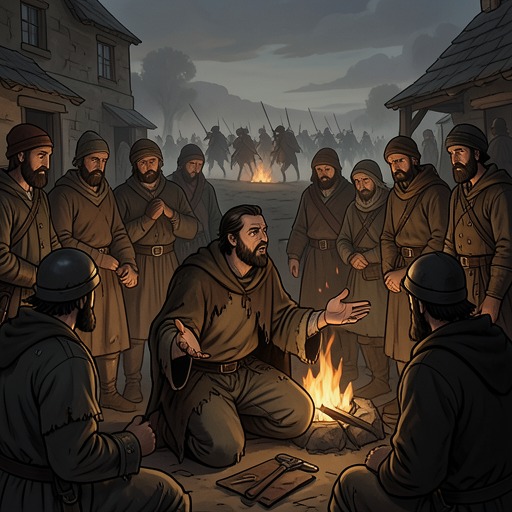
The warning reaches the village in the middle of the night. Residents wake to shouting and commotion and initially fear another attack by Tzara. Instead, they find Shai’s men helping them leave their homes and travel to the castle for shelter. The noise is therefore alarming but purposeful: this time, the village is being warned in advance, and the people assisting them are not the invading soldiers they fear.
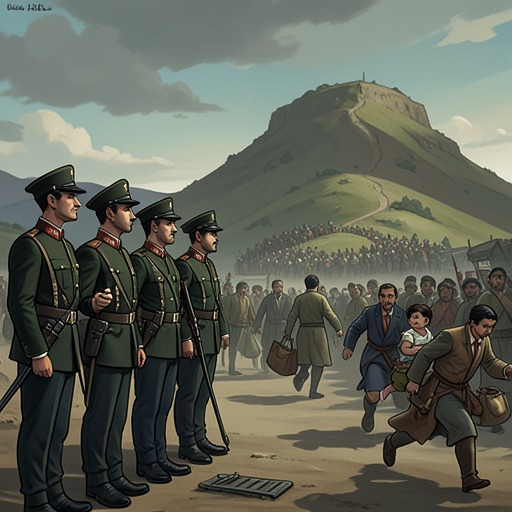
The villagers leave in their sleeping clothes because there is no time to change. Their hurried procession makes the practical cost of the order visible: immediate safety takes precedence over comfort, appearance, or ordinary household routine. The castle is the designated refuge, and Shai’s band supplies the people and effort needed to move residents there. The text does not describe a formal evacuation apparatus or specify how many people are moved; what it shows is a rapid, improvised operation in which an armed group helps guide civilians away from the threatened village.
The arrangement also depends on cooperation beyond Navon’s established forces. Earlier, Navi asks Shai what his people require, expecting that they will demand money; Shai replies that they are not doing it for money. In the evacuation, the band’s assistance is concrete rather than merely diplomatic: its members appear in the village and help residents reach shelter. That contribution matters in a kingdom already short of soldiers and facing a threat its customary alliances have failed to prevent.
Shelter, Defense, and Mabel’s Choice
The instructions distinguish between women and children, who are to go inside the castle walls, and men, who are to remain and fight. The plan defines shelter and defense through an explicit division of immediate roles. It is presented as a practical recommendation for the emergency, but Mabel sees its personal and moral consequence: following the villagers to safety would mean leaving the soldiers to face danger without her, despite having stood with them until then.
Mabel does not accept that separation as the only possible course. Watching the villagers file toward the castle, still dressed for sleep, she considers what it would mean to retreat while the defenders remain outside. Her reasoning links her identity as a soldier to responsibility for the people and comrades under threat. She believes that good people make the world worth saving; that conviction turns the question of where she belongs into a decision about what she is willing to defend.
Instead of joining the procession, Mabel returns to her house, puts on trousers and armor, takes her sword, and prepares to defend the city. The action is deliberate and immediate: she does not claim that the evacuation has failed, but chooses not to follow the prescribed refuge route herself. The arrangement’s division between protected civilians and fighting men thus meets a boundary case in Mabel, a woman who has become a soldier and understands service as staying with the defense. She waits for Tzara to invade, with her choice made before the battle begins.
Setting and Significance
Navon’s castle offers a defined destination for the evacuation. It stands atop a hill amid trees, and the approach to the palace is difficult for an enemy: the mountain range, forest, and surrounding terrain obstruct access, while a stone bridge provides the passage to the fortress. This geography gives the order to bring the village inside the castle walls a concrete defensive setting. The narrative does not establish which route the villagers take or how completely the castle can protect them, but it presents the fortified height as the shelter available before the attack.
The plan also marks a change in what the kingdom must ask of its people. Navon’s earlier military arrangements sent its men to defend other lands; now the threatened village, the castle, and the kingdom itself are the immediate concern. Navi’s effort to gather civilians and soldiers, aided by Shai’s band, turns defense into a shared undertaking. Mabel’s refusal to seek shelter exposes the human tension within that undertaking: protection requires some people to withdraw from danger, while others must remain in it. The scenes establish the evacuation and the decision to resist before Tzara arrives; they do not yet show the battle’s outcome.