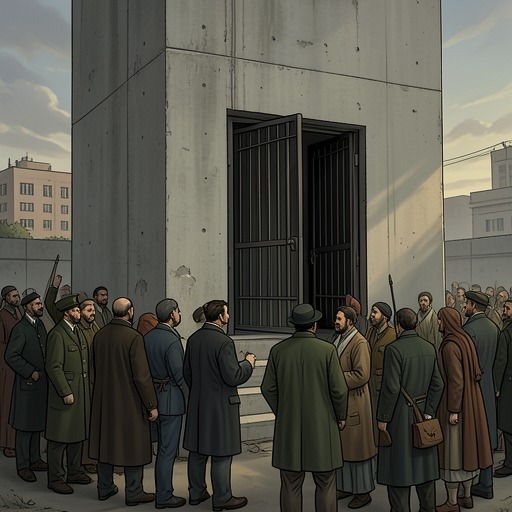
The Law Against Challenging Royal Authority
NeverthelessThe Law Against Challenging Royal Authority places a sharp limit on what a subject may say to the crown: Mabel understands that challenging royal power can lead to arrest and, in the gravest case, a public hanging. The narrative shows the law working before any punishment is imposed, as the possibility of state violence turns an argument with Navi into a calculation about what she can safely say.
Scope and Consequences
Mabel’s understanding of the law is explicit: “There was a law that the crown could never be challenged.” She imagines that answering Navi’s insult with an insult of her own could make her a criminal. The penalty she fears is not confined to imprisonment; depending on whom she had offended, she could be hanged in the public square as a warning to others. The law therefore protects royal authority through both a legal threat and its public example: a subject who speaks against the crown risks becoming a demonstration of what happens to dissenters.
The book does not describe a trial or show Mabel being punished under this law. Its immediate force is anticipatory. During her confrontation with Navi, she weighs what she wants to say against the danger of saying it, and decides that she does not want to become a warning. The silence is not agreement; it is a response to the unequal power between a prince and a peasant.
How the Law Shapes Mabel’s Conduct
That inequality is visible in a tense exchange after Mabel touches Navi’s chest to stop him. The contact makes his men hold their breath, and Mabel herself realizes the boldness of what she has done. She withdraws her hand and steps back, but still asserts that Shai is right. Navi’s reaction makes the risk of speaking plainly tangible: he clenches his jaw, and Mabel recognizes that he is letting someone else see what he thinks. Her ability to speak is real, but the scene shows how quickly an intimate gesture and an honest disagreement become charged by rank.
Later, when Navi calls her a plague, Mabel asks why he is doing this but holds back the harsher answer that comes to mind. Instead, she points to the danger of even raising her eyes to him and says she may address him as “Your Highness” while looking at her feet, lest she end up in a cold dungeon. Her remark is bitterly ironic: ordinary eye contact and speech have become things she feels obliged to treat as potential offenses. Navi replies that this is not what he meant, but his clarification does not erase the legal danger Mabel has already described.
Negotiation Under Royal Authority
The law’s pressure also shapes the choices Mabel pursues after Navi refuses to reconsider her place in the army. Rather than continue to press that demand, she asks whether she can work in the kitchen. The shift marks a practical narrowing of her options: she cannot make the prince grant her request by openly defying him, so she searches for another position within the limits he controls. Her appeal shows that the law’s significance lies not only in its threatened penalties but in the unequal conditions under which a subject must negotiate with royalty.
Royal Power and the Wider Legal Order
The prohibition belongs to a kingdom whose other rules also make legal status a matter of life and death. Under Navon's System of Banishment for Deserters, a deserter is branded with a hot iron D, permanently expelled beyond the kingdom’s boundaries, and sentenced to death if caught on Navon’s soil. That system governs the boundary between the kingdom and its exiles; the law against challenging royal authority governs the boundary between permissible speech and defiance. Both make punishment a means of maintaining political order, though the narrative presents Mabel’s fear of the latter as a constraint she must navigate rather than a sentence actually carried out against her.
The contrast is especially pointed because Navi himself speaks with the authority of a prince while Mabel must monitor her words, gaze, and distance from him. The law does not silence her completely: she still objects, makes a pointed remark about the dungeon, and proposes the kitchen. But it shapes the cost of each act of resistance, leaving her to seek agency without being able to confront royal power on equal terms.