Navon
NeverthelessNavon is at once the homeland Mabel Peloponnese longs to remain in and a kingdom whose defenses are tested when Tzara turns toward its land and gold. Its castle rises above a village and wooded valley, but the kingdom’s political and military choices have left it vulnerable: years of fighting for other realms have cost it soldiers, and potential allies fear becoming Tzara’s next target. The contrast between Navon as a familiar home and Navon as a threatened state gives its landscape both intimate and strategic weight.
Terrain and Defenses
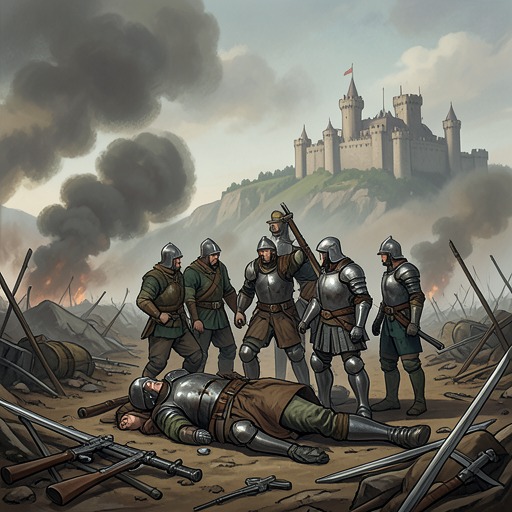
Navon’s castle stands on a hill amid trees that change color in spring. An approaching enemy would have to climb the mountain range and pass through the forest; the described route into the castle is at the front, across a stone bridge. The setting therefore offers natural obstacles as well as a defined threshold. The castle is elevated and approached through difficult terrain, while the bridge concentrates access at a single passage.
The village lies beyond the castle along a road that follows the riverbanks, with a valley on the other side. Leaving the castle for the village is not effortless: Mabel considers the horses in the stable unavailable to her and takes the longer walking route instead. Her choice makes the space between royal residence and village more than a map distance. It is a route she knows and values, one she takes at her own pace even when the journey could be made more quickly.
Navon’s defensive geography is not the same as invulnerability. When Tzara threatens to cross the kingdom’s borders, the castle’s hill and surrounding woods become part of a wider defense rather than a guarantee of safety. The later description of Tzara’s high wall, beyond which little of the city can be seen, sharpens the contrast: the story presents Navon’s difficult approaches and Tzara’s imposing border as distinct forms of territorial control.
Village, Castle, and the Meaning of Home
For Mabel, Navon is rooted in childhood as much as in its royal architecture. Her rustic village home holds the remembered pattern of family life: her father sharpening his sword in the early evening, her mother preparing food over a fire, and Mabel sleeping in a small adjoining room while imagining a future larger than others expected of her. She later understands her attachment to Navon as more than comfort or nostalgia. Its memories and familiar life make it a place she wants to remain in.
That attachment persists as Mabel moves between village and castle. The royal residence contains Navi’s office, crowded with books and centered on a long rectangular table where political decisions are contested. The throne room, by contrast, stages formal agreement: a long red carpet leads toward the throne, two guards stand on either side, and copper chandeliers hang above the room, unlit in the daytime. These rooms place Navon’s government inside the same castle that overlooks the village, joining private thought, negotiation, and royal authority within one physical center.
The village and castle also divide different kinds of security. When an invasion is expected, civilians are directed inside the castle walls for shelter. Women, children, and older people gather within the palace and gardens, while those able to fight are expected to defend the kingdom. The refuge is real but conditional: Mabel, who has served alongside soldiers, questions whether she can accept safety inside while they face the danger outside.
Political Exposure and the Cost of Alliances
Navon had not previously faced a threat to its own territory on this scale. Earlier battles were fought on behalf of other kingdoms, including by Mabel’s father, Amyntas. The narrative connects that history to the number of deserters: some did not want to fight wars that were not theirs. Alliances had offered military service in exchange for support, but the arrangement left Navon without enough soldiers when its own land became the object of an attack. Its longtime ally, unwilling to risk Tzara’s anger, also withdraws from the prospect of helping.
This dependence shapes Navi’s work as heir and general. In his office, he favors offering Navon’s best products in exchange for political alliances, while his counselors object to accepting terms that could impose lasting disadvantages. Navi considers special privileges demanded in return for protection unfair, but sees no easy alternative. The negotiations are not simply disputes over generosity: they expose how little bargaining power a vulnerable kingdom has when neighboring rulers know it needs help.
A letter from a neighboring kingdom confirms that concern. Navi had sent the request a month earlier, hoping to learn whether Navon would face the coming conflict alone. The reply shows the other kingdom weighing the risk of losing its troops and leaving itself exposed to Tzara. Its refusal leaves Navon without the assistance Navi had hoped to secure. The scene makes the kingdom’s isolation concrete: the danger is understood by its neighbors, but that understanding does not make them willing to intervene.
Navi also seeks help from Behrooz. He describes Navon’s shortage of experienced soldiers and offers a share of its wood production, weapons, and, if necessary, a third of its crops. Behrooz says he needs time and stresses how much he could lose by joining the fight. Navi argues that after Tzara destroys Navon, it will threaten others in turn, but the deal remains unclosed. The failed appeal leaves Navon’s leaders confronting the possibility that no external force will protect their home.
Exiles, Return, and the Defense of Navon
Navon’s political order has also shaped the population living beyond its boundaries. Under its harsh rule for deserters, those condemned to exile are permanently separated from society and left outside the kingdom; return can mean death if guards find them on Navon’s soil. Many of the people Mabel encounters in the forest are therefore not simply outsiders by choice. Alastair distinguishes deserters and exiles from criminals, explaining that many left because they would not fight wars that did not belong to them. Exile removes them from Navon, but does not erase their connection to it.
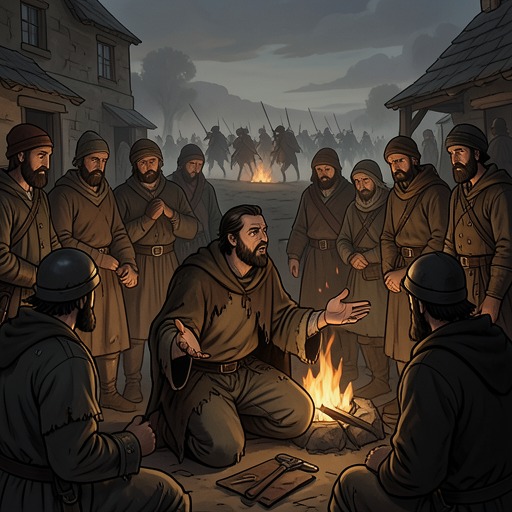
The forest refuge has developed into a community. Shai and his band hunt for food, share what they have, and live with their families; as more people join, the group becomes larger. Mabel spends weeks among them before returning to Navon with Shai, while the rest of the band waits outside the city. Shai is admitted to the castle on the prince’s authorization. The crossing brings former exiles close to a homeland whose rules have excluded them, yet their access remains negotiated rather than automatic.
When Shai warns Navi that Tzara is coming, he arrives with his men and says the expatriates will come as well. Navi agrees to let them through. His first response to the threat is practical: bring the whole village inside the castle walls, then call the army and find the soldiers. During the night, Shai’s men help move villagers to shelter, turning the exiles’ return into assistance at the moment Navon most needs it.
The defense also makes use of local knowledge. Eight hundred men of Navon’s army wait in abandoned houses and alleys, preparing to conceal themselves in the emptied village. Navi leaves the castle to join them, passing through doors that close behind him and separate the sheltered civilians from the forces waiting outside. Navon’s familiar streets become terrain for resistance: the same home ground that gives its defenders an advantage is also a place whose people must first be evacuated.
Narrative Significance
Navon’s geography repeatedly defines who can move and who can claim safety. The castle hill, the stone bridge, the river road, the village, and the forest refuge form connected but unequal spaces: a royal center, a civilian home, a difficult route, and a place of exile. Mabel’s movements across them register changing affiliations, from childhood resident to a figure welcomed back into the castle after time with Shai’s community.
The kingdom’s central irony is that the home it cherishes has been weakened by the very political arrangements meant to protect it. Navon once sent soldiers to other kingdoms through alliances; when its own borders face invasion, those commitments have left it short of troops and dependent on neighbors who decline to risk themselves. Its defense therefore requires more than walls or elevation. It requires the village’s evacuation, the army’s use of familiar streets, and the return of people whom Navon’s own laws had driven away. Navon remains Mabel’s home, but defending it becomes a test of whether its inhabitants and exiles can act together when the old order has failed to secure them.