Tzara
NeverthelessTzara is presented both as a kingdom with a carefully protected interior and as the aggressor whose attack forces Navon to confront war on its own soil. Its territory is more than a distant political presence: its pursuit of Navon’s gold and land brings the threat to Mabel’s home, while its enclosing border and difficult-to-enter royal city make protection and access central to its image.
A Kingdom and Its Expansion
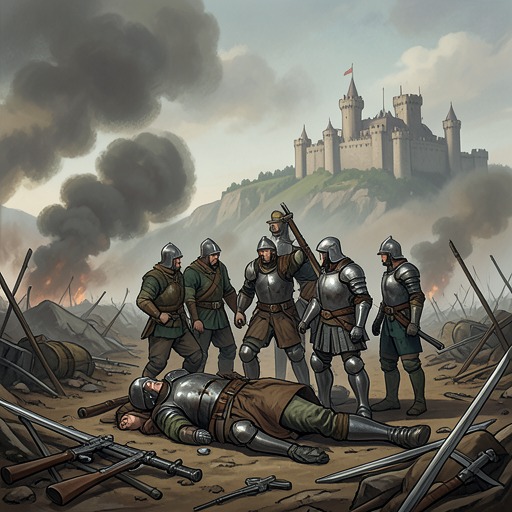
Before Tzara’s attack, Navon had not faced a threat to its own territory in its recorded history. Its earlier battles had been fought on behalf of other kingdoms, as part of alliances that exchanged Navonian soldiers for the defense of other rulers’ lands. The account associates that history with desertion: some soldiers did not want to fight wars that were not their own. When Tzara turned its attention to Navon’s gold and land, the kingdom faced a different kind of danger, but did so without the soldiers and dependable allied support it needed. An ally was too afraid of Tzara’s wrath to stand by Navon. The invasion therefore exposes the weakness of a political arrangement built around service to other kingdoms rather than the defense of Navon itself.
The narrative does not explain Tzara’s government, its rulers, or the motives behind its expansion beyond its interest in Navon’s territory and resources. What it does establish is the consequence of that interest: Navon’s vulnerability becomes immediate, and the question of whether the kingdom can protect its people replaces the older pattern of fighting elsewhere for the benefit of powerful allies. Tzara’s significance begins in that reversal. It is the outside power that makes Navon’s inherited military and diplomatic choices appear insufficient.
Border, Interior, and Access
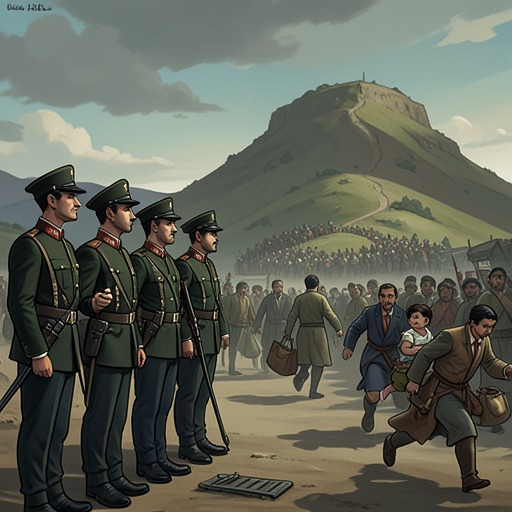
The clearest physical description of Tzara concerns its border and royal city. A huge wall runs along the kingdom’s boundaries. From outside it, the visible landscape is desert; beyond the wall, the villages and plantations are protected. The royal city is similarly withheld from view: an observer can see the tops of high buildings above the wall, but not the city itself. The description gives outsiders only fragments of the inhabited country, placing a barrier between what can be seen and what lies within.
This arrangement makes Tzara’s geography a system of unequal access. The wall protects settlements and cultivated land, while the city remains largely hidden behind it. The account also characterizes Tzara’s people as having mastered many forms of strategy and states that it is easier to leave the royal city than to enter it. That distinction makes the territory feel deliberately difficult to penetrate, without suggesting that it is impossible to enter. Tzara’s defensive strength is conveyed through the relationship between its boundary, its concealed interior, and the effort required to reach its political center.
The desert visible from outside sharpens the contrast between appearance and interior. From beyond the wall, an observer does not see the villages and plantations that the boundary protects; those signs of settled life remain on the other side. The kingdom is thus represented not by a broad view of its people or landscape, but by the limits imposed on a visitor’s view. Its built defenses shape what can be known about it as well as what can be reached.
The Invasion as Experienced from Navon
Tzara’s importance in the plot is chiefly registered through the people who must respond to its advance. When the attack begins, Mabel leaves her house with a sword and walks toward the village. She is angry and does not know whether she will return home after the fighting. The invasion changes her immediate surroundings from a place of ordinary life into the approach to a battlefield; it also gives her a direct reason to act. She says that Tzara killed her parents, rejects the idea that she should be treated as fragile, and identifies justice and the fall of Tzara’s kingdom as her aims. The threat is therefore at once political and personal, though the narrative presents her decision to fight as an answer to both.
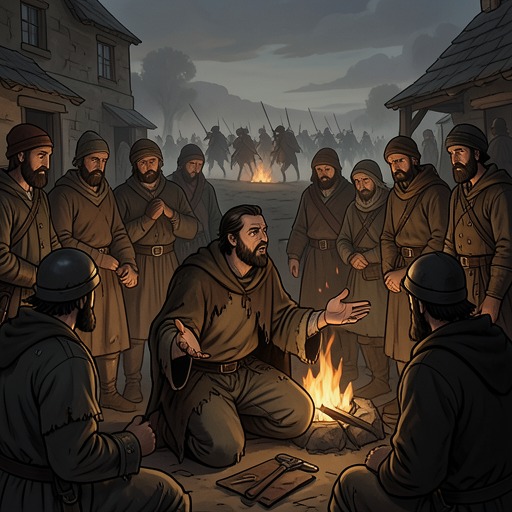
The danger is not confined to Mabel’s response. Shai warns Navi that Tzara will eventually cross Navon’s boundaries and says there is little time before its forces arrive. Navi’s answer is practical: the village must be brought to the castle for shelter, and the army must be called together. The threatened border makes the defense of civilians and the gathering of soldiers urgent parts of the same response. Tzara’s advance consequently tests not only Navon’s capacity to fight, but also its ability to move its population out of danger and organize protection in time.
Spatial Contrast and Narrative Significance
The narrative sets Tzara’s defended territory against Navon’s own vulnerable geography. Navon’s castle stands on a hill amid trees, with a stone bridge providing the passage to it from the front. When danger approaches, the castle becomes the intended refuge for the village. Tzara, by contrast, is described through the enormous wall around its borders, the desert seen outside, and the protected settlements and concealed city within. These details do not establish that the two kingdoms are exact opposites in military strength, but they give their spaces different narrative functions: Navon’s castle is a visible destination for people seeking shelter, while Tzara’s inner territory is kept from the view of those outside.
That difference also gives the invasion a broader meaning. Tzara’s barrier suggests a kingdom able to guard its own inhabited lands, while Navon must improvise protection as the threat approaches: its ruler orders the village evacuated to the castle, and its forces have to be gathered. The contrast is not simply between a wall and a castle, but between an established boundary that shields a territory and a threatened community trying to create safety under pressure. Tzara remains largely distant from the reader as a place, yet its political choices, defensive geography, and advance determine the choices available to people in Navon. Its decisive narrative role is to turn the question of territory into one of survival, justice, and collective defense.