Navon's Restrictions on Women's Military Service
NeverthelessNavon’s Restrictions on Women’s Military Service is a gendered norm sustained less by a clearly described written statute than by recruitment decisions, assumptions about military authority, and repeated declarations that a soldier must be a man. Mabel’s efforts to join the Navon King’s Army expose the restriction as both an institutional barrier and a contested claim: although officials deny her a fighting place, she repeatedly acts as a soldier, including in the defense of Navon.
The Rule and Its Authorities
The story presents women’s exclusion through direct encounters with people who control or speak for military institutions. When Mabel arrives at the recruitment field and says she wants to be a soldier, the commander assumes her interest may come from financial hardship. He offers to arrange a hearing with the king or assist her family, but she clarifies that she wants military service, not money. The response is categorical: she would have to be a man. The scene makes the rule visible in practice. Her stated purpose is heard, but gender is treated as sufficient reason to reject it.
The restriction also belongs to a wider contest over who has the authority to command. When Navi takes charge of political affairs while Dareh is away, a senior adviser challenges his youth and time abroad and argues that the counselors should handle the kingdom’s problems. Navi insists that, because he has been placed in charge, they must report to him and follow his instructions. The counselors comply because he is the heir, though reluctantly. This episode does not itself establish a rule about women in the army, but it shows that authority in Navon is actively negotiated among inherited rank, experience, and institutional office. Later disputes over Mabel’s status take place within the same contested structure: the king, the general, the prince, and military officers do not appear to exercise interchangeable powers.
Mabel’s Repeated Claims to Service
Mabel does not treat the recruitment refusal as a reason to abandon her goal. In the tavern, she introduces herself as being in the Navon King’s Army, prompting laughter from the men present. Alastair turns her claim into a joke about Navon being so desperate that it is recruiting women. Mabel answers that a woman had to occupy a place the men had left empty. Her reply contests not only formal exclusion but also the assumption that military service is inherently male and that her presence is a sign of institutional weakness.
Her access remains uncertain. When fighters prepare to resist Balthasar’s men, Mabel asks the person responsible for the arsenal to use a bow. He refuses, expecting her to waste the arrows. The refusal translates the broader gender assumption into a practical denial of equipment and participation. Yet Mabel does not accept that judgment as proof of incapacity. She asks what would happen if she could hit a target, challenging the authority to decide what she can do without allowing her to demonstrate it.
Navi later draws an explicit boundary around her role. He tells her that she is not part of his army and therefore has no right to question him about its affairs; he also insists that she is only a girl, not a military expert entitled to an explanation. He then declares her out of the army and orders her to stay away from the castle and from him. His words combine institutional exclusion with personal authority, turning her status into a means of ending a dispute between them. The encounter shows that her claim to service can be revoked by the same prince whose authority is itself still developing.
Conditional Inclusion and Conflicting Status
Navi subsequently acknowledges a form of responsibility toward Mabel and gives her back a position in the kitchen. He limits the concession carefully: she is not to train with the soldiers or fight in a war. The arrangement permits her to remain within the castle’s service while preserving the line between domestic work and military duty. It therefore represents inclusion on terms that do not recognize her as a combatant.
Mabel’s account of her status remains in dispute even later. When she asks Dareh for a place in the army, he says that choosing soldiers is the general’s responsibility and beyond his own reach. Mabel challenges that explanation, arguing that the king stands above such limits and could act if he wished. At a meal with Soray, Mabel again says she is part of the Navon King’s Army, but Navi responds that she is not. His correction makes the disagreement plain: Mabel asserts membership; Navi denies it. The evidence does not resolve the precise formal status of her enlistment. Instead, it presents service as a question shaped by gender, command, and competing accounts of what has been authorized.
Military Agency Beyond Recognition
The distinction between official permission and actual participation becomes especially sharp in wartime. At the mountain defense against Balthasar’s men, Mabel is initially told to hide while the fighters take their positions. Alastair urges the expatriates to fight and addresses Mabel as a soldier, but that recognition does not settle whether the army or its officers accept her. When she seeks a weapon, the arsenal keeper refuses her a bow. She nevertheless becomes involved in the fighting, and a soldier dies during the encounter. Shai helps her away afterward. The event brings the cost of participation into view without making it evidence that the institution has formally changed its rule.
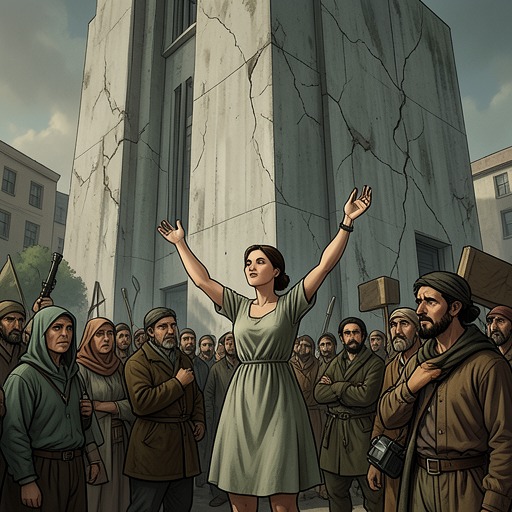
During a later threat to the village, Shai’s band helps lead residents toward the castle for shelter. The guidance divides people by gender: women and children are to enter the castle walls, while men are expected to stand and fight. Mabel understands the plan but questions the fairness of leaving the soldiers to defend the settlement while she takes shelter. She chooses to put on her armor, take her sword, and defend the city. Her action again exceeds the role assigned to women, this time in the face of an immediate attack rather than at a recruitment field.
Mabel’s conduct in the defense of Navon further reverses the assumption that women cannot occupy military roles. She overcomes an enemy commander and makes him her prisoner, intending to take him to the Navon King’s Army as a hostage rather than kill him. The scene establishes practical command over a defeated opponent, even as her formal standing has remained disputed. The restriction’s force therefore lies not in proving women incapable of military action, but in the gap between what the institution permits and what Mabel demonstrably does.
Significance
The rule is shown as a recurring practice rather than a single refusal: Mabel is denied enlistment, mocked when she claims army membership, refused access to a bow, excluded from training and combat by Navi, and directed toward a kitchen role. At the same time, she repeatedly acts in defense of others and of Navon. These episodes distinguish domestic service from military recognition, and gendered instructions for civilian safety from Mabel’s own decision about where she belongs.
The narrative also complicates the source of the restriction. Individual officials make consequential choices, but their authority is not uniform: the king says the general chooses soldiers, Navi denies Mabel’s membership, and others recognize or address her as a soldier in particular circumstances. The result is not a clear account of a law being formally repealed. It is a sustained conflict between the institution’s male norm and Mabel’s claim, expressed through action, to serve. Her eventual defense of the city and capture of an enemy commander make that conflict concrete: military agency is present even where official recognition remains unsettled.