Shai's band
NeverthelessShai's band is a group led by Shai that describes itself both as a provider of practical enforcement services and as a guard force responsible for maintaining order. First encountered by Mabel after its members rescue her, the band offers a form of help that neither depends on royal authority nor begins with a promise to find her brother. Its later readiness to support Navon against Tzara gives the group a broader role: it becomes a possible partner in a defense effort that must draw on forces beyond the kingdom's depleted army.
Identity and Work
The band presents itself through a range of names rather than a single formal title. Shai calls its members bounty hunters, mercenaries, or providers of bureaucratic services—work that other people would rather not do. He describes rescuing people, capturing murderers, and recovering stolen money as examples of their tasks. The list defines the group by what it does: intervening in disputes and pursuing outcomes that, in Shai's account, others leave undone.
Shai later gives the work a more moral description. When Mabel asks what he and his band are, he says, "We are the guards, and we maintain the order. If something is stolen, we bring it back. If someone commits a crime, we punish them." Mabel compares this to bounty hunting, and Shai treats the difference as one of naming. The exchange leaves the band's identity deliberately practical: it can be understood as a paid service, but its leader also claims a public responsibility to restore property and punish wrongdoing.
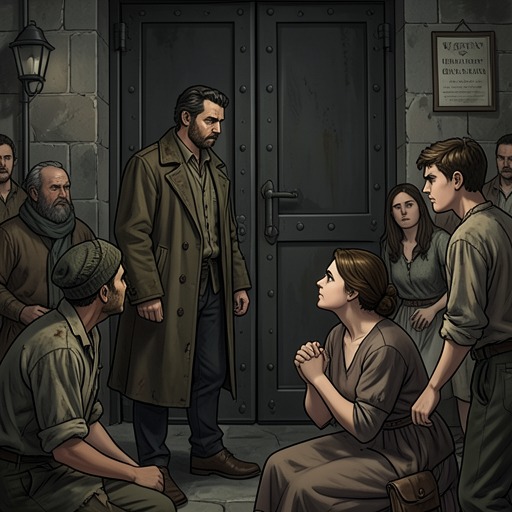
The available scenes establish Shai as the leader and show Gaspar among the men who act with him. When the band first appears, Shai points to the assembled men as his brothers. The account does not lay out a formal chain of command or a complete membership list; instead, it shows a group whose cohesion is visible in its collective action and in Shai's ability to speak for it.
Rescue and Mabel's Invitation
Mabel first meets the band after its members have intervened on her behalf. She does not know where the men have come from, but recognizes that they have just saved her life. Gaspar introduces himself, while Shai explains that they saw Mabel being followed from the tavern and intend to escort her back. Their assistance begins as a direct response to danger, not as part of a royal assignment.
Shai then offers a broader kind of help. When Mabel is wary, he explains what the band does and proposes that its members could fight for Navon, provided they are paid. The price he names is three gold weights. This turns the encounter from a rescue into a negotiation: the band has skills and is willing to enter a larger conflict, but Shai initially frames military service as work that requires compensation.
Mabel also asks whether the group can help her find her brother, Gael. Shai answers no. That refusal matters because it sets a clear limit on what the band knows or can promise; the offer is not presented as a guaranteed search. Instead, Shai tells her she need not act alone and invites her to go with them. He says, "We're going back. Are you coming with us?" Mabel accepts. The invitation gives her access to people who know the territory and are willing to include her, even though they cannot provide the specific answer she hoped for.
The group makes that welcome explicit later. Gaspar tells Mabel she could be a great help to the band and could stay with them if the soldiers do not want her, adding that they would be a family. The offer is not evidence that Mabel formally joins or that the band can find Gael; it shows that the group presents belonging as another form of support, alongside escort and practical assistance.
A Proposal for Cooperation
Shai's political proposal grows from his view that isolated forces cannot meet the threat effectively. He tells Mabel that men in Tenerife are considering fighting Tzara alone, but argues that two forces together would be stronger than one. His intention is to take Mabel to those men and demonstrate that cooperation is possible. The band therefore acts not only as a fighting unit but also as a connector, bringing potential allies into the same discussion.
Mabel recognizes that this proposal overlaps with what Navi is seeking: an alliance against Balthasar. She sees value in joining the men in Tenerife to Navon's cause, even though they are not nobles or the kind of soldiers Navi initially wants in his army. Her assessment distinguishes military worth from social rank. In her view, people outside the established elite can still accomplish important things together.
The proposal also answers a material and political weakness in Navon's position. The kingdom has been threatened by Tzara and has lost the security of an allied kingdom; earlier alliances had depended on Navon supplying men to fight in other kingdoms' wars. The account links that history to the kingdom's shortage of soldiers and to the desertions that followed. Against this background, Shai's attempt to bring separate forces together offers a different basis for defense: cooperation among groups that might otherwise remain apart.
From Payment to Shared Defense
The band's terms change as the alliance becomes more concrete. When Navi asks Shai what the men want in return, expecting that they will ask for money, Shai says they want nothing and are not doing it for money. This contrasts with the earlier offer of military service for three gold weights. The scenes do not explain every member's reason for helping, but they establish that the proposed cooperation with Navon is not ultimately presented as a paid contract.
The group's role becomes particularly clear when the village is prepared for another attack. Navi decides that the entire village must be brought to the castle before the army is called and gathered for battle. That night, Shai's men help villagers leave their homes and move to the castle for shelter. The villagers initially fear that Tzara's forces have returned, but the men arriving to assist them are members of the band. Their work turns the plan into action, carrying out the civilian evacuation while Navon prepares its military response.
This response expands the band's function beyond pursuit, recovery, or punishment. It is now participating in a coordinated defense that involves both the kingdom's army and the protection of civilians. The scenes do not show the band replacing royal forces; rather, they show it contributing people and organization where the kingdom's own resources are under strain.
Significance
Shai's band occupies a shifting space between paid service and collective obligation. Its members explain their ordinary work in terms of tasks for which people pay, and Shai initially gives a price for fighting. Yet the band's later offer to help Navon carries no financial condition, and its members take part in moving villagers to safety. That progression makes the group significant not as a fixed alternative to the state, but as a force whose skills can be redirected toward a shared emergency.
Its alliance-making also challenges the assumption that defense belongs only to established kingdoms or noble soldiers. Mabel understands the men in Tenerife as people whose contribution should not be dismissed because of their status, while Shai tries to bring them into a joint effort rather than leave them to fight alone. The band thus links practical local action—rescue, escort, and evacuation—to the larger political need for cooperation. Its development is measured less by a change in formal structure than by the widening scope of whom it helps and what it is willing to defend.