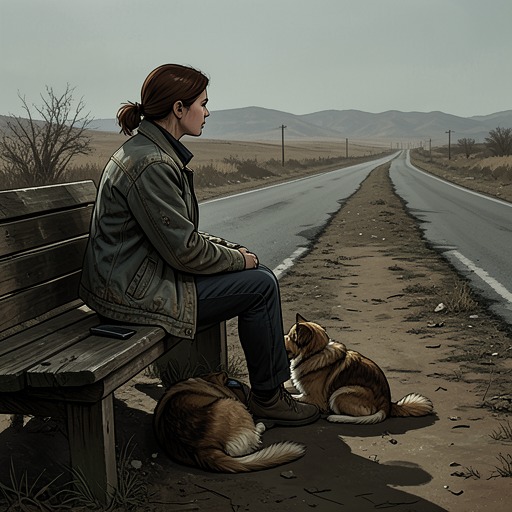
Dogs
NomadlandDogs are part of the practical and emotional fabric of nomadic life in the book: they travel with people through precarious work and housing, occupy scarce space in small vehicles, and sometimes become the focus of care that connects strangers. Their presence is not merely decorative. Coco affects how Linda May makes a bed in her tiny trailer, and the dogs looking at her during a crisis help define what she cannot bring herself to do. Elsewhere, dogs accompany workers and travelers, while an online community helps reunite one dog with its owner.
Companions in confined homes
When Linda May downsizes from a deteriorating, gas-consuming motorhome to the small trailer she calls the Squeeze Inn, she adapts its rear dinette into a bed. She finds a nearly new queen-size pillow-top mattress in a neighbor’s trash, removes its springs and padding, and cuts and resews the remaining material into a mattress seventy-two by thirty-six inches. The chosen width is not arbitrary: it gives room for Coco, her Cavalier King Charles spaniel, to share the bed. In this scene, the dog’s presence is built directly into the measurements and labor of making a livable home. The improvised bed is both a piece of practical renovation and an accommodation for a companion in a very small space.
Dogs also accompany people whose means and living arrangements have sharply contracted. Don Wheeler lives with Rizzo, a fifteen-pound Jack Russell terrier, in a 1990 Airstream he calls Ellie. The trailer’s interior retains personal traces of his earlier life, including race-car posters and a plastic hula girl on the dashboard, while his finances have shifted from spending about $100,000 a year to getting by on as little as $75 a week. Rizzo is part of this new household, sharing the mobile home as Don takes seasonal warehouse work. The account does not treat the dog as a solution to Don’s hardship; it places a companion within the same reduced circumstances.
Dogs at moments of vulnerability
Before Linda May began her nomadic life, she spent Thanksgiving Day in 2010 alone in a trailer in New River, Arizona. She lacked electricity and running water, could not find work, and could not return to her older daughter’s crowded household. In this crisis, Coco and Doodle, her two small dogs, were looking at her. Linda hesitated at the thought of leaving them in danger, and accepted a friend’s invitation to Thanksgiving dinner instead. Doodle, a toy poodle, later died before Linda moved into the Squeeze Inn; Coco remained her companion. The scene establishes a concrete limit in Linda’s crisis: the dogs are beings whose safety matters in her decision, not interchangeable details of the trailer setting.
The dogs’ presence also extends into the shared spaces of nomadic life. At a winter gathering, a cosmetologist offers haircuts near the Chevrolet Astro van where she lives with her husband and two dogs. Their household is one among many arrangements assembled around vehicles, informal services, and shared resources. The dogs are not described as taking part in the event’s work or exchange, but their inclusion in the household conveys how human social life on the road often travels with animal companions.
Travel, work, and online connection
Dogs accompany people across varied forms of mobile work and self-documentation. Tara Burns, a young sex worker who travels between strip clubs in a 1998 Chevrolet Astro, makes the journey with Bro, her border collie. Her blog, Hobo Stripper, combines accounts of van life and work with practical instruction, making the vehicle and its traveling household part of a public record. In a different case, Susan Rogers, a retired math teacher whose blog was inspired by George Lehrer, writes dispatches from a Chevrolet Express van towing a Casita trailer. The book describes her online following and the blog’s role in reuniting Rusty Reed, a veteran living in a pickup camper, with his lost shepherd mix, Timber, in Arizona. The reunion shows the internet functioning as more than a place to narrate travel: in this instance, a travel blog helps bring a lost dog back to its owner.
The accounts offer different kinds of evidence about dogs’ place in this world. Coco shapes a domestic object; Rizzo shares Don Wheeler’s sharply reduced household; Bro travels with Tara Burns; and Timber becomes the subject of a successful search reaching beyond one vehicle or campsite. Together, these episodes locate dogs within the material arrangements of vehicle dwelling and the human connections that form around it. They are companions in small, mobile homes, but they also make those homes legible as households, with routines and responsibilities that persist even when their occupants move from job to job.