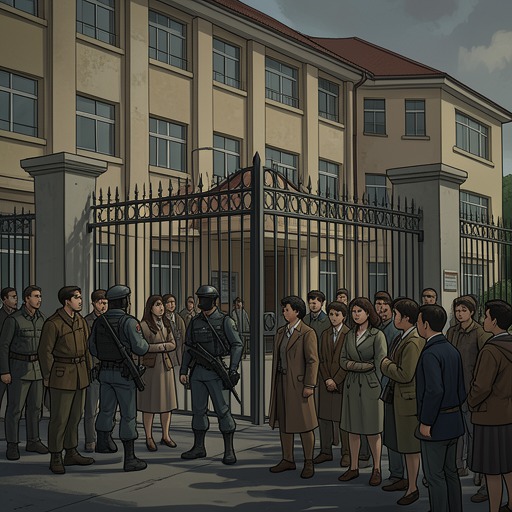
Officer Tate
On the Come UpOfficer Tate is a Midtown security officer whose restraint of Brianna Jackson becomes a defining part of the school’s security controversy. The incident is not presented as an isolated misunderstanding: students later describe Tate and Officer Long as known for disproportionately targeting Black and Latinx students, making Tate’s conduct part of a broader dispute over whose safety and testimony the school recognizes.
Identity and Introduction
Tate works security at Midtown alongside Officer Long. During an encounter with Brianna, the officers suspect her of bringing something into school and search her belongings. The evidence identifies Tate as part of that action, though it attributes the physical restraint and accusation specifically to Long rather than detailing Tate’s individual contribution beyond removing Brianna’s backpack.
The Restraint of Brianna
When Brianna tries to pull away, Long takes her arms behind her back and forces her down; Tate removes her backpack as she is restrained. Long then accuses her of bringing something into school and binds her wrists with plastic. Brianna cannot speak in the moment. Sonny shouts for the officers to stop, and Malik points a camera at the scene. The episode leaves Brianna feeling exposed rather than protected, and Long’s accusation supplies the language that will shape how others interpret the incident.
Labels, Recording, and Public Consequences
A video of the encounter circulates at school under the title “Drug dealer caught at MSOA.” The recording omits the lead-up in which Brianna is thrown down, leaving viewers with an edited account that presents the accusation as if it were an established fact. Brianna reflects on how the label “hoodlum” has been attached to her, then rejects it; the later “drug dealer” label shows how the officers’ suspicion travels beyond the original encounter and becomes a public identity imposed on her.
The dispute also enters the public debate over Brianna’s song “On the Come Up.” A news report describes the track as violent and links it to student protests, while classmates chant one of its lines at school officials. In a radio interview, Hype treats the lyrics as a possible threat against police; Brianna objects that her words are being made to explain the protest instead of the students’ grievances. The reporting and interview do not establish Tate’s role in those later controversies, but the filmed restraint remains part of the context in which Brianna’s actions are interpreted and scrutinized.
Student Testimony and Institutional Response
At a school district meeting, Shana Kincaid tells the superintendent that Tate and Long were known to target Black and Latinx students more than others. She lists pat-downs, random locker checks, and secondary screenings, and says students had experienced physical altercations with the officers. She adds that bringing armed police onto campus has left many students afraid for their lives. Her account situates Brianna’s recorded restraint within a pattern students had already complained about.
Shana points out that Midtown relies on students like her to obtain grants even as those students feel unwelcome. She says complaints against the officers had been filed and that video showed them physically assaulting a Black student, yet they were allowed back on the job. Dr. Cook acknowledges that racism and racial profiling are unacceptable but declines to discuss the specific incident because an investigation is ongoing. The response leaves the students’ central question unanswered: why the officers returned despite complaints and video evidence.
Narrative Significance
Tate is characterized primarily through the consequences of his security work and the testimony of students, not through a personal history or private perspective. His presence in Brianna’s restraint, the subsequent circulation of a misleadingly titled video, and Shana’s account of differential treatment connect a single encounter to Midtown’s wider racialized security crisis. The contrast between the footage’s public framing and the students’ testimony makes the question of who gets believed as consequential as the original search.