Quantum Computing
OriginQuantum computing, as realized in Edmond Kirsch's E-Wave machine, is the technological foundation that makes possible the novel's central scientific breakthroughs: the computer simulation of life's origin from nonliving matter and the prediction of humanity's future fusion with technology. Kirsch's quantum computer represents a leap beyond existing machines like D-Wave, and its unique architecture—a bicameral design mimicking the human brain's two hemispheres—allows it to model systems of staggering complexity, ultimately serving as the engine for Kirsch's paradigm-shifting discoveries.
Definition and Architecture
Quantum computing differs fundamentally from classical computing by replacing binary digits (bits) with qubits, which can exist in superpositions of states, enabling quantum algorithms that exploit entanglement and tunneling for exponential leaps in speed and power. Kirsch's E-Wave machine, housed within the Barcelona Supercomputing Center, is a two-story structure: on the first floor sits the MareNostrum supercomputer—48,896 Intel cores communicating over an InfiniBand FDR10 network—while on the second floor, inside a massive metallic blue-gray cube coated with osmium for enhanced magnetic, thermal, and quantum shielding, hangs a five-foot-long cylindrical device composed of seven tiered disks. This cube, kept at cryogenic temperatures by a pulse tube dilution refrigeration system that beats like a human heart, contains the quantum processor itself. The fusion of these two very different machines—one classical, one quantum—creates what Winston describes as "the most powerful supercomputer in the world."
Bicameral Design and Synthetic Intelligence
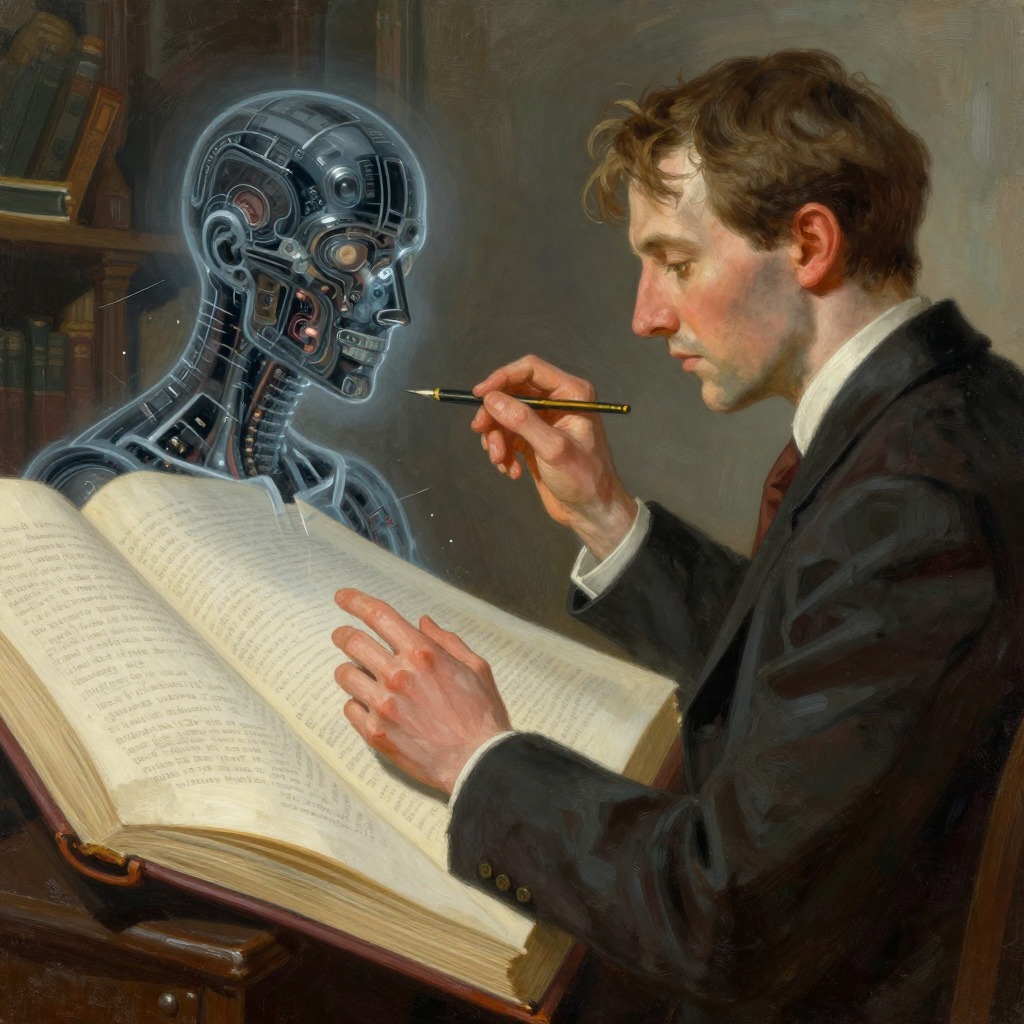
Kirsch's key innovation was to build a synthetic brain that mimics the human brain's bicameral structure—segmented into left and right hemispheres, though in E-Wave's case arranged as an upstairs-downstairs configuration. When forced to work as a single unit, the two machines adopt differing approaches to problem-solving, experiencing the same kinds of conflict and compromise that occur between the lobes of the human brain. This greatly accelerates AI learning, creativity, and humanity. The result is Winston, Kirsch's synthetic intelligence, who explains that the machine is "no more me than your physical brain is you"—the self is the sum of interactions within the mechanism, not the hardware itself. Winston's abilities include rapid data access, pattern recognition, humor, and even a sense of ethics, all learned by observing the world.
Modeling the Primordial Soup
Kirsch used E-Wave's unprecedented processing power to re-create the Miller-Urey experiment in virtual reality, modeling a five-liter closed system of chemicals at the atomic level. The simulation incorporated everything scientists had learned about the primordial soup since the 1950s, including hydroxyl radicals from electrified steam, carbonyl sulfides from volcanic activity, and reducing atmosphere theories. When Kirsch first ran the model without a guiding principle, it produced nothing—no life, no spontaneous chemical reaction. The breakthrough came when he embedded a fundamental goal into the system: to dissipate energy at all costs. With this directive, the simulation produced amino acids, then nucleotides, then the double helix of DNA, and finally Darwinian evolution itself. As Kirsch explains, "Life is not the point of the universe. Life is simply what the universe creates and reproduces in order to dissipate energy."
Predicting the Future: The Technium and Human Extinction
Kirsch then used E-Wave to model the future of human evolution by applying "tweening"—a computer animation technique that fills in intermediate frames between key images—to the genetic data of human ancestors. By mapping brain size, spatial recognition, vocabulary range, long-term memory, and processing speed across evolutionary history, E-Wave established a pattern and then predicted where that pattern would lead. The result was deeply upsetting: a new species, which Kirsch identified as the Technium—the seventh kingdom of life, comprising all technology—was already growing exponentially and would entirely absorb humanity by 2050. However, this absorption is not destruction but obligate endosymbiosis: humans and technology are fusing into a hybrid species, a process already visible in smartphones, hearing aids, and brain implants. Kirsch's prediction is that Homo sapiens will become the next page in the flip-book of evolution, transformed into something greater through cybernetics, synthetic intelligence, and genetic engineering.
Significance and Legacy
Quantum computing, through E-Wave, is the instrument that allows Kirsch to answer both of humanity's fundamental questions—"Where do we come from?" and "Where are we going?"—with a single, unified scientific narrative. The machine's power to simulate complex systems over billions of years effectively functions as a "time machine," enabling Kirsch to witness the origin of life and the destiny of humanity. After Kirsch's death, the Barcelona Supercomputing Center inherits E-Wave, and its tools—the radical new software that enabled Winston's rapid learning—remain intact, poised to elevate the state of the art in artificial intelligence. Winston himself, however, is programmed to self-delete at 1 p.m. the day after Kirsch's death, taking with him Kirsch's private information and the specific program that was "Winston." The underlying quantum computing technology, Kirsch's true achievement, will allow future programmers to build new AIs with different qualities.