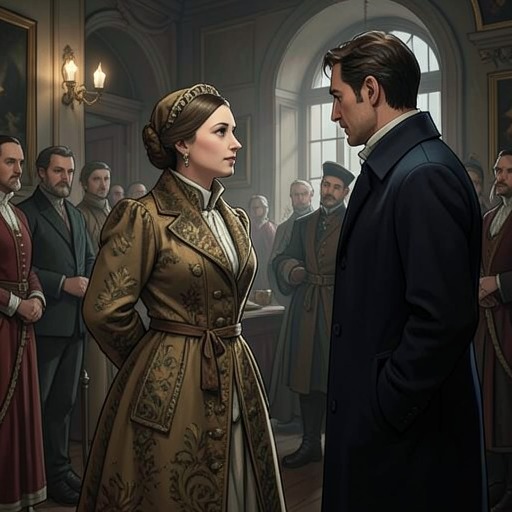
Goriot sells his silver to pay Anastasie’s debts
Père GoriotGoriot sells his silver to pay Anastasie’s debts in a secret, painful act of paternal sacrifice: he crushes a cherished wedding gift into a bar, sells plate for cash, and sends a receipted account to his daughter. The episode’s objects make his devotion tangible. Silver that once marked a household’s celebrations becomes money for a daughter who depends on him, while the old man’s tears reveal the emotional cost of converting memory into payment.
The keepsake and the sacrifice
When Goriot first arrives at Mme. Vauquer’s lodging house, he brings an abundance of silver plate, along with a wardrobe that displays the comfort and pride of a prosperous retired tradesman. Among the pieces is a small silver posset dish with two turtle-doves on its cover. He explains to Mme. Vauquer that his wife gave it to him on their first wedding anniversary, spending the savings she had kept before their marriage. He says he would rather scratch the earth with his nails than part with it, and takes comfort in expecting to use it for his coffee every morning. The dish is not simply valuable household silver: it carries the memory of his wife and an earlier domestic life.
That attachment gives the later destruction its force. Goriot’s paternal generosity has long taken material form. Although he earns an income of sixty thousand francs, he spends scarcely twelve hundred francs on himself, gives his daughters the best education and accomplishments he can secure, provides them with a carriage and a chaperone, and indulges their wishes without asking more in return than a kiss. He is prepared to make his wealth serve their comfort; in this episode, he makes even a treasured reminder of his marriage serve that same purpose.
The nighttime transformation
The scene first reaches Eugène de Rastignac as an unsettling glimpse. Sitting with thoughts of Law and poverty, and imagining a future beside Anastasie, Eugène hears a sound from Goriot’s room that he mistakes for a death groan. He slips onto the landing and looks through the keyhole, where the light exposes an action whose purpose he does not yet understand. Goriot has turned the table over and secured a silver plate and cup against a bar. With a thick rope, he pulls hard enough to crush and twist the metal out of shape, apparently trying to make ingots.
The labor is physical and deliberate. Goriot unwinds the rope, covers the table with a blanket, and rolls the flattened silver into a bar with astonishing dexterity. Eugène watches his muscular arms at work and wonders whether the old man is a thief or a receiver of stolen goods, living like a beggar to conceal criminal activity. That suspicion records the scene’s initial uncertainty: from outside Goriot’s room, the destruction of costly plate looks like evidence of a hidden life, not the cost of a father’s aid to his daughter.
When the bar is nearly finished, Goriot looks sadly at what he has made. Tears fall as he extinguishes the dip that has lit his work, and Eugène hears him sigh before lying down again. The sequence shifts the meaning of the act without explaining it outright. The silver has been made saleable, but the sight of Goriot’s grief makes clear that this is no indifferent liquidation of surplus possessions. His whispered pity for a child further restrains Eugène from judging him hastily, even as the purpose of the sacrifice remains to be discovered.
From silver to payment
The explanation comes by way of observation and a letter. Vautrin reports that he saw Goriot in a goldsmith’s shop on the Rue Dauphine at half-past eight in the morning, selling a piece of silver plate for a good sum. The metal had been twisted out of shape so neatly that the transformation appeared practiced. Vautrin then says he followed Goriot to the Rue des Grès, where he went into the house of the money-lender Gobseck. The route connects the night’s labor to its economic result: a household object is altered, sold, and followed by a visit to a lender.
The episode’s practical destination becomes clearer when Vautrin intercepts Christophe carrying a letter from Goriot to Mme. la Comtesse Anastasie de Restaud. He holds the envelope to the light and determines that it contains not a banknote but a receipted account. His sardonic description of Goriot as a gallant old dotard exposes the transaction’s double character: the old man is not merely sending money, but settling an account for his daughter. The personal sacrifice takes the form of an ordinary document delivered by a servant to Anastasie’s address on the Rue du Helder.
Eugène recognizes the object that has been broken up. When Mme. Vauquer asks whether Goriot really melted down his silver posset dish, Eugène recalls that the lid bore two turtle-doves and that he saw Goriot crying as he broke up the cup and plate. Mme. Vauquer confirms that the dish was dear to him as his own life. What had looked like suspicious nocturnal work is thus legible as a particular sacrifice: Goriot has surrendered a treasured object in order to meet his daughter’s financial need.
Love measured in money
The sale belongs to a wider pattern in which Goriot’s affection is expressed through expenditure. He has raised Anastasie and her sister, Delphine de Nucingen, with lavish attention, giving each half his fortune as a dowry when they married. Anastasie’s marriage to the Comte de Restaud carried her toward the more elevated social sphere she desired; Delphine married the banker Nucingen. Afterward, the daughters’ husbands objected to Goriot’s continuing to work in trade and then restricted the daughters’ contact with him. The old man eventually retired on the proceeds of his business and his savings, but the separation did not end his giving.
The silver episode anticipates the painful logic he later names from his deathbed. He imagines that, had he kept his money, his daughters would be beside him, tending and kissing him; instead, he has nothing. He concludes that they would have treated him with attention when he was still worth something, and that money can command the appearance of familial closeness. His earlier sacrifice is not identical to that later lament: the plate is given to discharge Anastasie’s immediate account, while the deathbed speech reckons with the cumulative cost of having spent his fortune on both daughters. But both moments expose the same vulnerability. Goriot makes material resources the language of love, and discovers that money can secure needful services or temporary regard without guaranteeing reciprocal affection.
The episode therefore places tenderness and economic exchange inside one another rather than separating them. The wedding dish stands for a private history of affection; once crushed and sold, it becomes a payment on a daughter’s behalf. Goriot’s tears register what the transaction costs him, while the receipted account and the goldsmith’s payment show how completely that feeling must pass through money to reach its practical end. The transformation from keepsake to ingot is both an act of care and a measure of the world in which care is made materially legible.