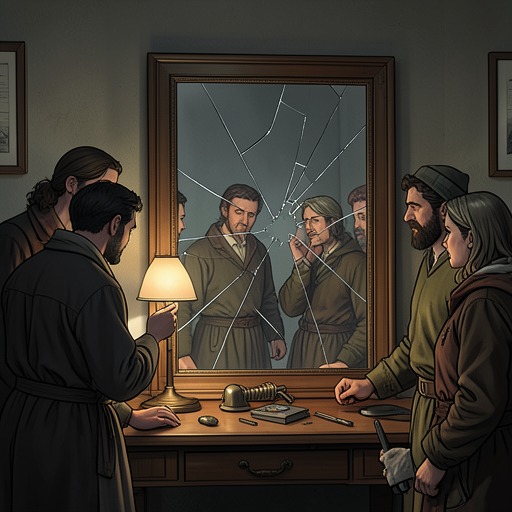
Acadian’s threat poems
PleasureAcadian’s threat poems make rhyme serve as an instrument of coercion: each message sounds composed and controlled while setting out dangers that leave its recipients no safe choice. The first addresses Magnus through Daenaira and her unborn child; the second redirects the crisis toward Malaya, exploiting Guin’s predictable response to a threat against her. Together, the poems turn a personal grievance into a timed test of loyalty, rescue, and sacrifice.
The First Poem: Penance and the Forced Choice
The first message reaches Magnus when Daenaira lies unresponsive. He has found her breathing but unable to wake, with a crumpled piece of sky-blue stationery smoothed out and resting on her stomach. The poem’s placement makes the written threat inseparable from her body: she is both its subject and the means by which Acadian can reach Magnus. Guin reads the note, then recognizes that it presents a threat and a choice without yet explaining where Daenaira must be rescued from.
Its opening identifies the grievance behind the punishment: “A penance for the priest who killed my youngest one.” Addressing Magnus as a priest ties his religious identity to the accusation, while the word “penance” frames the coming suffering as a debt to be paid. The next line, “The price, to say the least, will be my greatest fun,” sharply unsettles that language. Penance might suggest moral correction or atonement, but Acadian presents the price as a source of personal pleasure. The poem’s neat rhyme therefore does not soften its cruelty; it gives revenge a polished, deliberately composed form.
The threat then binds Daenaira and her child together: “Here lies your love, like the dead, her child also as well,” followed by the instruction, “If you dream her escape in your head, you’ll save her from her hell.” The apparent death is complicated by Magnus’s discovery that Daenaira is still breathing, while the reference to dreaming points toward a kind of escape beyond ordinary waking action. The note does not, in this moment, explain how that rescue is to be accomplished. Guin’s question about where Magnus is supposed to save her from marks the gap between the poem’s command and the practical knowledge needed to obey it.
Acadian adds conditions that turn the rescue into a trap. Magnus must “bring a friend or two,” and the warning that he will “not survive alone” makes isolation itself part of the danger. The Senate meeting supplies a deadline: it is the “only minute” available, because Acadian says she will return afterward. If Daenaira remains imprisoned, the poem threatens that she will “in Light” burn. Yet saving her carries a second threatened consequence: “But save her and your child will die,” while leaving her to die would leave Magnus with “the husk of her body” until the child is born. The alternatives are not rescue and surrender in any ordinary sense. Each is described as a different form of loss, and the promised return makes delay dangerous as well.
The Second Poem: The Threat Shifts to Malaya
A second message appears during Guin’s attempt to free Daenaira. He climbs her bare body to reach the note tied around her waist, carefully bracing himself as he pulls it free. Even in the urgency of the rescue, he reads it because it may contain a warning whose disregard could cost Daenaira her life. The physical effort of retrieving the card makes the message part of the scene’s immediate danger, rather than a threat delivered at a distance.
This poem begins with an apparent invitation: “Oh, do come save her, this maiden in such perilous distress;” Its courtly description of Daenaira as a maiden in distress briefly resembles a conventional rescue appeal, but the following question reveals the trap: “But ask yourself this, steady savior, who now watches over your mistress?” The phrase “steady savior” flatters Guin even as it assigns him a role Acadian can manipulate. The word “mistress” redirects attention from Daenaira to Malaya, so the person Guin is not currently rescuing becomes the next target.
The message makes its timing explicit. “When Senate ends so close I’ll be, and you without any but this clue;” places Acadian near the threat’s anticipated moment and stresses Guin’s lack of information. The next line supplies the intended consequence: “So waste your time setting this one free, whilst my dagger runs Malaya through.” The contrast is brutally economical: time spent freeing Daenaira is presented as time in which Malaya is exposed to a dagger. Unlike the first poem’s series of threatened outcomes, this one concentrates the pressure into a direct competition between two urgent acts.
Design and Narrative Function
The poems form a sequence of narrowing choices. The first message pressures Magnus with Daenaira’s unconsciousness, the threatened child, a condition of imprisonment, and the Senate deadline. The second recognizes that Magnus has turned to Guin for help and redirects the danger toward Malaya. Guin understands that Acadian knew whom Magnus would choose: he describes her as knowing he could not ignore a threat to Malaya, however likely or unlikely its success appeared. The threat therefore works through knowledge of the rescuers’ loyalties, not merely through the physical dangers it describes.
The changing forms of the messages reinforce that strategy. The first is a longer poem on blue stationery, found on Daenaira’s stomach; the second is a card bound around her waist and retrieved during the rescue. Both use rhyme, direct address, and warnings about what will happen if the recipient acts or fails to act. Their verse gives each ultimatum a memorable shape, but its apparent order only sharpens the disorder imposed on Magnus and Guin. Acadian makes a written clue seem like guidance while ensuring that every instruction carries another threatened consequence.
The second poem also changes Guin’s task without resolving the first. He cannot simply treat Daenaira’s rescue as the only immediate concern once the note names Malaya, and he cannot safely ignore the warning merely because Acadian may be manipulating him. As he steadies his thoughts and handles Daenaira as carefully as he can, the threatened alternatives become bodily and immediate: she is in pain, and the method needed to proceed risks hurting her. The poems thus turn rescue into a contest over attention and time. Their central cruelty lies not only in what Acadian threatens to do, but in making the people who care for one another choose where to place their limited protection.