Hurish restraints
PleasureThe Hurish restraints are real, electrically charged devices that Acadian uses to bind Daenaira in the Dreamscape. Their danger lies not only in the force they can deliver but in their crossing of the boundary between dream and waking life: a shock or even light from the devices could destroy Daenaira’s dreaming self and leave her body in Realscape damaged beyond healing. Freeing her therefore becomes a problem of understanding and safely interrupting the restraints’ physical mechanism.
Design and Operation
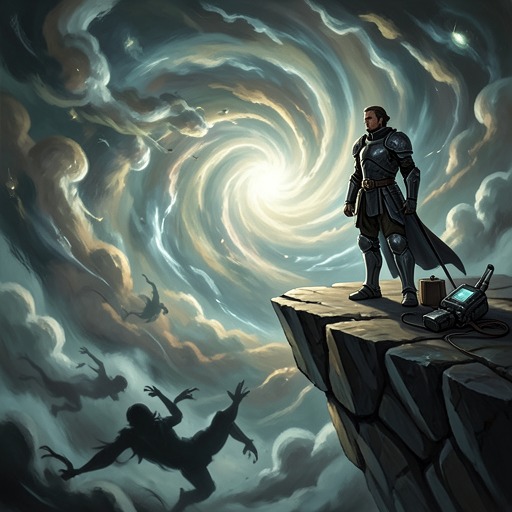
Magnus recognizes the restraints as Hurish technology when he and Guin examine Daenaira’s rigging without touching her. The apparatus consists of cuffs binding her wrists and a collar at her throat. Its electrical charge belongs to a method of controlling animals: under ordinary conditions, a shock warns a creature away from an action. But the men understand that these restraints will not deliver merely gentle warnings. A sufficiently fierce shock, or light of any kind, could permanently gut Daenaira of her dreaming self. In Realscape, her body would remain alive, but her mind would be destroyed and the resulting damage could not be healed.
The device’s significance changes sharply with its setting. Acadian has brought the restraints into Fade, and Magnus identifies them as real rather than dream-created. They are thus not simply an image of bondage that can be altered by changing the dream; their real electrical charge can cause real harm across Daenaira’s divided states. The scene makes the material apparatus central to the danger: its construction and contact with the surrounding space determine whether rescue is possible.
Daenaira’s Captivity and the Danger of Removal
The restraints also recall Daenaira’s history: Magnus explains that she was kept in Hurish for years, and that Acadian has likely drawn the idea from Daenaira’s own dream imagery. The device is therefore both a means of present captivity and a form whose use reaches back into Daenaira’s experience. Its appearance in this scene is not an abstract threat; Magnus has already tried to cut similar restraints from her and knows the attempt can injure the people trying to help.
On that earlier occasion, cutting them caused feedback to shoot through Magnus and Daenaira. That memory rules out a simple attempt to sever the cuffs or collar. Magnus cannot think of another way to remove them, while Guin is also aware that his own knowledge of the Dreamscape is rudimentary compared with Magnus’s. Their uncertainty is practical, not merely emotional: a wrong move could trigger the very charge they need to neutralize, with Daenaira’s mind and body at stake.
The Circuit and the Rescue
Guin finds a possible explanation by studying the rigging. He reasons that the technology must have a mechanism that distinguishes Daenaira’s movement, weight, and warmth from their own. The men themselves, he realizes, can complete that mechanism: while they stand on the floor, connecting themselves to the rigging would create a closed circuit between the Hurish restraints and their trigger. To free Daenaira, they must get off the floor rather than simply pull or cut at the device.
The chains provide the means to do so. Guin works while supported by a chain, holding Daenaira against him as he reaches the lock on her collar. His position is made more precarious by a stab wound in his off side. The strain of supporting their weight tears the wound further, and blood saturates his clothing as he uses his dominant hand to work. The restraints turn rescue into a coordinated physical task: Guin must handle the lock, Daenaira must hold on, and Magnus must prepare for the possibility that the detached pieces could still conduct through the floor.
Before Guin drops the restraints, he warns Magnus to catch them. Though disconnecting them should make them inert, neither man is willing to risk contact with the floor. Magnus strips off his tunic and quickly makes it into a sack. Guin then opens the collar without a spark, removes it, and drops it into the makeshift container; the wristlets follow. Once his tools are away, he removes Daenaira’s gag and holds her tightly as he judges the distance to the floor. The immediate danger of the restraint charge has been overcome without the feared shock, though the scene does not treat the rescue as uncomplicated or cost-free.
Narrative Function
The Hurish restraints bring together captivity, remembered harm, and mechanical problem-solving. Their ordinary purpose is to warn animals away from an action, but the device’s use on Daenaira—and its dangerous power in Fade—makes that seemingly controlled warning potentially catastrophic. The contrast between a warning shock and the destruction of a person’s dreaming self gives the apparatus a threat disproportionate to its visible form as cuffs and a collar.
The restraints also shape how the rescue can happen. Magnus’s prior experience explains why cutting is dangerous; Guin’s reasoning about the closed circuit points toward a different method; the chains keep the rescuers from standing on the floor; and Magnus’s tunic becomes a container for the detached pieces. After the collar and wristlets are removed, Daenaira tells Guin that Acadian had appeared to her as Helene, Angelique, and Malaya, leaving her unable to tell what was real. The restraints’ removal thus closes one immediate physical danger just as the confusion surrounding Acadian’s disguises turns attention to a further threat to Malaya. Their role is both material and consequential: the devices force the characters to read the rules of their environment under pressure, and their successful removal does not end the danger unfolding around them.