Veronica’s prohibition on psychotherapy
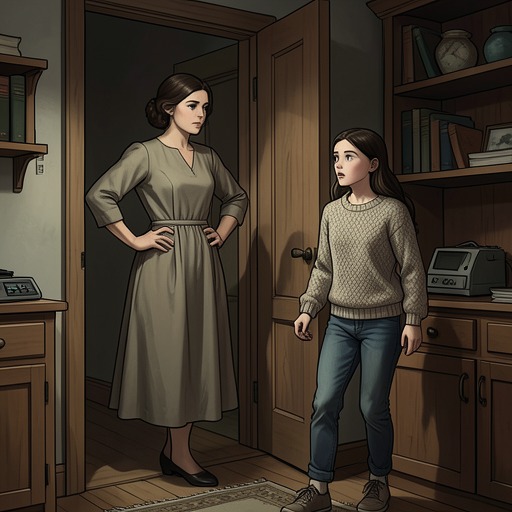
QueenieVeronica’s prohibition on psychotherapy turns Queenie’s attempt to seek care into a conflict over what a family is permitted to acknowledge. When Queenie, living with her grandparents after losing her job, tells Veronica that a nurse has referred her for help, her grandmother forbids her to go. The refusal draws on an inherited expectation of silent endurance, but Wilfred intervenes: Queenie is allowed to seek counseling, and the conversations that follow begin to give language to experiences she had learned to minimize.
The request for help
The confrontation takes place at the grandparents’ home, where Queenie is living during a period of serious instability. She has lost her job and tells Veronica that she feels ill and carries a weight on her chest. A nurse has referred her for support, but Queenie is hesitant even before the argument begins: she has absorbed the belief that the family should be strong and get through hardship without outside help. Her apology on seeing the National Health Service letter further shows how readily she treats the request as something for which she must account.
The referral is therefore more than an appointment. It asks Queenie to name distress as something that warrants care, rather than as a private failure to withstand difficulty. She tries to explain that she needs to speak to someone, while anticipating that the explanation will not be welcomed. The conflict makes the gap between her need for support and the family’s habits of endurance explicit.
Veronica’s refusal
Veronica answers Queenie’s request by invoking her own history of pain. She recalls the hardship she endured from youth through adulthood and imagines that her own mother would have condemned her for seeking psychotherapy. In her view, surviving suffering without professional help is not simply what happened to earlier generations; it becomes the standard Queenie is expected to follow. Veronica treats therapy as a shameful departure from that standard and insists that Queenie is not going.
Her argument also folds Queenie’s distress into the family’s wider troubles. Veronica points to Sylvie’s mistreatment by Roy and precarious circumstances, and blames Queenie for losing her job because she did not hold herself together. The comparison does not lead her to support treatment; instead, it strengthens her claim that Queenie should endure without it. She also invokes the practical dependence created by Queenie’s living under her grandparents’ roof, asking where Queenie could go if she left. The prohibition thus operates through both a moral judgment about resilience and the pressure of Queenie’s limited housing options.
This is not an isolated expression of household tension. In the recurring family dinners, Roy uses the gathering to belittle Queenie or Sylvie, while Sylvie often remains silent. That atmosphere helps explain why speaking about suffering has been difficult, but the psychotherapy dispute has a distinct focus: Veronica makes professional help itself the point of conflict. Her refusal reproduces a family pattern in which endurance is expected and the circumstances causing pain are left largely unaddressed.
Wilfred’s intervention
Queenie tries to defend her decision by recalling her achievements: she is the first in the family to finish school, attend college, earn a degree, and hold a full-time job. Veronica turns even this list against her, treating therapy as another first that should not be attempted. The exchange ends in an apparently final command, with Veronica folding her arms and declaring the conversation over.
Wilfred’s entrance changes the outcome. After asking what has happened, he listens as Queenie explains that she wants counseling and then tells Veronica to let her go. His reasoning directly challenges the inherited rule: he suggests that if earlier generations had learned to talk about their troubles, they might not have carried them throughout their lives. He does not dismiss the family’s history of hardship; he argues that silence has had a cost. Veronica stops washing up but continues looking into the sink, and Wilfred leaves with his walking stick. The exchange does not establish that Veronica has changed her broader beliefs, but her prohibition no longer prevents Queenie from proceeding.
What counseling makes speakable
In sessions with Janet, Queenie begins by downplaying her childhood. She describes Roy’s home as clean, with a garden, and remembers that he cooked well, as though those details might make being screamed at or ignored seem less consequential. Janet challenges that minimization and tells her that either experience matters to a child’s development. The contrast identifies one effect of the family’s stoicism: Queenie has learned to weigh evidence of care against the harm, and to question whether the harm counts.
As she continues, Queenie describes Roy breaking her belongings, making false accusations about her, and making her sleep in a car. She also recounts how, after Roy made Sylvie sell their small house, the family moved into the house with the garden. When Roy’s relationship with Sylvie deteriorated, Queenie and her mother were initially placed in a rented flat; before long, Sylvie returned to Roy and the flat was left to Queenie. Janet identifies the situation as dangerous for a vulnerable young person. Queenie, by contrast, explains that she considered it preferable to living with Roy, whose treatment had made her feel hated and unwanted.
Counseling also gives Queenie room to reconsider her understanding of Sylvie. In a conversation with Janet about the period when her distress intensified, Queenie wonders whether her pregnancy and possible experience of motherhood brought her own relationship with her mother into sharper focus. She begins to see Sylvie not only as the person who should have protected her, but as someone who endured loss, isolation, and the consequences of Roy’s abuse. That recognition is painful and complicated: Queenie feels she has repeated her mother’s collapse, but now blames herself for her own difficulties. The conversation nevertheless quiets some of her immediate dark thoughts, showing a concrete difference between speaking about distress and being required to bear it alone.
Significance and limits
Veronica’s prohibition represents intergenerational mental-health stigma in domestic form. Her own endurance, and the imagined judgment of her mother, supply the rule’s authority; Queenie’s reliance on her grandparents gives that authority practical force. The conflict is not simply between an older and younger generation, since Queenie herself has internalized the expectation to be strong. Her hesitation and apologies show how the rule can persist even when the person who needs help recognizes that she is unwell.
Wilfred’s response offers a counter-principle: hardship need not be passed forward as silence. His intervention does not erase the family’s history or resolve its conflicts, and the available scenes do not show Veronica withdrawing her belief that psychotherapy is unacceptable. What changes is Queenie’s access to care. With Janet, she begins to connect present distress to childhood neglect, Roy’s abuse, Sylvie’s circumstances, and her own fear of rejection. The prohibition is therefore consequential not because it permanently stops treatment, but because it exposes the resistance Queenie must move through before recovery and self-understanding can begin.