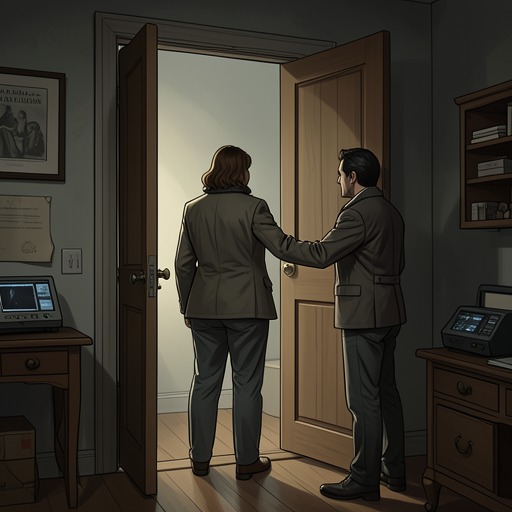
Springton High harassment and disciplinary policy
RESprington High harassment and disciplinary policy is the school district’s formal response to the campaign of harassment directed at Tabitha Moore. Its decisive significance lies in the shift from treating individual incidents as jokes or interpersonal disputes to treating them as a connected institutional and potentially criminal crisis. The policy gives the Springton school board authority to investigate, suspend, expel, impose remedial education, cooperate with police and prosecutors, and support legal action when student conduct threatens a student’s safety and access to education.
Institutional Response and Escalation
The policy becomes visible when Pamela Cribb, acting for the Springton school board, rejects Principal Edwards’s assumption that the situation has been resolved. Cribb regards the school’s handling of the matter as a developing fiasco rather than a settled disagreement. Karen Williams’s late-night call, made in anger and near tears, has alerted her to the seriousness of the situation; their long friendship through the Springton United Methodist Church and Women’s Fellowship Choir makes Karen’s distress especially persuasive. Cribb therefore approaches the school not as a passive administrator but as someone responsible for preventing the crisis from expanding.
The board’s immediate response is to remove Erica Taylor, Brittney Taylor, and Kaylee Mendolson from class and place them under suspension. The action is not presented as a routine punishment based on a single accusation. Cribb ties it to an immediate school-board harassment investigation, while also noting that Springton police has a county lawyer preparing charges, the parent-teacher association is receiving angry calls, and Seelbaugh and Straub has submitted a second notice of claim. The school faces possible lawsuits before the board has even completed its fact-gathering, creating pressure to establish the facts before the conflict produces expulsions, court proceedings, or a wider legal battle.
Misconduct, Evidence, and the Meaning of a “Joke”
The policy’s clearest test comes through Clarissa Dole’s theft of Tabitha’s missing notebook. Clarissa initially describes the act as a joke and uses the collective word “we,” but questioning forces her to concede that she alone removed the notebook and placed it in a restroom waste bin. The evidence is circumstantial but specific: Mr. Stern had given Clarissa permission to leave class for the restroom, Tabitha had not gone there, no other student in that period had needed to go there, and the notebook was found in the bin. The policy therefore treats the act as misconduct rather than accepting Clarissa’s self-description as harmless humor.
Cribb explains that stealing would ordinarily warrant parental notification, a minimum five-day suspension, and a permanent-record entry. The circumstances are more severe because Clarissa acted during a criminal harassment investigation. Earlier false allegations had nearly cost a teacher his job and seriously threatened Tabitha’s reputation; students had also reported constant harassment and two physical attacks severe enough to require medical attention. Tabitha, despite being at the top of her class, was considering voluntarily withdrawing from Springton High because she did not feel safe. In that context, the notebook incident is not isolated mischief: it is another act within an atmosphere that has made continued attendance itself uncertain.
Sanctions and Enforcement Powers
The policy allows the school board to impose consequences beyond an ordinary short suspension. Cribb tells Clarissa that she may be expelled for the remainder of the school year. Depending on the board’s ruling, she may or may not be permitted to enroll in remedial night classes or alternative education within the district. She will also receive a mandatory course on behavior and conduct, and she must pass it. If she does not, she can expect to repeat ninth grade at Springton High the following August.
The disciplinary framework also extends beyond school-based penalties. Cribb states that the Springton Police Department is owed a debt of gratitude in connection with Tabitha’s case and that the district attorney and an independent law firm are preparing legal action. The board intends to assist through expulsions, turning students over for arrest, and appearing in court as witnesses. This makes the policy an institutional bridge between school discipline and criminal accountability: behavior that students present as teasing or a joke can become evidence in a broader harassment case when it forms part of repeated intimidation and harm.
Limits, Stakes, and Narrative Function
The policy gains force partly because the school’s earlier response appears inadequate. Principal Edwards had believed that smoothing relations between the Thompson and Moore families might end the matter, while Cribb sees the need for immediate investigation before events “snowballed completely out of control.” The contrast exposes a central administrative problem: a disciplinary system can exist on paper while failing in practice if officials classify repeated abuse as ordinary conflict, demand an artificially simple victim-and-perpetrator account, or prioritize institutional calm over student safety.
Tabitha’s history gives the policy its social and emotional stakes. She remembers being marked as “Tubby Tabby,” mocked for her weight and smell, and associated with the stigma of the Lower Park trailer park. At school, the contrast between that remembered identity and the elegant, slender redheaded teenager other students see does not erase exclusion; within weeks, she realizes that being thin and attractive is not enough to produce friendship. Alicia Brooks becomes a genuine friend, but the school environment remains dangerous enough that Tabitha’s attendance is threatened. The policy thus confronts more than isolated rule-breaking: it confronts the persistence of social labeling, peer surveillance, and institutional failure across changing appearances.
The framework’s importance is reinforced by what follows the investigation. Tabitha is physically endangered, later survives a catastrophic assault, and awakens after being legally declared brain dead. Her parents are devastated, while Karen Williams regards the family and neighborhood as having failed to protect her. Against that background, the school board’s willingness to investigate, suspend, expel, cooperate with prosecutors, and testify in court represents a belated recognition that harassment can produce consequences far beyond embarrassment or hurt feelings. Springton High harassment and disciplinary policy therefore functions both as a rule system and as a measure of whether the community will finally treat Tabitha’s safety as an institutional responsibility.