Tabitha's Second Timeline Restart
RETabitha's Second Timeline Restart is the second major temporal rupture experienced by Tabitha Moore: after apparently dying in 1998, she awakens again at the beginning of the same displaced life, with her body, relationships, and circumstances restored to their earlier state. The event turns time travel from an improbable escape into a cycle of trauma and loss. Its decisive effect is not merely that Tabitha returns to the past, but that the life she had painstakingly rebuilt is stripped from her, leaving her to face a repetition she had believed she had already survived.
Causes and Temporal Background
The restart follows the crisis at the Williams family lake house, where Tabitha had been left with a severe head injury and understood herself to have died. She later explains to Alicia Brooks and Elena Seelbaugh that, seconds after blacking out on the lake-house floor, she somehow restarted the timeline by waking inside the MRI in May 1998. Her account connects the second reset to the earlier MRI-induced displacement that had sent her mind forty-seven years backward from 2045. The first discovery had already forced her to recognize that the familiar machine from her future was the same prototype involved in the original disaster; the second restart makes that temporal mechanism more terrible because it does not simply transport her, but appears to overwrite the life produced by her first intervention.
The immediate trigger is the prototype MRI machine in the Emsie St. Juarez Pediatrics ward. It emits a shriek so powerful and painful that people several blocks away cover their ears, then blows the electrical breaker and causes a power outage across Jefferson County. When backup power returns, black smoke pours from the machine, the room becomes dangerously hot, and the fire alarm sounds. Thirteen-year-old Tabitha lies motionless inside the device while the medical staff struggle to remove her. The scene mirrors the original awakening closely enough to make repetition itself part of the horror: her father, Alan Moore, again bursts in angrily and demands that she be taken out of the machine, repeating the same response as before.
What the Restart Erases
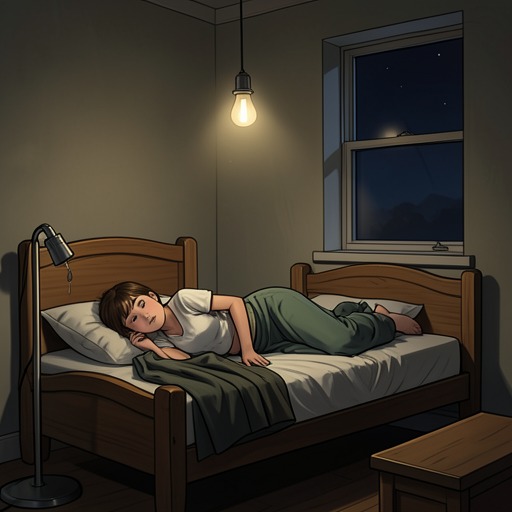
The first sign of the reset is bodily. Tabitha looks down and finds small, chubby fingers where she remembers a different body, and the lean muscles developed through her summer training have disappeared beneath a soft, heavy frame. Her blue orthopedic cast, decorated with Alicia's artwork and the signatures of her close friends, is gone. The wrist and hand beneath it are pudgy but unbroken. The cast had represented not only an injury but a visible record of friendship and survival; its disappearance makes the reset materially legible before Tabitha can fully understand it.
The physical reversal reopens the self-hatred she had hoped to escape. Returning to the overweight adolescent body makes her fear that she has been forced to become the same useless, stigmatized girl again. Her reaction is not simple disappointment about weight or appearance: the body signals the loss of an entire achieved identity, including the discipline, confidence, and social connections attached to her transformation. The restart therefore restores an earlier body while also threatening to restore the emotional conditions in which she had hated that body.
The greater loss is relational. Tabitha cries that the reset has taken everyone and everything she had gained, including moments that arose by happenstance and could not be recreated through planning. She later tells Alicia and Elena that she could not bear to sort things out with her mother again from the beginning. The second timeline is consequently defined by absence: the people remain potentially reachable in the past, but the particular bonds she formed with them have been erased as lived history. A second chance becomes a second bereavement, because Tabitha remembers what the others no longer remember.
The Nightmare Between Deaths
The restart is narrated through unstable transitions between waking reality, memory, and dream. After the MRI crisis, Tabitha experiences a grotesque intermediate sequence in which Julia appears at the Perkins restaurant, the familiar place where Tabitha used to stop while traveling down I-275 after Julia's suicide. Julia's appearance places grief inside the machinery of temporal displacement: the restaurant is not simply a location but a recurring memorial space where Tabitha had preserved her friend's memory by returning to the same booth and sometimes crying over a dinner special. Julia's sudden disappearance and the shift from daylight to evening make the scene feel like a memory being replayed and then abandoned.
The nightmare then gathers several figures associated with Tabitha's fear and past. Carrie tells her that she is dead and that she has wasted a second chance. An eighth-grade Elena Seelbaugh and Erica Taylor appear beside Carrie, while Erica carries the Louisville Slugger from the Halloween party. The figures are drawn from different times and contexts, so the scene refuses ordinary chronology even as it expresses the emotional logic of the reset: past antagonists, lost friends, and threatened identities collapse into one accusatory tableau. Tabitha insists that they are not real, but the denial cannot protect her from what they represent.
Her attempted escape takes the form of the Dream F-22 Fighter Jet, a vehicle associated with an earlier fever dream and with the fantasy of leaving the nightmare behind. The aircraft rises despite having no runway and despite Tabitha's inability to fly it. Escape fails when something grabs her ankle and pulls her backward. The cockpit becomes the circular aperture of the prototype MRI at the University of Louisville Hospital, joining the dream's image of flight to the medical apparatus that governs her temporal fate. The transition makes the machine appear less like a neutral instrument than a recurring threshold through which body, memory, dream, and historical time are forcibly exchanged.
Death, Survival, and the New Timeline
Inside the MRI, Tabitha experiences herself as an aged woman, with frail muscles, aching joints, and blood running from her nose. Medical personnel hear her screaming and struggle to remove her while the machine scrapes, squeals, and fills with black smoke. Through painful flashes she sees the sky beyond the enclosure as the F-22 tumbles backward in an uncontrolled tailspin. The fading dream image and the failing machine converge as parallel versions of collapse.
At the climax, another blood vessel ruptures in Tabitha's brain and everything goes dark. She then falls through a void while the fighter jet drops away beneath her. A small hand catches hers, allowing her to hang in darkness, and she sees a final glimpse of a frail sixty-year-old body lying still inside the MRI. This image leads her to suspect that her future self, left behind in 2045, is now dead, even though some part of her consciousness has escaped back into the dream. The restart thus does not provide a clean resurrection. It divides Tabitha across ages and realities, leaving survival uncertain and making identity itself a matter of which version of her remains active.
The event's aftermath is a renewed 1998 rather than a simple return to an unchanged past. Tabitha understands that she is back at the beginning all over again, and her later explanation confirms that the second timeline began with her awakening in the MRI in May 1998. Her knowledge of the previous altered history remains, but the social world does not carry its memory with her. This creates a severe asymmetry: Tabitha possesses the consequences of a life that everyone else has lost, while also lacking the power to restore its unrepeatable accidents exactly.
Narrative Significance
Tabitha's Second Timeline Restart gives the novel's time-travel premise its central traumatic pattern: recognition, attempted repair, apparent progress, and forced repetition. The event repeats the MRI awakening with altered stakes, turning the earlier miracle into a form of temporal violence. What once looked like a route away from an unwanted life now threatens to make every attachment provisional. The repetition also exposes the limits of personal agency. Tabitha can remember, choose, and struggle, but she cannot guarantee that the people, injuries, friendships, or moments that shaped her will recur in the same form.
The restart also complicates the meaning of a second chance. Tabitha had treated the first displacement as an opportunity to become someone other than the girl she remembered with shame. The second displacement reveals the cost of that transformation: losing the new life hurts precisely because it had become real to her. Her grief therefore contains both fear of returning to the old self and mourning for the self she had become. The event's emotional force lies in that double movement, as time reverses the body and circumstances while leaving memory intact enough to make reversal unbearable.
As a piece of unnatural narration, the sequence asks the reader to accept several incompatible states at once: Tabitha may be dead, alive in 1998, trapped in a dream, or divided among versions of herself. The narrative does not resolve these contradictions into ordinary realism. Instead, its fragmented transitions reproduce Tabitha's disorientation, so that the reader experiences chronology as something that can shear apart between one image and the next. The second restart is therefore both a plot mechanism and a formal expression of trauma: the past returns not as stable history, but as an intrusive repetition that demands to be lived again without promising that anything can be recovered.