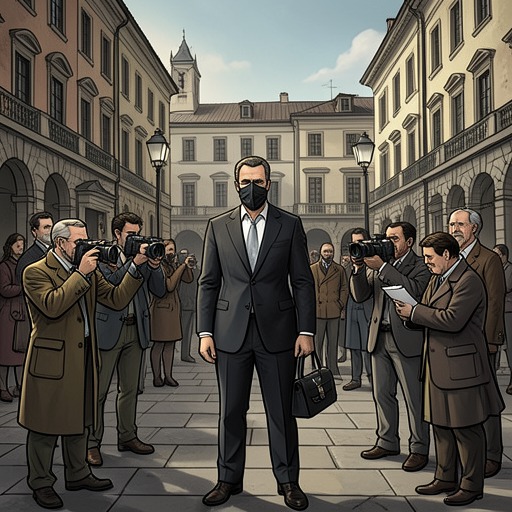
Lourdes Rubio's defense of William Rupert Bantling as her trust in him collapses
RetributionLourdes Rubio’s relationship with William Rupert Bantling shifts from calculated professional alliance to an uneasy defense conducted without trust. Bantling selects her partly for the credibility her reputation and public image might lend his case; Rubio initially accepts his account and regards him as a friend. Once she understands that he concealed his crimes and has used her advocacy to pressure C.J. Townsend, she continues to face the duties of counsel while refusing to let those duties become a route to his freedom at any cost.
A lawyer chosen for appearances
Before Bantling’s arrest, Rubio knew him socially. They jogged together on Saturday mornings in South Beach and sometimes shared cappuccino at a bookstore. He presented himself as a successful, charming, sincere businessman, and she accepted the image. When he later needed a lawyer, she believed she understood the man she had known; that confidence made his deception especially disorienting.
Bantling, however, had researched Rubio before retaining her. He distrusted women and did not regard a woman lawyer as a natural choice for a matter involving his life, yet he considered Rubio strategically useful. She was respected in Miami’s legal and Latin communities, educated, conservative in presentation, and, in his calculation, likely to make jurors wonder how someone who seemed so respectable could represent a supposedly monstrous defendant while maintaining his innocence. His choice was not a simple expression of trust: it was a judgment about what her presence might persuade others to believe.
Rubio initially saw the case through the same reassuring image that had shaped their acquaintance. She had believed the arrest might be a mistake or a frame-up and did not think Bantling could be either a rapist or the serial murderer known as Cupid. His charm and apparent sincerity had defeated the caution she brought to criminal defense work, where she knew clients might lie even to their own lawyers. Bantling’s selective disclosure later made clear that he had not offered her the whole truth; he gave her information according to what he considered her need to know.
Defense strategy and a personal rupture
Rubio’s defense of Bantling brought her into direct conflict with C.J. Townsend. Rubio learned that Townsend had legally changed her name from Chloe Larson and had been raped in New York twelve years earlier. Bantling claimed that he was the attacker, while Rubio argued that Townsend’s history clouded her judgment in the murder prosecution and that she was withholding evidence because of a personal vendetta. Rubio formally sought Townsend’s removal from the case and planned to raise the issue with the State Attorney.
The accusation placed Rubio’s work inside Bantling’s effort to turn Townsend’s past into a weapon in the present case. In the meeting where Rubio disclosed the allegation, Bantling taunted Townsend with private knowledge of the assault. Rubio promptly rebuked him and told him to stop. Her response marked a limit: she was still his attorney, but she would not treat his conduct in the room as useful advocacy or permit him to present it as harmless courtroom maneuvering.
The confrontation also exposed how far Bantling’s interests had diverged from Rubio’s understanding of her role. He wanted to use the accusation to weaken the prosecution and improve his chances of release; Rubio was confronting evidence that her client had seriously harmed Townsend. The expired New York statute of limitations meant that the old crime could not be prosecuted there, but that legal barrier did not make the allegation irrelevant to Rubio’s judgment of him. She came to believe that Bantling was a rapist and that his claim against Townsend was not an innocent defense tactic.
Doubt, conscience, and the evidence
Rubio’s own professional history sharpened the conflict. After leaving the Public Defender’s Office, she had built a solo criminal practice over eight difficult years in a profession dominated by men. She had become one of Miami’s most respected and highly paid defense attorneys, but success had required her to work forcefully within a system she believed often failed vulnerable people. In Bantling’s case, she recognized that using Townsend’s victimization to secure a quick legal advantage would make her part of that failure.
At the hearing, Rubio had grounds to challenge the stop that led to the evidence against Bantling. She also knew about the anonymous tip concerning his Jaguar. A police officer had disclosed at The Clevelander that the stop had not happened for the reason later given in court. Rubio obtained the 911 recording from the Miami Beach Police Department on the twenty-ninth day, just before such recordings were routinely erased after thirty days. She believed she could have used the circumstances to get Bantling released, and she understood that the stop evidence could be central to his defense.
During the hearing, Rubio had the officer’s account cornered, but she stopped pressing. Her decision was not because she had lost sight of the possible defense: she knew the legal opportunity remained. Rather, she could not reconcile exploiting it with what she had learned about Bantling. She believed he had raped Townsend, suspected he had harmed other women, and saw no remorse in his treatment of Townsend. Her work as an advocate for women, including her leadership in La Lucha, which helps immigrant Hispanic women seek safety from domestic violence, made the prospect of helping him walk free intolerable.
Rubio’s restraint carried its own cost. She believed she had failed her client by not pursuing the officer more aggressively, while also believing that winning for Bantling could expose another woman to harm. She contemplated her own role in his eventual death sentence as a form of complicity, even as she could not bring herself to use her skill to secure his release. The conflict was not resolved by discovering a clean distinction between professional duty and personal conscience; it became the defining burden of representing him.
The collapse of trust
By the time Rubio looked at photographs of Anna Prado’s murder, the man she had befriended and the client she had defended no longer fit together. She knew Bantling had raped Townsend and believed he had fooled her about who he was. She still questioned whether he was Cupid, and she had to confront the possibility that her judgment had failed in both directions: she had trusted him too readily, while the evidence inventory from searches of his home and cars did not contain what she believed should have been there. She could no longer rely on her former confidence in her ability to read people.
Her relationship with Bantling therefore ends not in reconciliation but in a divided professional position. She remains his lawyer, aware of the obligation to defend him, yet no longer grants him the trust that had grown from their social acquaintance. Bantling had chosen her as an instrument of persuasion; Rubio had chosen to believe him as a friend and client. Once those choices were exposed, her defense became a test of whether advocacy required her to help him escape accountability. She ultimately refused to let the prospect of victory erase the women whose safety and claims had become inseparable from the case.