Nazi Party
ReunionThe Nazi Party is portrayed as a political force that advances from the edges of everyday life into the school, the street, and the Schwarz family’s future. The novel gives little account of the party’s formal organization; instead, it shows how its antisemitism acquires power through public slogans, social pressure, and the reclassification of Jewish neighbors as outsiders. That gradual intrusion overturns the confidence of Hans Schwarz and his father, both of whom had understood themselves first as members of their German home.
Emergence in Everyday Life
At first, the Nazi Party seems distant from the sheltered friendship between Hans and Konradin von Hohenfels. Political unrest is associated with Berlin, where Nazis and Communists clash, while Stuttgart appears calm. There are already signs of hostility: swastikas appear on walls, a Jewish resident is harassed, and Communists are beaten. Yet cafés, vineyards, the opera, and plans for summer holidays continue to define ordinary life. The contrast is important: the party’s presence is visible, but the characters initially treat politics as something outside their private world.
That confidence rests on a deeply rooted sense of belonging. Hans remembers the Schwarz family as having lived in Stuttgart for at least two centuries and describes his own identification as Swabian, German, and then Jewish. His father, Dr. Schwarz, shares that order of allegiance. He rejects Zionism and regards himself as an assimilated German, convinced that Jewish participation enriches German culture rather than putting loyalty to Germany in doubt. His patriotism is grounded in service as well as sentiment: he was wounded twice in the First World War and remains prepared to fight for his country.
The father also believes the political crisis will pass. He compares Nazism to a temporary illness in a healthy national body and trusts the cultural inheritance associated with Germany’s writers and composers. His confidence is reinforced by public esteem: he is a popular doctor, respected across religious lines, and honored by a deputation of prominent citizens. The Iron Cross, First Class, and his officer’s sword, displayed beside a picture of the Goethe-Haus in Weimar, stand for a German identity he believes cannot simply be revoked.
Ideology Enters the School
The novel marks a change when political hostility becomes harder to dismiss as passing unrest. Blood-red posters attacking the Treaty of Versailles and Jews appear around town; swastikas and Communist symbols cover walls, and unemployed people march through the streets. Inside the school, however, the old curriculum still emphasizes earlier history. That separation between lessons and current events leaves pupils poorly equipped to understand the political transformation taking place around them.
A new history teacher, Pompetzki, exploits that gap. He tells the class that hidden forces are undermining national life and heritage, avoiding explicit identification while making the intended target clear. The lesson turns insinuation into a classroom method: a racial and political accusation is presented as a concealed explanation of history. Some boys reject his theory, but others accept parts of it. The teacher’s arrival is followed by a sharp alteration in the school’s atmosphere. Hans hears an intense argument about Jews before entering his classroom; when he appears, the discussion stops, and Bollacher and Schulz stare at him with open hostility.
Hans initially avoids responding because a fight would not undo the prejudice already spreading through the school. The institutional response makes that prejudice more consequential. After Bollacher tells him to go back to Palestine, Pompetzki treats the insult as friendly advice, tells the boys they may fight outside, and promises that their problems will soon be solved. His response does not protect Hans; it makes antisemitic exclusion sound acceptable and hints that political change will soon ratify it.
Social Pressure and Exclusion
The party’s influence is shown not only through formal political references but through the way people learn to mark and avoid those classified as Jewish. Muscle Max, who had previously challenged Hans to demonstrate his strength, begins wearing a small silver swastika on his jacket and stops approaching him. Other pupils and even older teachers cease speaking to Hans. The change is not a single expulsion announced by the school: it is a cumulative withdrawal of ordinary companionship and recognition.
The consequences also reach beyond Hans’s classroom. Konradin confesses that his mother, from a once-royal Polish family, hates Jews and believes Hans has corrupted her son and threatens the family’s standing. She interprets the friendship through conspiratorial ideas linking Jews, religious influence, and Bolshevism. Konradin says he has had to fight for the hours he spends with Hans and has avoided acknowledging him when his parents are present. This private constraint reveals how antisemitic beliefs can govern relationships even without a party official intervening directly.
As Hans’s isolation deepens, his family decides to send him to the United States. In December, Dr. Schwarz tells him the move is temporary, explaining that his parents will remain in Germany because it is their Fatherland and home. Hans leaves school at Christmas and departs for America on January 19, his birthday. The family’s decision makes the consequences concrete: the political climate has already narrowed Hans’s future in Germany, while his parents still hope that their own rootedness will protect them.
Public Defiance and Its Limits
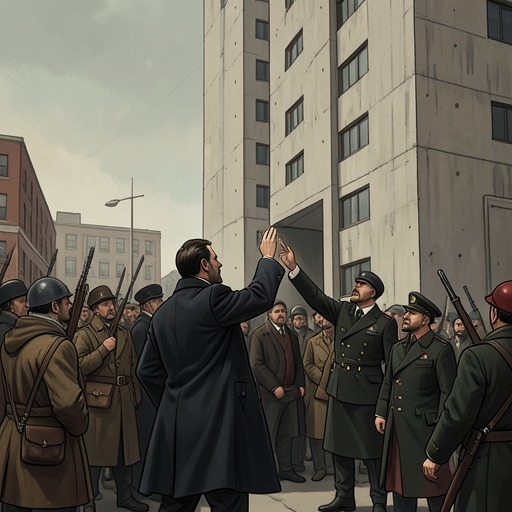
Years later, Hans recalls a direct confrontation with antisemitic propaganda outside his father’s surgery. A Nazi official is stationed there with a notice warning Germans to avoid Jews. Dr. Schwarz responds by putting on his officer’s uniform and decorations, including the Iron Cross, First Class, and standing beside the official. The gesture sets the father’s record of service and his claim to German belonging against the attempt to stigmatize Jewish citizens.
The crowd first watches in silence, then begins jeering at the official. The hostility is directed at him, and he eventually leaves; he is neither seen again nor replaced. For a moment, the display of public intimidation is defeated by the public’s response to Dr. Schwarz’s act. But this local reversal does not mean the family is secure. A few days later, while his wife is asleep, Dr. Schwarz turns on the gas, and both parents die. The episode sharply separates the immediate outcome of the protest from the larger historical danger: the official can be made to withdraw, but the family’s safety is not restored.
Narrative Significance
The Nazi Party’s narrative force lies in the widening distance between national belonging as the Schwarz family understands it and belonging as antisemitic politics defines it. Dr. Schwarz’s service, professional reputation, and German patriotism cannot ensure acceptance; even the medal he treats as a token of loyalty cannot permanently protect his family. The shift is traced through familiar settings rather than only through distant political events: the street where signs appear, the classroom where a teacher recasts prejudice as history, and the surgery whose entrance becomes a site of public exclusion.
The account also preserves distinctions between actors and their degrees of power. Schoolboys repeat and enact hostility, Pompetzki legitimizes it in class, and a Nazi official publicly enforces an antisemitic message. The father, by contrast, answers through the visible signs of his German service and the crowd briefly supports him. These scenes show the party’s influence spreading through both institutions and everyday behavior, while avoiding any claim that every German responds in the same way. For Hans, the result is lasting estrangement: after his parents’ deaths he avoids Germans where possible, distrusts even those with records of resistance until he has checked their pasts, and experiences speaking German as a painful reminder of what happened. The political force that once seemed temporary has permanently damaged his sense of home.