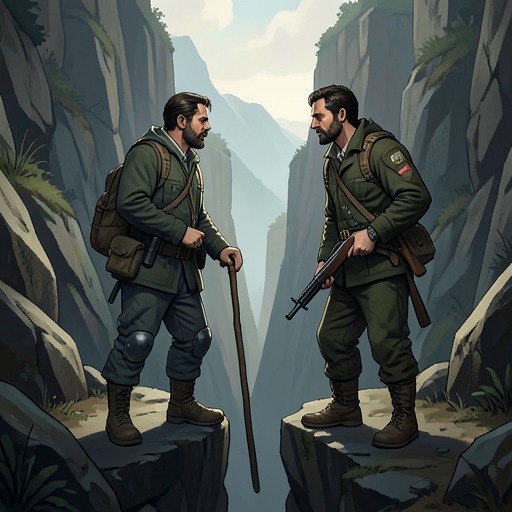
Matt and Borka’s beast fight and the merger of their robber bands
Ronja, the Robber's DaughterMatt and Borka’s beast fight and the merger of their robber bands mark the conversion of a feud into a single, stronger alliance. Prompted by the sheriff’s escalating pursuit and Noddle-Pete’s warnings, the two rival chiefs submit leadership to a customary contest of strength; Matt wins, but preserves Borka’s status and his command over his own men. The result is not simply a change of chief: an old rivalry becomes a negotiated kinship, and the united band’s prospects are set against the danger posed by the sheriff.
Causes and Background
The fight answers a threat that the two bands’ separate existence has made increasingly difficult to ignore. The sheriff’s men have grown more active, and Matt recognizes that the authorities are pursuing him in particular after his men helped free Peller and two of Borka’s robbers from the sheriff’s dungeon. Noddle-Pete argues that one strong band could face the sheriff and his soldiers, whereas two rival groups waste their strength competing and fighting over plunder.
His warnings acquire urgency when Borka rides to Wolf’s Neck with news of an ambush on Robbers’ Walk. The soldiers have captured two of Borka’s men, and an arrow has badly wounded a third as he tried to escape. Borka comes to warn Matt in return for Matt’s recent rescue of Borka’s men. Their exchange makes cooperation more than a convenient proposal: each chief has already acted across the feud’s boundary, and the sheriff’s pressure now threatens both bands.
Matt’s first response is to speak of teaching the soldiers a lesson. Only afterward does he notice that he has said “we,” an unconscious shift from his own men to a shared cause. He proposes joining forces, though the suggestion disturbs him because it means making common cause with his hereditary enemy. Borka accepts the principle at once, but insists that the combined band needs one chief and presents himself as the obvious choice. Matt answers with laughter and a challenge, turning the question of alliance into a contest whose result both will have to recognize.
The Contest at Wolf’s Neck
The contest takes place on a cold, sunny morning below Wolf’s Neck, with frost on the ground. Matt’s robbers and Borka’s robbers gather with spears to form a ring around the two chiefs. Noddle-Pete watches from a nearby rocky outcrop, wrapped in a fur; despite his recent poor health, he is keen to see the confrontation that his advice has helped bring about.
A wild beasts’ match is governed not by the sheriff’s formal authority but by a local custom with its own strict limit. Almost any trick or hold is permitted, including biting, scratching, and kicking, but a kick between the legs is forbidden; committing that offense means immediate defeat. The rule makes the contest a rough test of strength and guile, yet also gives the assembled robbers a shared standard for judging its outcome.
When the signal is given, Matt and Borka rush at each other. The contest establishes Matt as the stronger contender, and, once it is over, he stands as chief. He is bloodied and his shirt has been reduced to rags, but both groups accept the result. The defeat is especially difficult for Borka, who is left badly shaken, yet the contest has settled leadership in a way the rival bands can recognize: the chief is chosen through their custom rather than imposed by the sheriff or agreed through another bout of argument.
Terms of the Merger
Matt’s victory does not mean that Borka is cast out or stripped of every distinction. Matt addresses him as a brother and declares that, from then on, they are brothers. He promises that Borka will retain a chieftain’s name and reputation and continue to lead his own men. At the same time, he states the new hierarchy plainly: Matt is the mightiest chief in the woods and mountains, and his word now carries greater authority than Borka’s.
This settlement joins the bands without making their former leader disappear. Borka keeps a recognized position and responsibility for his people, but the united group has one final authority. The arrangement turns the fight’s winner into the band’s chief while giving the defeated rival an honorable place within the new order—an outcome that answers Noddle-Pete’s call for unity without requiring the past rivalry to be denied.
Aftermath and Significance
That evening, Matt holds a feast in the stone hall for the robbers of Matt’s Fort, both his own men and Borka’s. As they sit together, Matt and Borka grow more companionable, alternately laughing and crying as they recall childhood exploits, including hunting rats together in an old pigsty. The robbers listen and laugh with them; what began as a public contest over who would command ends in a shared gathering where the two chiefs recover a personal connection older than their feud.
Ronia and Birk sit at the far end of the table, and their laughter rises above the robbers’ voices. Matt and Borka are glad to hear it: after a long period without either young person at Matt’s Fort, having them home has become part of the hall’s renewed happiness. Matt’s recollection of the contest therefore unfolds alongside a domestic reconciliation. The combined band is made stronger by a common chief, but its celebration also gives space to family ties and old friendship.
Matt acknowledges that Borka’s prospects may improve in the future: when the two older chiefs are gone, he expects Borka’s son to become chief, since Matt’s daughter does not want the role and her refusal is final. The remark leaves the present hierarchy intact while showing that the merger need not close off Borka’s family’s future. It also reflects the distinction between inherited expectation and personal choice: Matt once declared that Ronia would follow him as a robber chief, but now recognizes that she will not. Against the sheriff’s growing threat, the fight provides the robbers with unity; within Matt’s family, Ronia’s refusal remains something he must accept.