Ronia
Ronja, the Robber's DaughterRonia is the daughter of Matt and Lovis, but she refuses to let birth decide what kind of life she will lead. Raised in Matt’s Fort among robbers who expect her to become their chief, she discovers the wider world, learns how her father’s livelihood affects other people, and chooses both a different moral path and a chosen family with Birk. Her journey from the protected child who loves Matt to a daughter able to oppose and later reconcile with him makes her story one of growing judgment, attachment, and independence.
Identity and Early Life
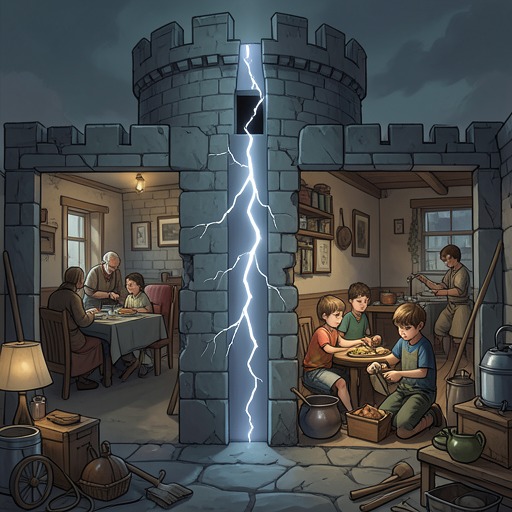
Matt’s exuberant announcement that he has a child is followed by his declaration that she is a robber’s daughter. Lovis has already chosen her name: Ronia. The name is hers by her mother’s decision, not a role bestowed by the robber band, and it accompanies a childhood spent inside the stone hall of Matt’s Fort.
At first, Ronia knows nothing of the longstanding feud between the Matt and Borka families or of her father’s status as a feared robber chieftain. To her, Matt is simply the bearded father who laughs, sings, and gives her porridge. She loves him without knowing what his work entails. The robbers’ hall is her first whole world: she plays beneath the long table with pebbles and pinecones Matt brings home, listens to the men sing, learns their ditties, and joins their dancing and leaps. Her delight in the songs and her father’s pride in her sit beside facts she cannot yet understand: the men’s evening revelry follows their raids on travelers.
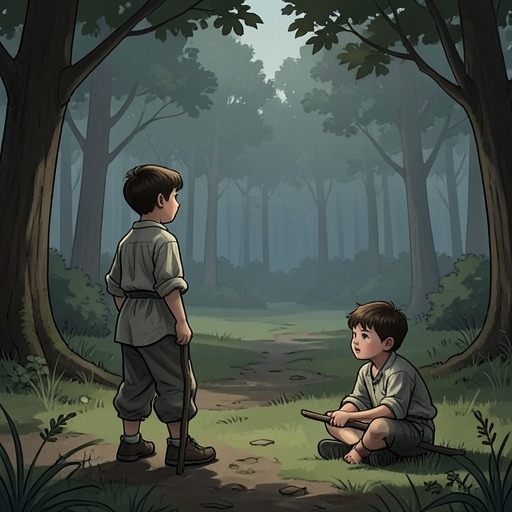
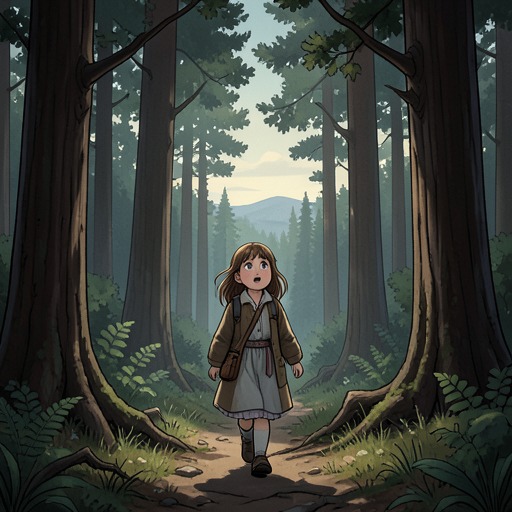
That sheltered knowledge begins to change when Ronia is allowed to explore. The forest, river, and lake make the world seem larger than Matt or his stronghold. She follows a path to the lake, where she splashes in the water, climbs mossy boulders and trees, and rests beneath the rustling branches. Her first explorations are not a flight from home; they are the discovery that home is not the whole world. At Hell’s Gap, the chasm splitting the fort, she sees a boy sitting on the other side. She already imagines that he will grow into a Matt, while she herself will grow into a Lovis—a child’s first way of sorting the people beyond her familiar household.
Moral Awakening and the Forest
Ronia’s understanding of her family changes when she realizes where the robbers’ goods come from. The possessions loaded onto their horses do not grow in the forest: her father has taken them from other people. Her question about whether those people become angry marks the point where the robbers’ cheerful stories can no longer hide their victims from her. When Matt tells her that generations of her family have been robber chiefs and that she, too, is to become one, she refuses. She will not accept the calling simply because it is inherited, nor does the anger of those robbed make the taking right.
Matt tries to preserve her admiration by arguing that he takes only from the rich. But the relationship between love and judgment cannot be resolved by his explanation. Later, when he moves to seize Birk, Ronia draws a firm distinction between stealing goods and taking people: Matt may rob money and possessions, she tells him, but if he robs people, she will no longer be his daughter. The threat is not a casual rebellion. It makes plain that her loyalty to her father has limits, and that his authority cannot require her to betray what she believes.
Her moral independence also appears in how she thinks about the forest. When she and Birk argue over fox cubs, Ronia calls them hers and claims the woods as hers. Birk answers that fox cubs belong to themselves and that the forest is shared by foxes, wolves, bears, elk, wild horses, birds, insects, and other creatures. Ronia says she already knows the living things there, but his rebuke exposes a difference between knowing the forest and claiming it. Her developing sense of belonging comes to rest less on ownership than on coexistence.
That understanding deepens in spring. Ronia and Birk sit among the returning birds and animals; newborn fox cubs play nearby, squirrels move through the trees, hares pass through the moss, and a pregnant snake rests in the sun. They leave one another undisturbed. Ronia accepts Birk’s point that she should not take a horse from the woods merely because she wants to ride, even as she holds on to her wish to ride. The scene makes room for both her desire and the animals’ claim to their own lives: spring, as she puts it, is for everyone.
Birk, Separation, and Exile
The boy Ronia first sees across Hell’s Gap becomes the person with whom she makes her closest chosen bond. In a winter crisis, Birk finds her trapped and returns with the ski she has lost. When he bends to help, she clings to him and begs him not to leave her again. He answers that he will keep a rope’s length away, then lies down beside her and works until she can free her leg. Their exchange turns practical rescue into a declaration of attachment: they may tease and quarrel, but each has become indispensable to the other.
Their sibling bond is tested when Matt threatens to keep Birk in a dungeon until the end of summer unless Borka leaves. Ronia believes Birk would not survive that confinement and understands that she may lose both her brother and her father. In the midst of that conflict, she runs and leaps across Hell’s Gap to Borka’s side. The leap reverses the division the chasm has represented since she first found the boy opposite her: Ronia crosses from Matt’s family and stronghold to stand with Birk, her father’s enemy’s son. Matt sees his daughter on the far side beside his enemy, a sight he cannot comprehend.
Ronia and Birk make their own refuge in Bear’s Cave. Their life there is difficult, but warmth, food, and freedom give it a value distinct from comfort in the fort. By the fire, with the river below and the waking forest around them, they call the place their kingdom because no one can drive them out. Their freedom is not mere escape from adults; it is a life built through mutual care and a sense that the wilderness belongs to many kinds of life, not to either robber family alone.
The refuge also brings hardship into view. As frost reaches the woods across the river, Birk jokes about the cold, while Ronia grows afraid of what winter will mean. She longs for the warmth of home but believes she cannot return to Matt’s Fort because she is no longer Matt’s child. Her fear shows the cost of the break: choosing Birk and her convictions has not erased her love for her family or her need for shelter. When Lovis visits, Ronia is glad to see her mother and loves her, yet wishes the visit had come at another time. After danger, she wants first to be alone with Birk, to recover and be glad that they are alive; still, she smiles at Lovis and answers her kindly. The moment holds both attachments without pretending that either cancels the other.
Reconciliation and Return
The decisive change comes when Matt finds Ronia and claims her as his child again. She weeps into his beard and asks whether she is truly his daughter; Matt answers that she has always been his child and tells her how much he has suffered in her absence. Yet reconciliation does not immediately settle where she will live. Matt asks her to come home, and Birk recognizes that this is the moment to say goodbye. Ronia knows that accepting the invitation would leave Birk alone in the winter forest, and she cannot abandon him.
She tells Birk that she would stay with him whether he liked it or not, because nothing can part them. He first worries that she would throw away her life for him, then agrees to go with her, even though living among Matt’s robbers would be difficult for him. The exchange makes her choice reciprocal rather than a simple sacrifice: she will not desert her brother, and he will not ask her to lose her life for his sake. Matt’s invitation allows father and daughter to reunite, but Ronia’s return depends on preserving the bond she has chosen.
As they leave Bear’s Cave, Ronia quietly tells Birk that they will move back the following spring. He answers that they will still be alive, and Matt walks ahead through the forest, singing as the wild horses scatter—except for the two familiar horses that remain. Their departure is therefore a return to family without a final surrender of the wilderness life that has become theirs. At the end, Ronia and Birk come back to Bear’s Cave in spring, now as its new inhabitants. The cave and surrounding woods are familiar, the river still runs below, and the season is new yet recurring. Ronia warns Birk that her spring yell is coming; the book ends not with her absorbed into the robber life, but with her voice, her chosen brother, and the wild home they mean to share.