Ronia and Birk meet and rescue each other at Hell’s Gap
Ronja, the Robber's DaughterRonia and Birk meet and rescue each other at Hell’s Gap in a scene that turns a children’s contest into a test of whether one child will risk herself for another. On the broken parapet of Matt’s Fort, the divided fortress that is home to opposing robber families, their impulsive leaps begin as an act of bravado and end with Birk stranded above the abyss. Ronia’s braided leather rope saves him; the rescue makes their rivalry personal, and gives the feud between their families a human complication that neither child can simply jump away from.
The encounter on the broken parapet
Ronia has come to the roof of Matt’s Fort, where a deep, unguarded chasm divides the fortress. She spots a boy sitting on the far side with his legs dangling above Hell’s Gap. She knows there are children elsewhere in the world, but has never encountered another child in her own stronghold and forest. From what her mother, Lovis, has told her, she imagines that she will grow up to be like Lovis, while this boy will become like her father, Matt. Before they have properly met, she is already reading him through the rival adult worlds around them.
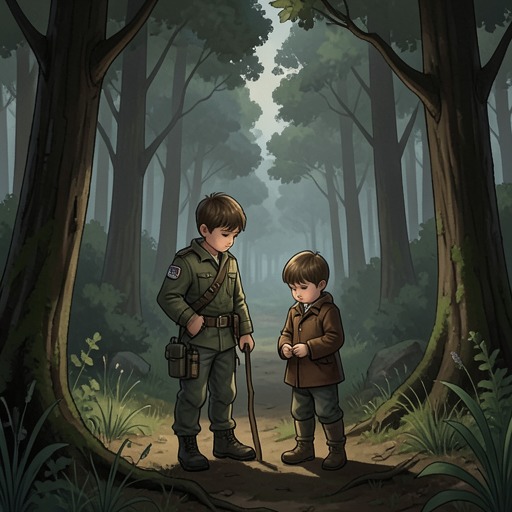
The boy identifies himself as Birk Borkason and says he lives there: his family moved in the previous night. He names those who came with him—Borka, Undis, and their twelve robbers. The discovery makes the gap between the children more than a physical divide. Ronia is the robber chief’s daughter on one side; Birk belongs to the newly arrived rival band on the other. When she thinks of Matt’s robbers returning and driving the Borka robbers out, family allegiance quickly gives her an imagined script for what should happen next.
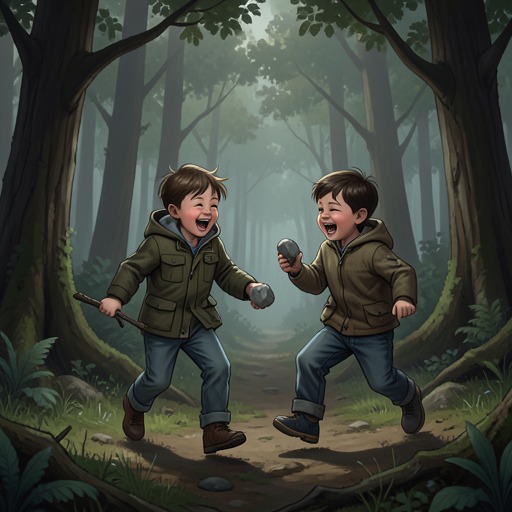
Birk interrupts that script by preparing to leap across the chasm. Ronia warns him off, but he jumps, lands on her side, and grins as he challenges her to follow. His daring makes the leap an immediate contest: Ronia cannot bear the implication that a Borka robber can do what a child of Matt’s Fort cannot. She jumps across herself, then leaps back before Birk can settle the score. What began as curiosity becomes an escalating back-and-forth, with neither child willing to yield the display of nerve.
The fall and the rescue
The contest turns abruptly when Birk slips on a loose stone at the edge of Hell’s Gap. Ronia hears him cry out and sees him disappear into the depths. Looking down, she finds him standing on a narrow projection from the shattered walls, with room only for his feet and no way to climb out unaided. The danger is no longer a dare: unless someone helps, Birk will fall when he can no longer hold on.
Ronia uses the braided leather rope she carries for climbing in the forest. She ties one end around herself, makes a loop at the other, and lowers it to Birk, telling him to put it around himself and wait for her signal before climbing. A block of stone torn from the parapet by the storm on the night she was born lies near the edge; Ronia lies flat behind it and uses it as an anchor point. When Birk climbs, the rope tightens around her waist and each tug hurts. She holds on until the strain suddenly vanishes and Birk is back above the chasm.
The rescue reverses the balance of the contest. Birk’s first leap established him as the bolder jumper; his fall leaves him dependent on Ronia’s judgment and strength. She has to control the timing of his climb, bear the pull of his weight, and keep herself from being dragged toward the edge. The rope links them across the gap more consequentially than their earlier jumps did: this time, one child’s survival depends on the other’s deliberate action.
Rivalry, gratitude, and separation
Once safe, Birk jokes that he will have to jump again to get home to Borka’s Keep. Ronia rejects the suggestion and orders him away, then punches him on the nose. Her hostility does not erase what she has done. Birk tells her not to do that again, thanks her for saving his life, and leaves her with the promise that they will see each other again. Ronia runs off without looking back. Their parting preserves the sharpness of the first meeting: rescue has not made them courteous or dissolved their competing loyalties, but it has made simple enmity harder to sustain.
The encounter also plants a contrast that becomes important to Ronia’s understanding of her family. Later, hearing the robbers discuss the goods they bring home, she realizes that they take those possessions from other people and asks whether the victims become angry. Matt describes robbery as a family calling, pointing to generations of robber chiefs and declaring that Ronia will become one too. She refuses, insisting that she will not take part even if the victims cry. The early leap across the chasm is not itself a declaration against robbery, but it already shows Ronia acting beyond the rival group labels adults have given the children: when Birk’s life is at stake, she uses her own skill and risks her own safety to help him.
Significance in the wider conflict
Hell’s Gap gives the episode its physical structure and its central reversal. The chasm separates the halves of Matt’s Fort, just as the children’s names and families place them on opposing sides of the feud. At first, they treat the divide as something to cross for the sake of competition. Birk’s fall exposes what that game conceals: the same gap is a lethal drop, and a person on the other side is not merely a rival to outdo but someone who may need help.
The rescue offers a small, concrete counterpoint to the robber families’ inherited hostility. Ronia does not abandon her anger at the Borka band, and Birk does not cease to belong to it; nevertheless, she saves him because he is in danger, not because his allegiance has changed. The episode therefore establishes their relationship through action rather than a sudden reconciliation. Its lasting promise is not that they will stop clashing, but that their connection has begun in a moment when Ronia chose another child’s life over the logic of the feud.