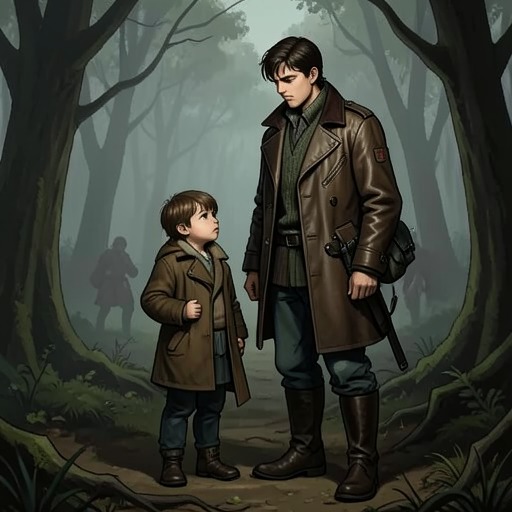
Ronia and Birk’s self-imposed exile in Bear’s Cave
Ronja, the Robber's DaughterRonia and Birk’s self-imposed exile in Bear’s Cave is both a break with their families’ robber life and a beginning of their own. Their departure follows Ronia’s refusal to inherit Matt’s calling and his later threat to rob people; when Birk decides he can no longer endure life in Borka’s Keep, Ronia chooses to leave Matt’s Fort as well. The cave gives them a place to live together on their own terms, but the forest’s shared life—not possession or conquest—shapes what that freedom means.
The Refusal Behind the Departure
Ronia’s decision grows from what she learns about the robbers’ work. She understands that the goods brought home on horses are not forest produce: Matt’s men have taken them from other people. When she asks whether those people become angry, Noddle-Pete confirms that they do. Matt then presents robbery as a family inheritance, telling Ronia that he follows a line of robber chiefs and expects her to become one too. Her answer is an emphatic refusal: she will not become a robber chief, even if the victims are angry and cry.
That refusal becomes sharper when Matt’s defense of his profession gives way to a threat against people close to Ronia. He insists that he can rob money and goods, but she tells him he cannot rob people without losing her as his daughter. Matt answers with insults and says he will have his father’s fortress cleaned out, leaving her free to decide whether she remains his daughter. His threat makes the conflict more than a disagreement about inheritance: Ronia has drawn an ethical boundary, and Matt’s authority cannot make her withdraw it.
Her objection rests on a view of the forest that is larger than human ownership. She once orders Birk to leave her fox cubs and get out of her woods; he answers that the foxes belong to themselves and live in a wood shared with wolves, bears, elk, wild horses, birds, and even small creatures such as snails, spiders, and ants. Ronia says she already knows the living things there, but the exchange supplies a principle that reaches beyond the quarrel: knowing and caring for the forest does not make its inhabitants her property. Later, when Noddle-Pete proposes a plan to unite the robber bands, Ronia gives her own alternative directly: the cleverest solution would be to stop robbing.
Birk’s Move and Ronia’s Choice
The immediate occasion for their shared departure is Birk’s decision to leave Borka’s Keep. Ronia has spent three days looking for him in the woods, unable to understand why he has not come. Spring surrounds her, but she cannot enjoy it without him; she remembers that the forest once seemed sufficient when she was alone, and recognizes that now she needs Birk to share it with her. When she finally hears him whistling among the fir trees, he arrives carrying a large bundle and says he is moving into the forest because he can no longer bear the nagging and hard words at the keep. Three days, he says, are enough.
Birk’s action gives Ronia a model for changing what has become unbearable. She thinks of Matt’s silence and understands that she, too, can leave. She announces that she will leave Matt’s Fort and asks Birk whether he will be waiting for her at the cave. His answer is yes. Her choice is therefore not a solitary flight: it is a commitment to a shared life, made with the assurance that Birk will be there when she arrives.
The Bear’s Cave is a place Ronia already knows, not a refuge chosen in ignorance. Matt had shown it to her; he had sometimes lived there as a boy in summer. Noddle-Pete had told him that bears slept there in winter, which gave the cave its name. It lies above the river between two rocky cliffs. Reaching it requires following a ledge that is narrow and perilous at first, though it broadens into a stone platform just outside the entrance. From that high ledge the morning can be watched rising over the mountains and forests, a view Ronia has already experienced and knows she can live beside. The destination links a childhood familiarity with a new independence: a place connected to Matt’s past becomes the setting for the life she chooses away from his authority.
Making a Home in the Forest
The cave does not make life easy. Ronia and Birk know their life there will be hard, and they have little reason to expect abundance: after their last mouthful, they say they will drink spring water and nothing else. Birk observes that it will not make them fat, though it will not kill them either. Their laughter does not erase the material limits; it shows that the limits no longer define their spirits. Once they are fed and warm by their fire, with morning bright around them, the weight of the days behind them recedes and they feel free.
The freedom they name is inseparable from the place and its living company. As they sit by the fire, the river rushes below, the forest wakes around them, cuckoos call, a woodpecker hammers nearby, and an elk family appears on the opposite bank. Ronia calls the cave and its surroundings their kingdom, but immediately distinguishes this realm from something another person can seize: nobody can take it away or drive them out. The claim is not a return to the idea that the forest belongs to her. In light of Birk’s earlier correction about the fox cubs, it reads as a description of refuge and self-direction, held within a forest they share with other life.
The difference between chosen companionship and ownership also appears in their dealings with animals. When Ronia and Birk watch newborn fox cubs, squirrels, hares, and a pregnant snake, they leave the animals undisturbed, and the snake leaves them undisturbed; spring, the narration observes, is for everyone. Ronia consequently questions whether she should take a horse away from the woods simply because she wants to ride. Their life in the cave is thus not a simple escape into possession of the wilderness. It asks them to find pleasure and sustenance while recognizing that wild animals have lives and claims of their own.
A Refuge, Not a Claim of Mastery
Their later experiences with horses make that distinction concrete. Ronia struggles to ride Villain, while Birk rides Savage successfully and shows off around her as she kneels to milk. When she tries again, Villain bolts through the woods, frightened and determined to throw her. Ronia holds on by gripping his mane and sides with her knees, terrified that she may fall and break her neck. Birk catches up on Savage and stops abruptly; Villain has to stop too, and Ronia is thrown halfway over his head before she clings on and gets back into her seat. The incident records both the excitement of their shared riding and the force of an animal whose will cannot simply be assumed away.
Lia’s milk makes the limits of their dependence even clearer. When the mare eventually gives only a few drops and makes it plain she has had enough, Ronia takes Lia’s head in her hands, thanks her for the days she has given them milk, and reminds her that the milk belongs to her next foal. Birk thanks Lia too. They remain with her as she follows them a little way through the summer night, then returns to her herd. They see her afterward and hear her whinny when they call, but she never leaves the herd to come to them: she is a wild horse, not a domestic animal. By contrast, Villain and Savage come eagerly to Ronia and Birk and enjoy racing with riders on their backs. The contrast prevents the refuge from becoming a story of nature’s easy submission to human desire: Lia’s return to the herd remains her choice.
The exile’s decisive change is that Ronia and Birk turn separation from family authority into a life they can affirm together. Their cave is high above a rushing river, difficult to reach, and spare enough that spring water may be all they have to drink; yet it is also where they can sit warm by a fire and watch the forest wake. The place offers no proof that hardship has vanished. Instead, the children discover that hardship is bearable when they have chosen one another, and that freedom in the woods carries obligations as well as pleasures: the world they call their kingdom is also home to lives that belong to themselves.