Rats
SanctuaryRats occupy the boundary between the Old Frenchman place’s material decay and Temple Drake’s frightened consciousness. They are first mentioned as creatures that might reach the sleeping child, then become the hidden occupants of the barn where Temple spends the night, and finally appear as a visible, aggressive animal that traps her in a loft. Their importance lies not in any human-like agency but in the way their movements make darkness, confinement, and uncertain observation physically legible.
Rats and the Ruined Household
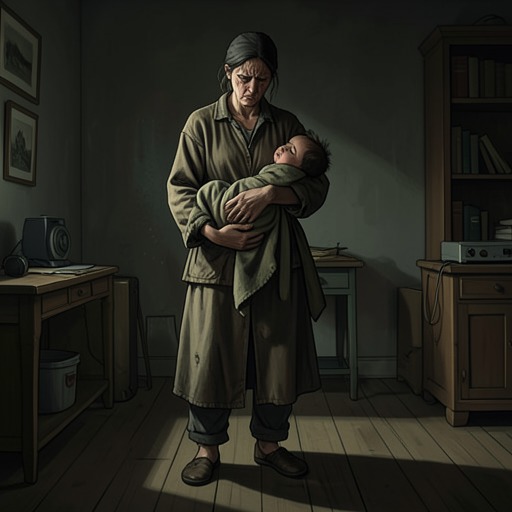
The first direct reference to Rats occurs in the kitchen of the Old Frenchman place. The woman keeps her sleeping child in a box behind the stove and explains that this is necessary because Rats might get to him. The box therefore has a double function: it is a crude cradle and a defensive enclosure, an improvised barrier against the creatures moving through the house. The child’s vulnerability is placed beside the household’s other conditions of neglect, where cooking, violence, poverty, and danger occupy the same domestic space.
The setting intensifies that association. The Old Frenchman place is a gutted plantation ruin, its former fields, gardens, and lawns returned to jungle while local people dismantle it for firewood or search for buried gold. The Rats belong to this abandoned material world, where human structures remain but no longer guarantee human control. Their presence is not an isolated nuisance; it is one expression of the ruin’s continuing life after the social order that built the house has decayed.
The Night in the Barn
When Temple Drake and the woman leave the house, they cross toward the barn in darkness and enter a room that smells of dusty grain. Something rushes nearby with a scurrying sound, and Temple steps on something that rolls beneath her foot. The woman identifies it as a rat, but Temple reacts as though the floor itself has become unsafe: she throws herself against the woman and tries to keep both feet off the ground. The animal is still unseen, yet the possibility of its movement is enough to overwhelm her.
The woman restrains Temple and tells her that cottonseed hulls are available for her to lie on. They kneel together against the wall, and Temple remains crouched beside her, shaking. The scene reverses ordinary ideas of shelter. The barn offers concealment from the men in the house, but its darkness also removes the distinctions between floor, bedding, and animal habitat. The cottonseed hulls provide a place to rest while simultaneously exposing Temple to the Rats that live among them.
In the morning, Temple wakes in a tight ball beneath narrow bars of sunlight. The rough planks, broken harness, ladder, and loft make the room a cramped agricultural enclosure rather than a secure refuge. She remembers the rat and rushes toward the door, clutching a fistful of cottonseed hulls. Her fear is immediately linked to the texture of the place: what seemed like bedding is also the medium through which the animal can approach her.
The Visible Attack
Temple’s escape turns the Rat from a suspected presence into an active antagonist. After she runs into the barn’s loft and falls through loose planks into a pile of hulls, she discovers the animal crouched on a cross beam less than twelve inches from her face. Its eyes suddenly glow, and it leaps toward her head as she springs backward. The encounter is presented through abrupt bodily reversals: running becomes falling, escape becomes enclosure, and the attempt to avoid the animal places Temple directly in its path.
She falls again among hulls and gnawed corn cobs. The Rat is now in the opposite corner, close enough for its eyes to glow and fade as it breathes. It stands erect against the wall with its forepaws curled to its chest and squeaks in small, plaintive gasps. The animal’s posture and sound do not make it human, but they give the confrontation a disturbing reciprocity: Temple watches it, it faces her, and both occupy the same tiny field of action. She backs away on hands and knees before rising and hammering at the door, watching it over her shoulder.
The scene’s terror develops by stages. At first there is only a dry tapping and an invisible movement; then there is the mistaken belief that the movement may be a person; finally the Rat is seen in full proximity, its eyes and leap converting dread into immediate physical danger. The delay before the reveal makes the creature part of the room’s entire sensory system. Darkness, loose boards, hulls, corn cobs, and the trapped body all become evidence of a threat that cannot be safely located until it is already almost upon Temple.
Rats, Human Threat, and Memory
The Rats also reshape Temple’s understanding of the men around her. After hearing movement in the barn, she initially thinks it is the blind old man, and later insists that a man had been watching her from the bushes. Her fear moves between animal and human forms because both are encountered through concealment, sound, and the inability to control who can see her. The Rat is therefore not a substitute for the human violence surrounding her, but its material counterpart: small, hidden, persistent, and capable of turning a supposedly protective space into a trap.
When Temple later recounts the night to Horace Benbow and Miss Reba Rivers, she says that she first thought the sounds were Rats but came to feel that people were present in the darkness. She remembers two Rats, one in each corner, and explains that the cottonseed hulls made every breath audible. Her account joins animal movement to the men’s drinking and watching on the porch, so that the remembered room contains two kinds of unseen presence. The Rats become part of the language through which Temple reconstructs danger, even as she describes the experience in a bright, chatty manner that Horace recognizes as carrying pride and vanity.
Narrative Significance
Rats mark the collapse of the boundary between domestic care and degradation at the Old Frenchman place. The woman protects her child from them by placing him in a box, while Temple must sleep in the same abandoned agricultural material where they live. The image links infancy, female vulnerability, and the ruin’s animal life without equating them: the child is defended, Temple is temporarily hidden, and the Rats remain free to move through the structures that humans have lost the power to govern.
Their recurrence also gives the novel a concrete form for fear that precedes explanation. A sound in darkness can be an animal, an old man, or one of the men Temple imagines approaching; the uncertainty is itself part of the danger. By forcing Temple to confront an animal at close range, the narrative makes her terror physical before she can narrate or interpret it. Later, her memory preserves the Rats alongside the human watchers, showing that the ruined house has transformed perception itself: what cannot be seen may still be felt, heard, and feared as present.