Carolina wren
SanctuaryThe Carolina wren appears in a moment of darkness and alarm, functioning both as a real bird in the landscape and as the immediate trigger that exposes Popeye’s physical fear. Its abrupt movement turns an ordinary passage through the trees into a scene of bodily panic, while Horace Benbow’s attempt to identify it supplies a fragile rational explanation for what has startled them.
Appearance and Naming
The bird is introduced through motion rather than a static description. A shadow-shaped form stoops rapidly toward Popeye and Horace Benbow, passing so close that it leaves a rush of air across their faces. Its wings are described as soundless and feathering, making the encounter feel less like an observed animal crossing the scene than like a sudden, nearly disembodied force.
Horace Benbow identifies the creature as an owl, then corrects or supplements that identification by recalling that the Carolina wren is called a “fishingbird.” The name emerges as something he had been unable to remember earlier, so the bird is linked not only to immediate perception but also to the recovery of a word from memory. The episode therefore gives the Carolina wren a double presence: it is an independently moving animal, yet it is also caught within the human effort to classify an unsettling sensation.
The Encounter in the Trees
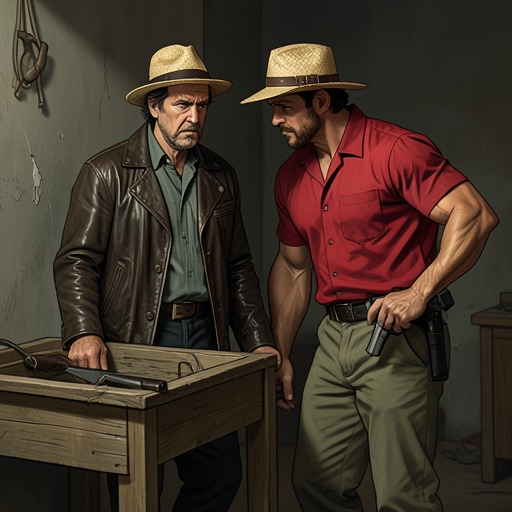
The bird’s appearance occurs as it and Popeye move through nearly dark woods. The surrounding landscape has already become threatening: Popeye’s gait has slowed, and he repeatedly jerks his hat from side to side while looking around with a cringing vigilance. The bird’s flight punctuates that mounting unease. Rather than merely decorating the setting, it changes the immediate relation between the two men by producing a physical shock.
Popeye springs against Horace Benbow and claws at his coat and pocket, hissing through his teeth like a cat. Horace Benbow responds by reducing the event to a familiar natural explanation, saying that it is only an owl and nothing more. His explanation does not erase the force of the encounter, however. The bird remains associated with a rush of air, sudden contact, and Popeye’s involuntary grasping, so that its small-scale movement briefly dominates the human scene.
Bodily Fear and Perception
The Carolina wren is important because it reveals Popeye through another character’s perception. Popeye’s fear is not first explained psychologically; it is registered as a bodily reaction. His body springs, his hand claws, and his breath or voice becomes a hiss. The bird thus acts as a stimulus that makes his vulnerability visible before any interpretation can contain it.
Horace Benbow’s perception also shifts under the pressure of the moment. After calming Popeye with the bird’s identification, he thinks that Popeye smells like the dark material that had run from Bovary’s mouth onto her bridal veil when her head was raised. The association makes the bird encounter part of a larger chain of disturbing sensory impressions. The Carolina wren itself is not described as corrupt or violent, but its passage opens onto an atmosphere in which living movement, bodily smell, death, and menace become difficult to separate.
Narrative Function and Significance
The bird’s narrative role depends on the tension between its ordinary identity and the extraordinary intensity of the response it provokes. Horace Benbow insists on a natural explanation, and the bird is ultimately named rather than treated as a supernatural apparition. Yet the scene preserves the disproportion between cause and effect: a small bird crosses the men’s path, while Popeye reacts with a convulsive fear that transfers itself to the space between the two travelers.
The Carolina wren also gives the landscape limited but decisive agency. The woods are not an inert background through which the men simply proceed; darkness, wings, air, and animal movement interrupt their intentions and redirect attention toward the body. A moment later, the house rises above the jagged trees as a stark square mass against the failing sky. The bird’s flight therefore serves as a threshold disturbance, carrying the men from open movement into the ominous presence of the house and sharpening the sense that the environment itself participates in the scene’s danger.