The Division’s Restructuring and Collective Demobilization
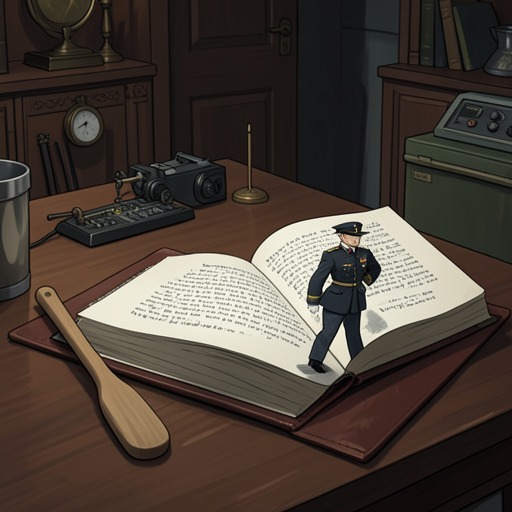
Serve the People!The Division’s Restructuring and Collective Demobilization is the dismantling of Wu Dawang’s army division under a pilot scheme to streamline and reorganize the armed forces. It turns a central administrative initiative into a sequence of transfers, cancelled promotions, collective departures, and a formal demobilization, while granting Wu Dawang an exceptional route into civilian work. The division’s collapse ends his military career and brings his affair with Liu Lian toward an apparent close, but the speed and ceremony of his departure obscure how much of his future has been decided above his head.
Origins and Personal Stakes
The restructuring arrives after Wu Dawang has built his ambitions around a written marriage pledge. Before marrying Zhao Ezi, he promised to earn commendations within a year, join the Party within two, and become an official within three; if he failed to move her to a city home where she could eat steamed rolls every day, he would accept lifelong service to her on her terms. Those targets make promotion more than a matter of rank: they are the promised means to a different household and a different life. His mother dies two weeks after the marriage, and the narrative describes him thereafter as no longer master of his destiny or marital happiness.
His early progress is slow and precarious. He works without winning a commendation, then struggles without being admitted to the Party. Letters from his wife and father-in-law asking how he is doing intensify his panic, and repeated failures leave him contemplating suicide. The vacant Catering Squad sergeant’s position eventually gives him a route forward: although its work is dirty and exhausting, it is known as a fast path through the ranks. After joining the squad as deputy sergeant, Wu Dawang rises to full sergeant, enters the Party, and receives commendations, but promotion to officialdom remains out of reach. The reorganization therefore strikes at the very ambition his career had seemed to bring within reach.
The Pilot and the Division’s Unmaking
At a Beijing seminar organized by the Central Military Commission, the Division Commander volunteers his formation for a pilot scheme intended to streamline and restructure the whole army. Its practical consequence is the division’s disbandment: within the larger military organization, the unit is to disappear. The measure changes not only the division’s institutional existence but also its personnel arrangements. Most companies are to be demobilized and a minority transferred, while promotions are temporarily cancelled. For Wu Dawang, the pause threatens to defeat his remaining hope of becoming an official through bureaucratic circumstance rather than any failure of effort.
The dismantling proceeds in visible stages. The First Regiment leaves in its entirety, followed by the First Battalion of the Second Regiment and then the Machine Gunners. Three battalions and four companies have already been sent to a remote frontier division five hundred miles away. A Corps Commander, the Division Commander’s immediate superior, arrives to take charge of restructuring and demobilization, confirming that the changes are being carried out at a level beyond the departing soldiers and their immediate officers.
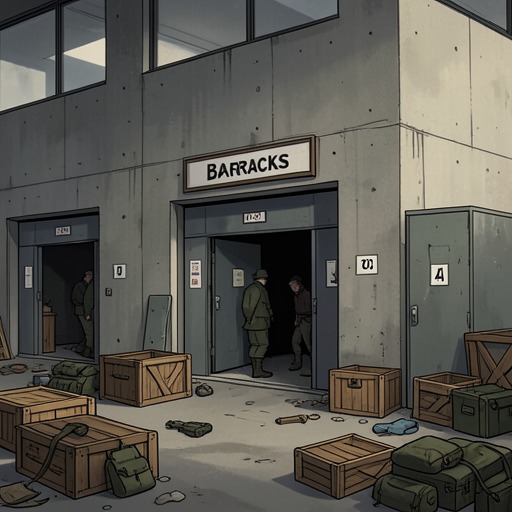
The Machine Gunners’ departure gives Wu Dawang a particular view of what collective demobilization means inside the barracks. By the time he visits, the company has been dispatched in five trucks marked “Liberation” to a special military transport station. The company had twice won collective commendations in the Civil War; now its vacated building is in disarray. Wooden drill guns lie on the floor, the vaulting horse has been damaged, and a notice board once used for discipline and official messages bears a hostile scrawl. The emptied premises and the unit’s departure set past collective honour against present uncertainty, making the reorganization tangible as the destruction of familiar routines and shared institutional identity.
Unequal Arrangements and Wu Dawang’s Departure
The same upheaval produces sharply different prospects for different people. The Division Commander’s wife has personally informed the officers that serious family problems require Wu Dawang to take three months of home leave. Because the majority of companies are being demobilized and the rest transferred, ordinary promotion channels are suspended. Yet the Division Commander leaves instructions that an exception be made for Wu Dawang: a job is to be arranged for him in a city in his native province, his family is to be moved there, and suitable work is to be found for his wife.
His relationship with Liu Lian is also caught up in the new personnel uncertainty. Turnover among the orderlies in the Division Commander’s household has been high; successive men have angered the Commander despite their efforts to act discreetly, and Liu Lian has tried to smooth matters over. Because the Commander’s temper is uncertain, Wu Dawang is told not to return to his former post or visit the house without pressing reason. The Political Instructor’s explanation eases Wu Dawang’s immediate fear that the affair has been discovered, but also separates him from Liu Lian as his departure approaches.
Within a week of his return to the army, Wu Dawang and his family are provided with work and housing in the city nearest their village. While his comrades remain anxious about their prospects, he needs only to complete and sign forms prepared by military bureaucrats. The abruptness makes the arrangement seem almost effortless from his point of view, even as the narrative emphasizes that the decision has been organized urgently and far above him. His individual security is thus produced within the same process that is scattering other soldiers and cancelling their chances for advancement.
After receiving formal notice of demobilization, Wu Dawang learns that his assigned position is at the East Is Red Tractor Factory, described by the Political Instructor as the city’s biggest factory. He is due to report two days later and must travel that night to settle in before beginning work. The Captain and Political Instructor help tie up his luggage, while the division supplies cardboard boxes, wooden crates, and rope. The logistics are meticulous, and the train is not due to leave until 12:30 at night; in contrast to the scale of the institutional rupture, his own departure is managed as a precise sequence of packing, transport, and reporting instructions.
Ceremony, Contradiction, and Aftermath
Before Wu Dawang leaves, his company holds a lavish supper and farewell meeting. Around a hundred uniformed soldiers remain in the mess after dinner, seated on small stools while songs are sung and quotations from Mao Zedong are recited. The Political Instructor announces Wu Dawang’s special early discharge for factory work, and the assembled company responds with silent astonishment. The Head of Management, who has come in person, then announces that Wu Dawang is receiving the Third Order of Merit and is the division’s sole Exemplary Servant of the People.
The award is publicly explained through Wu Dawang’s study of Mao Zedong’s collected works, his supposed moral character, and his success in putting theory into practice. His city job is presented as a consequence of serving the people wholeheartedly. Yet neither Wu Dawang nor his Captain nor the Political Instructor had known beforehand that the farewell meeting would end with this public recognition. The ceremony gives an official, ideological shape to an outcome already arranged through the Division Commander’s instructions and the reorganization’s personnel decisions. Its praise is not simply false or unsupported by the scene; its significance lies in the gap between the exemplary public account and the private, contingent machinery that has secured Wu Dawang’s placement.
As the company sees him off, soldiers shake his hand, congratulate him, and wish him well. Wu Dawang says little and continues greeting them; when the jeep engine starts, he is overcome and cries as his final journey out of the barracks begins. The farewell carries a double meaning: his own prospects have been settled, but the officers accompanying him remain exposed to the same dismantling. The Head of Management says he may be demobilized too and would have accepted a demotion if that could have kept him in the army; after Wu Dawang’s jeep departs, he goes to see the Division Commander and ask to stay.
The departure is presented as drawing to a satisfactory conclusion, but that appearance belongs to Wu Dawang’s immediate outcome, not to the division as a whole. His early discharge, city employment, family arrangements, and public honour form a secure exit from an organization that is losing its units and leaving its remaining personnel unsure of their future. At the same time, being forbidden to return to Liu Lian’s household and leaving the barracks bring their relationship toward an abrupt ending. The demobilization therefore resolves one part of Wu Dawang’s long pursuit of security while exposing the unequal, administratively managed costs of the division’s dissolution.