Musket Regiment
ShōgunThe Musket Regiment is Yabu’s covert attempt to make firearms decisive in a military order that prizes the sword and individual combat. Conceived as a disciplined body of gun-armed samurai rather than a collection of marksmen, it promises to alter both battlefield tactics and the balance of political power. Its creation is also a test of what happens when an inherited code of honor confronts a weapon many samurai regard as dishonorable.
Origins and Strategic Purpose
Yabu’s opportunity begins with the captured ship’s armament. Its cargo includes five hundred muskets, abundant powder and shot, twenty cannon, thousands of cannonballs, and crates of fire arrows. He orders the equipment landed, repacked, concealed under nets or sacking, and sent secretly to his castle at Mishima. The scale of the cache gives him resources beyond what he had imagined, but secrecy matters as much as possession: he intends to develop a new military method before rivals understand what he has acquired.
The firearms arrive in a society already familiar with guns but not organized around them. The Portuguese introduced muskets and gunpowder to Japan; Japanese manufacture followed quickly, yet guns remained a novelty, used for hunting as well as warfare, while bows were considered more accurate. Samurai combat was associated with individual, hand-to-hand encounters and the sword. Under Bushido, the Way of the Warrior, honor governed fighting, loyalty, fearlessness before death, and the preservation of one’s name. Guns therefore carry not only tactical potential but also a challenge to the values by which samurai judge a weapon and a warrior.
Yabu has privately considered that challenge for years. His proposed force is five hundred chosen samurai armed with muskets and trained to act as a unit, supporting twelve thousand conventional troops. Twenty cannon, operated by specially trained men and used according to a distinct plan, would add another unfamiliar element. He imagines firearms deciding the coming war, even as the question of whether their use violates Bushido remains unresolved. The regiment is thus conceived as a military innovation and a deliberate gamble with the moral language of the warrior class.
Organization and Secrecy
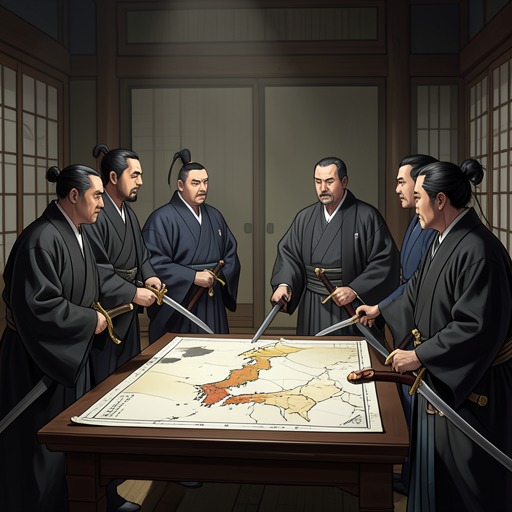
Yabu assigns Igurashi command of the five hundred gun-samurai and gives Omi responsibility for one of their hundreds. The officers arrange how Toranaga’s men might be incorporated when they arrive, but also plan how to neutralize those outsiders if they prove treacherous. Omi proposes a further secret reserve: three additional units of one hundred samurai, trained elsewhere on the peninsula. The reserve is meant to replace losses and guard against a betrayal by Toranaga, so the regiment’s organization reflects suspicion as well as preparation for battle.
The precautions extend into its command structure. Yabu intends to choose five assistant officers for Toranaga’s men, giving them the responsibility of killing their own commander if necessary. The code word for killing Toranaga and the other outsiders is Plum Tree. Igurashi is to select the men, each personally approved by Yabu; none is to know the full strategy. This arrangement places a hidden threat inside the proposed joint force. The regiment may serve an alliance, but its internal safeguards preserve Yabu’s ability to turn against that alliance.
The plan develops amid efforts to prepare Izu for a wider conflict. Igurashi reports that a purported war exercise can block every road and pass into the province within three days, while a mock pirate fleet could threaten unescorted ships to the north. Those preparations give the regiment a protected setting for training and make clear that its purpose is not limited to drill: control of roads and warning at sea could help preserve the force and its lord’s freedom of movement.
Training and Political Dispute
Yabu wants Blackthorne to teach his men to shoot and to explain how foreign armies wage war. He later asks Toranaga to remain for several days, approve the selection of two hundred and fifty men, and meet their commander. Toranaga declines because he must reach Yedo quickly. Yabu nevertheless presses ahead with the clandestine training plan, hoping to gain time for his five hundred guns and the additional reserve. He believes the new weapons could provide overwhelming power once, in the right battle, before opponents learn how to counter them.
The regiment’s purpose provokes a direct argument about what firearms will do to samurai society. Yabu accepts that guns are distasteful but treats their growing importance as an unavoidable feature of modern war; he maintains that the bravest samurai will still prevail. Naga objects that firearms have helped produce armies of conscripts and mercenaries, whose soldiers fight for pay and loot rather than duty to a lord. He fears that the same change will reach Japan and argues that guns should be outlawed. His objection is not simply to a weapon’s mechanics: it is that firearms may transform who fights, what motivates soldiers, and what military service means.
Demonstration and Significance
The regiment’s public test is a carefully staged mock battle. Jozen first notices that the musketeers carry no swords and expects them to be massacred. Instead, the attackers form five disciplined phalanxes, each four ranks deep with twenty-five men in each rank. Three formations advance while two remain in reserve. On command, the line halts at range and fires a coordinated salvo. The front rank kneels to reload while successive ranks shoot over it, sustaining the sequence of volleys. The ammunition is blank, but the spectacle makes the method’s intended effect legible: coordinated fire can inflict losses before sword-bearing defenders close the distance.
The exercise also stages the regiment’s vulnerability. When the defending samurai charge, the phalanxes break and run. They retreat hundreds of paces, then regroup on command in a V formation and resume firing. The defenders’ attack falters under the renewed salvos. The exercise ends with the participants sorting themselves out, collecting weapons, and acknowledging that the imagined battle would have been disastrous for the defenders. Jozen, who had begun by scornfully questioning the swordless samurai, congratulates Yabu once he understands the demonstration.
That result proves the value of formation, command, and repeated volleys within the exercise; it does not record a real battle or establish how the regiment would perform under live fire. Its significance lies partly in this distinction. The demonstration persuades observers by making a new method visible, while the story leaves its ultimate battlefield test ahead. The Musket Regiment embodies the possibility that military power may shift from individual prowess toward coordinated training—and that a weapon condemned as dishonorable may nevertheless become the means by which its users seek victory.