Alice Pagett's psychological deaf-mutism
ShrineAlice Pagett's psychological deaf-mutism is the condition that leaves her unable to hear or speak after an illness at age four. Doctors find no physical abnormality in her ears or throat, and the novel presents their explanation as psychosomatic: Alice's mind has prevented her body from hearing and speaking. Her eventual recovery gives that explanation new force, while the crowd reactions around her make the boundary between an individual condition and collective influence uncertain.
Onset and Medical Explanation
Molly Pagett traces Alice's condition to the usual childhood illness at four years old, whose unusual aftermath was deafness and muteness. The account establishes these as long-standing features of Alice's life, not a physical malformation identified in her ears or throat. When Father Hagan explains the condition to Gerry Fenn, he states that Alice cannot hear or speak; the scene makes the practical reality plain before the story turns to questions of cause.
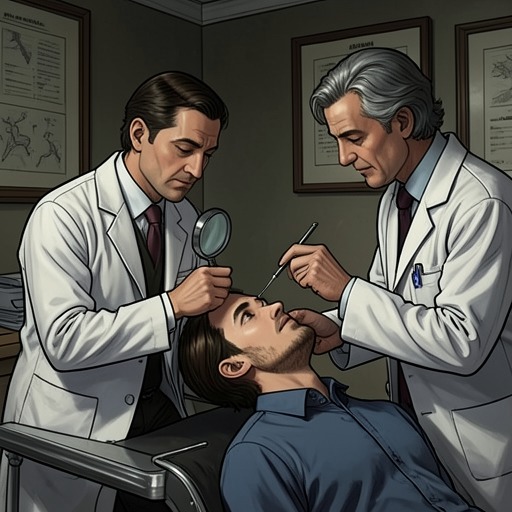
Specialists had told Alice's parents that they believed the condition to be psychosomatic. In Father Hagan's account, her mind had told her body that it could neither hear nor speak, and so she neither heard nor spoke. After her sudden recovery, he understands that her mind is now allowing those senses to function. The medical explanation therefore accommodates both the original disability and its reversal, but does not explain what caused the change.
Recovery and Unresolved Cause
After the events at the oak, Alice can hear and speak again. She is still undergoing tests at Sussex Hospital in Brighton when Father Hagan reflects on the change. For the medical profession, the recovery may be understood as a change of mind rather than a miracle; for Hagan, the unresolved question is what brought that change about. He considers the possibility of a profound emotional or spiritual experience, without establishing whether it was self-induced or divine.
The distinction matters to the story's treatment of Alice's condition. Its observable beginning and end are narrated alongside competing interpretations, rather than a confirmed account of the force behind them. Recovery does not retrospectively make the earlier deafness and muteness unreal: it sharpens the question of how a condition understood as psychological can alter so suddenly, and why.
From Individual Condition to Crowd Response
During the gathering at the oak, several children fall or break into tears as adults approach to collect them. Fenn connects their behavior to what he takes to be Alice's hypnotic state, imagining that it has somehow spread among them. This is his interpretation of the scene, not a medical finding that Alice caused the children's reactions. The episode nevertheless links her condition, in the reporter's mind, to a form of influence extending beyond her own body.
Fenn and Sue later discuss the gathering in terms of mass hysteria. He compares it with the collapse of children at the Mansfield Marching Band Festival, where more than three hundred children reportedly collapsed together. Sue adds that some investigating doctors disagreed with the conclusion of mass hysteria and considered organic poisoning; traces of malathion had been found in the soil, though Fenn observes that they were not considered sufficient to explain the event. Their exchange preserves uncertainty about how group symptoms arise instead of treating the psychological explanation as settled.
Recurrence at the Procession
At a later procession and open-air Mass, people in the congregation again begin to collapse. Sue sways, and Fenn steadies her; soon afterward he feels dizzy and sinks onto a bench with her. When Ben reaches out and brushes Fenn's cheek, the dizziness immediately passes. Fenn experiences the change as though his weakness has moved to the boy, but Ben shows no visible distress. The moment echoes the earlier suggestion that states can pass between people, while leaving the apparent transfer unexplained.
These episodes broaden the condition's narrative significance without proving that Alice's deaf-mutism itself spreads. The story distinguishes her medically described, individual condition from the crowd's observable reactions and from characters' explanations of those reactions. Its recurring pattern—symptoms appearing among groups, followed by uncertainty over psychological or environmental causes—keeps the psychosomatic account relevant but incomplete.