Alice Pagett's restored hearing and speech
ShrineAlice Pagett’s restored hearing and speech are the first concrete change that makes her encounter with the Lady in White appear miraculous: after years of deafness and muteness, she can hear and speak, yet neither medical examination nor her own account settles what caused the change. The restoration moves Alice from a child whose condition had been explained in clinical terms to the focus of an argument over mind, faith, and the meaning of cure.
The Condition and Its Sudden Reversal
Before the change, specialists had found no physical malformation in Alice’s ears or throat. They told her parents that they believed her condition was psychosomatic: her mind had persuaded her body that she could neither hear nor speak, and her body had followed that belief. The explanation made the disability real in its effects without locating a bodily defect that could account for it.
The reversal was abrupt. When Alice spoke during the encounter, Gerry Fenn and Father Hagan were startled into silence. She said that the Lady in White wanted them to return and had a message for everyone. Her voice was soft, but the gathered crowd heard her despite the surrounding hubbub. The moment therefore demonstrated more than speech: a sound that should have been lost in the commotion reached the people around her, and the men’s astonishment registered how completely the event overturned their expectations.
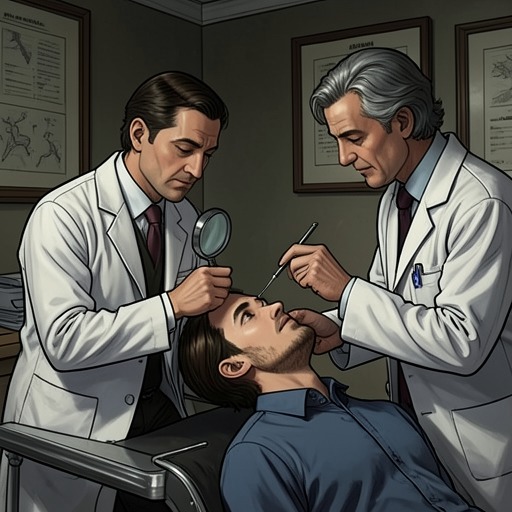
Father Hagan later had no doubt about the observable result: Alice was no longer deaf and mute. Her sudden ability both to speak and to hear made her an unusually compelling medical case, and her local doctor insisted that she be taken to Sussex Hospital in Brighton for examination by specialists. She stayed overnight, with further tests carried out through the following day. The restoration was thus not only a claim made by Alice or her family; it became the subject of direct clinical attention. Yet the earlier diagnosis offered no account of what had changed her mind, or why it had changed at that moment.
Alice’s Account of the Encounter
At the hospital, doctors questioned Alice about the woman she said she had seen. Although she had regained speech, she said little overall. When the questions turned to the Lady in White, however, her face became serene, and she repeated the same account she had given Father Hagan. She described the figure as white and shining, like the statue in St. Joseph’s Church but glowing and sparkling; when offered the word shimmering, Alice recognized it as a fitting description.
Alice said the woman had identified herself as the Immaculate Conception and had told her to come back. The promised message was not for Alice alone, but for everyone. She could not give a date or explain how she would know when to return; she said only that she would know. The uncertainty in these details contrasts with the firmness of her recollection that the encounter had happened. Asked why the woman had helped her, Alice treated the question of being cured as unfamiliar, then answered simply that the woman had done so. Her account supplies an agent and a purpose for the return visit, but not an explanation of the mechanism of recovery.
The questions also exposed a difference between Alice’s remembered condition and the meaning adults assigned to the event. She remembered that she had once been unable to speak or hear, but did not describe the restoration as an achievement of treatment. To her, the woman had helped her. When asked whether she liked the visitor, Alice answered with affection and wept. The medical staff were pleased by her recovery, yet her quiet serenity affected them beyond the practical relief of seeing her senses restored.
Medical Observation and Religious Interpretation
The examinations confirmed the importance of the change without resolving its cause. In clinical terms, Alice’s earlier condition had been attributed to her mind, and the return of hearing and speech could be described as a change of mind. That description did not explain what produced the change. Father Hagan could accept that the decisive event might lie in the psychological shift itself, but he remained uncertain whether it had been self-induced or divinely caused.
His uncertainty matters because the restoration is both clear and difficult to classify. The visible result is not in dispute: Alice can hear and speak. The unresolved question is whether an extraordinary change in a psychosomatic condition should be understood as a medical event, a spiritual experience, or both. Father Hagan also sees Alice’s recovery as potentially profound in emotional and spiritual terms. In his comparison with Lourdes, he distinguishes a cure recorded by medicine from the renewal of faith and inner peace that a pilgrimage may bring. His interpretation leaves room for a kind of significance that clinical tests cannot measure, without making the tests irrelevant.
Public Consequences and Significance
Alice’s return to speech immediately gives her account a public reach. The crowd hears her words, and news coverage soon turns the episode into a story of a possible miracle. Father Hagan is troubled by the comparison with Lourdes and fears the spectacle that attention could bring, even as he recognizes that the recovery has freed Alice from an affliction. The restored senses are therefore both a personal change and the basis for other people’s claims about what happened.
The episode does not present medical recognition and religious belief as simple opposites. The hospital can observe the restoration, while Alice’s account identifies the Lady in White as its helper; neither establishes the cause to everyone’s satisfaction. Father Hagan’s caution keeps that gap open. At the same time, Alice’s repeated testimony and evident serenity make her more than a case described by others: she speaks for herself about what she saw, what she was told, and how she feels. Her recovery consequently becomes the narrative’s first lasting test of how an event can be medically real while its meaning remains contested.