Battle of Sekigahara
ShōgunThe Battle of Sekigahara is the decisive military victory through which Toranaga defeats Ishido’s forces and clears the way to rule. Fought near Sekigahara on the North Road in fog and sleet, it turns the succession crisis into a new political order: Toranaga wins, forty thousand heads are taken, and Ishido is captured alive and condemned to a public death.
Causes and Strategic Stakes
Toranaga sees the coming battle not as a contest to defend his mountain strongholds, but as a chance to strike where Ishido is exposed. He considers fighting near Gifu, Ogaki, or Hashima, then settles on the mountains by Sekigahara, astride the Nakasendō. His principal advance is to use the North Road rather than the coastal Tokaidō. The choice shifts the conflict toward the capital’s approaches and away from the safer position behind his own mountains.
The campaign depends on keeping Ishido uncertain. Toranaga intends to pretend to change his plan repeatedly before committing to the northern route. Zataki, his brother, is to ride with him; Toranaga also expects Zataki to convince himself that Ishido has betrayed him to Kiyama. The alliance is therefore part of the battlefield design, but also a calculation about what each participant will believe.
Toranaga’s plan anticipates a further reversal among the Christian lords. He expects Kiyama to change sides during the battle and attack his hated rival Onoshi; that move would serve as the signal for Toranaga’s guns to advance and roll up the flanks of the opposing armies. This is presented as Toranaga’s forecast, not as a step-by-step account of everything that happens in the battle. The outcome confirms his victory, while the precise sequence of every anticipated maneuver remains unstated.
Forces and Methods
The battle’s strategic setting follows earlier experiments with firearms and disciplined formations. In a demonstration witnessed by Jozen, musketeers assemble in five phalanxes, each four ranks deep, with three formations forward and two in reserve. The front rank fires, kneels to reload, and gives way to the next ranks, which shoot over it. When a simulated charge forces the formation to retreat, the musketeers regroup in a V and resume their salvos. The exercise suggests how coordinated gunfire might overcome a conventional attack, though it is not itself the Battle of Sekigahara.
That innovation challenges the established honor code. Firearms had been regarded as dishonorable beside the sword and the individual combat associated with samurai warfare. Yabu, however, has imagined a trained unit of five hundred musketeers spearheading twelve thousand conventional troops, supported by cannon operated by specially trained crews. His secret theory treats guns not as a novelty but as a means to make a new strategy possible. Toranaga’s later expectation that his guns will advance during the battle belongs to the same transformation in military thinking; the evidence does not specify that Yabu’s proposed force or exact formation was deployed at Sekigahara.
Course and Outcome
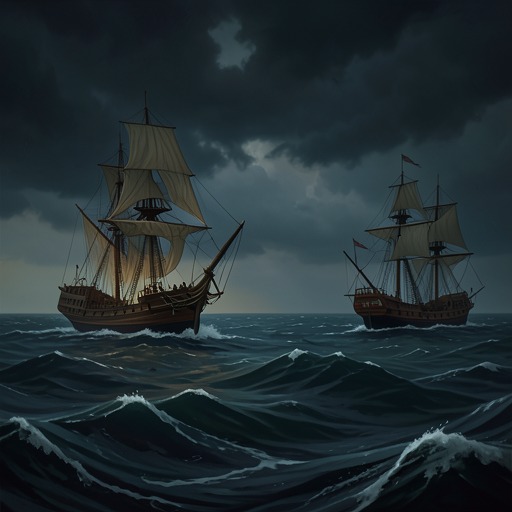
The armies clash at dawn on the twenty-first day of the tenth month, the Month without Gods. The battle takes place in the mountains near Sekigahara, across the North Road, under foul weather: first fog, then sleet. By late afternoon, Toranaga has won. The account moves from the weather-bound encounter to its terrible measure of victory: forty thousand heads are taken.
The battle’s result is both military and political. Toranaga had considered the North Road the route to Ishido’s exposed position, and his victory turns that strategic opening into a decisive defeat for his rival. The text does not narrate the fighting in detail or confirm every turn Toranaga had predicted; it gives the battle’s location, conditions, outcome, and the scale of the slaughter, leaving the larger reversal to be understood through his prior calculations.
Ishido’s Capture and the New Order
Three days after the battle, Ishido is captured alive. Toranaga recalls a prophecy as he sends him in chains to Osaka for public viewing. Rather than granting his defeated opponent an immediate death, he orders that Ishido be buried upright, his feet fixed in the earth and only his head left above ground, so passersby can saw at his neck with a bamboo saw. Ishido lingers for three days before dying at an advanced age. The victor’s treatment of him turns capture into a public spectacle and extends the defeat beyond the battlefield.
Toranaga’s private calculations reveal what victory is meant to secure. He imagines becoming president of a new Council of Regents, arranging Kiyama’s reward and succession, and placing Kasigi Omi in a position from which Kiyama can be checked. He also expects the Taikō’s Expulsion Edicts to be invoked against Christian political power, and plans to confine foreign trade and foreigners to a guarded part of Nagasaki. These are intentions and forecasts, not all outcomes shown as completed in the battle’s immediate aftermath. The victory nevertheless opens the path Toranaga has envisioned: he declares that it is his karma to become Shōgun.