Toranaga announces the Crimson Sky battle plan
ShōgunToranaga announces the Crimson Sky battle plan as both a military mobilization and a carefully staged political declaration. Before 150 officers, he presents a public account of the coming conflict that affirms loyalty to the Taikō’s testament and the Heir Yaemon while concealing the plan’s most consequential details. The speech steadies his forces, threatens his opponents, and disguises how much of the strategy is already in motion.
Military setting and the promise of firearms
The announcement comes amid a changing military order. Firearms had reached Japan through the Portuguese, but their use remained at odds with the samurai ideal of honorable individual combat with the sword. Guns were long regarded as a novelty; bows were considered more accurate, and firearms were associated with cowardice and dishonor. That tension gives Toranaga’s battle plan significance beyond its immediate objectives: disciplined gunfire challenges both battlefield practice and the values used to define a warrior.
Yabu had independently imagined a force built around five hundred musketeers trained to fight as a unit, supported by twenty cannon and conventional troops. His plan treated guns as weapons capable of deciding a new kind of war, despite the conflict with bushido. Toranaga’s forces, too, demonstrate the tactical possibilities of collective fire. In a mock engagement, five disciplined phalanxes—each four ranks deep and twenty-five men across—advance, halt on command, and fire in sequence. The front ranks kneel to reload while the ranks behind them shoot; after appearing to flee, the units regroup in a V formation and resume their salvos. The demonstration uses blank ammunition, but its spectators conclude that a real attack could have slaughtered two thousand defenders. The display supplies a practical basis for the confidence behind Toranaga’s public preparations.
The public announcement
Toranaga addresses the officers after a dispatch has been brought before them. He says that Ishido is likely to convene a new Council of Regents unlawfully, falsely impeach him, and declare war against him in violation of the law. Toranaga casts the conflict as a defense forced upon him by traitors, not a bid for expansion. He declares, “I uphold the Taikō’s testament and acknowledge my nephew Yaemon as Kwampaku and heir to the Taikō. I desire no other lands. I want no other honors.” He then argues that defending himself would also mean defending the Emperor against those who deceive him and seek to seize power.
The declaration is met with a roar of approval. Shouts of “Kasigi” and “Toranaga” echo through the fortress, ending the uncertainty that had unsettled the warriors. Toranaga’s speech does more than report a plan: it frames obedience as service to the established succession and makes readiness for war appear a defense of lawful order. Its public force rests on a sharp contrast between the restraint he professes and the military action he is preparing.
Orders, omissions, and the concealed timetable
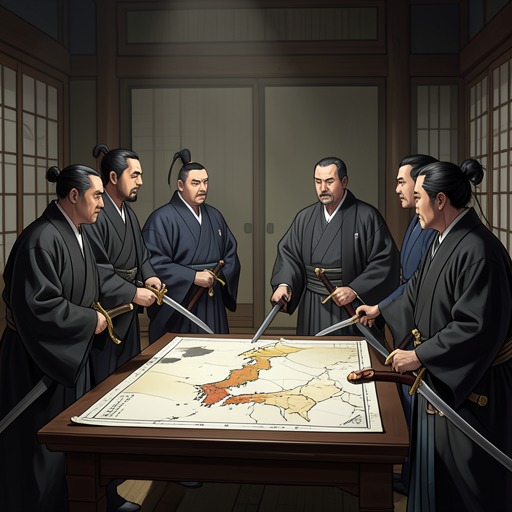
The operational instructions make the campaign concrete. The Attack Regiment is to embark for Yedo within five days, under Buntaro’s command, with Omi as second-in-command. Yabu is ordered to mobilize Izu and send six thousand men to the frontier passes, where they can guard the lines of communication against an attack from Ikawa Jikkyu. Toranaga predicts that Ishido will attack the Kwanto after the rains cease, giving his officers a stated sequence of danger and preparation.
That timetable is deliberately incomplete. Toranaga withholds the secret uprisings and the fact that the attack will use the northern, not the southern, coastal road. More strikingly, although he tells the officers that he will issue the code words “Crimson Sky” when the rains end, he and his senior commanders have already agreed to launch the attack during the rains, at once. Omi recognizes the risk of fighting through the Shinano Mountains in such conditions, while Yabu has expressed confidence that the guns can force a way through. The public plan thus serves as cover for a more urgent one: the officers hear a future campaign, while Toranaga protects the surprise of an early offensive.
Political purpose and consequences
Toranaga’s presentation is also a performance of strength designed to unsettle his enemy. Privately, he believes a war against the coalition aligned with Ishido, Ochiba, and the Heir Yaemon would end in the destruction of his armies and his line; he sees no clear chance except to wait and hope Ishido brings about his own downfall. Yet he intensifies his officers’ appetite for battle because it is essential to throw his enemy off balance. The apparent confidence of the announcement therefore masks strategic peril rather than disproving it.
He reinforces the promise of victory with a concrete reward: he grants Yabu the provinces of Suruga and Totomi, valued at three hundred thousand koku, in addition to Izu, confirming Yabu and his line as their overlords. The officers acclaim the grant, and Yabu is flushed with elation. The offer binds personal ambition to military service while helping make the coming campaign seem assured. In this scene, Crimson Sky is simultaneously a battle plan, a public justification, and a deception: Toranaga declares the war he expects to face, conceals the route and timing he intends to use, and uses the language of loyalty to prepare his followers for a struggle whose real risks he alone fully acknowledges.