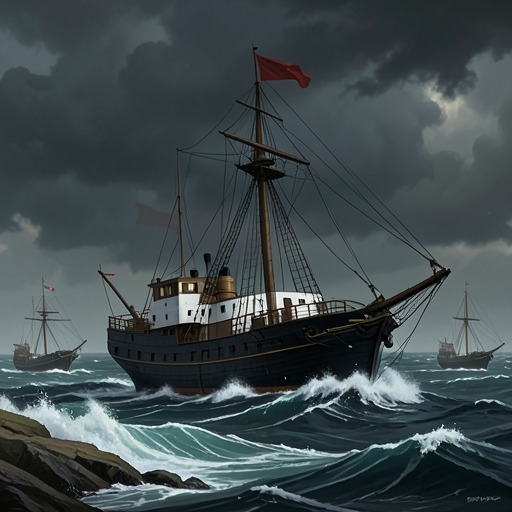
Blackthorne’s restored freedom
ShōgunJohn Blackthorne’s restored freedom is a change in political standing as much as a release from confinement: he is a free samurai with a ship and vassals, and can again pursue the naval ambitions that made him valuable to Toranaga. Yet freedom does not mean independence from the struggles around him. Yabu sees Blackthorne’s ship and skill as instruments for remaking the balance of power, while Blackthorne’s need to command a crew that includes Christians leaves his newly reopened future fraught with danger.
From Pilot to Political Asset
Before that freedom could carry meaning, Blackthorne’s authority rested on maritime knowledge. In a world where existing charts could not fix longitude, a pilot’s detailed navigation manual recorded practical knowledge accumulated at sea: courses between ports, depths and seabed, winds and currents, storm seasons, safe anchorages, and hazards such as shoals and reefs. Portugal and Spain guarded their knowledge of distant routes, while their Dutch and English rivals sought it. Such manuals could also contain copying errors or deliberate falsehoods; a pilot could not be certain of their accuracy until he had sailed the route himself. Blackthorne’s expertise therefore combined learning with the judgment earned by direct experience.
His position on a ship already gave that expertise a form of command. He understood that at sea the pilot set the course and ran the vessel, even when the captain-general and other men feared or hated him. That practical authority becomes consequential in Japan, where control of a ship and the ability to navigate are not merely personal skills but potential political leverage. The restored ship makes it possible for Blackthorne to put such authority back into practice.
Freedom Tested at Sea
During the voyage toward Anjiro, Rodrigues chose a faster but more exposed route. Rather than keep close to the coast, the galley turned west-southwest from Cape Ito toward a landfall two hundred miles away. Rodrigues explained that Toranaga had asked him to pilot the Japanese lord to Anjiro and back quickly; the short schedule and bonus mattered more than the safety of hugging the coast. The episode also establishes the limits of Japanese ocean-going experience as Rodrigues understood them: Japanese sailors were capable coastal seamen and fighters, but deep water frightened them, and the Taikō had required Portuguese pilots aboard the few ocean ships Japan possessed.
Blackthorne’s judgment later mattered in a different contest at sea. When the Santa Theresa bore down on the galley near the cliffs, he assessed the frigate’s speed against its need to tack in the wind, while the galley could maneuver more freely. With little room between a successful passage and disaster, he asserted command to Yabu and told the galley to hold its course. These earlier scenes make clear what restored freedom returns to him: not simply movement, but the capacity to make decisions under pressure and to direct a vessel whose survival depends on them.
That capacity exists alongside an unequal maritime threat. When the galley approached a European frigate, Blackthorne recognized the preparations that could already have been made aboard it: primed cannon, issued muskets, ready ammunition, armed men in the rigging, and stern guns trained toward the approaching vessel. His assessment reflects how quickly a ship in a hostile harbor can turn from transport into a fortified position. The freedom to sail, then, does not make Blackthorne invulnerable; it places him back within the dangers his seamanship must manage.
A Ship Becomes a Political Bargain
Yuriko interprets Toranaga’s plans as a larger exchange of ships, military resources, and alliances. She reasons that returning Blackthorne’s ship with its cannon and powder, together with two hundred committed men and substantial money, would enable an attack on the Portuguese Black Ship. In her view, taking that ship would deprive the Christian priests of a central source of wealth and trouble the Christian lords whose power they influence. This is presented as Yuriko’s reading of Toranaga’s intentions, not as proof that the proposed attack has already happened.
Yabu sees the same maritime potential in more immediate, personal terms. He tells Yuriko that ten ships commanded by ten men like Blackthorne could let him control the seas from his base to Kyushu. Even without that fleet, he imagines using Blackthorne to hurt Kiyama, Onoshi, and Harima, defeat Jikkyu, and secure Izu. He resents the prospect of Toranaga letting Blackthorne go, because in Yabu’s calculation the foreign pilot’s usefulness could protect and restore Yabu’s own power. The restored ship thus signifies both Blackthorne’s renewed agency and the competing claims others make upon it.
Yabu eventually turns that calculation into an offer. He tells Blackthorne that he does not fear or hate him and proposes that they pursue the Black Ship together: Blackthorne would lead the ship, while Yabu would lead the attack on land. Yabu offers to persuade Toranaga and says he could provide more men if needed. Blackthorne accepts the bargain. Yabu recognizes that the partnership can benefit them both despite Blackthorne’s continuing hatred of him; their agreement converts a fraught relationship into coordinated action without erasing their mistrust.
The Limits of Release
Blackthorne’s status as a samurai and free man does not resolve the danger posed by religious and political hostility. Yuriko recalls that an earlier attempt on his life had been funded by Kiyama’s chief steward, and warns that Blackthorne remains vulnerable outside the castle if he is careless. The threat matters in light of his changed position: freedom and a ship make him more capable of acting, but also more exposed as an enemy to those who oppose his influence.
The prospect of a crew makes that exposure a personal dilemma as well as a political one. Looking at the distant ship, Blackthorne thinks that he needs his existing crew aboard and will need more men, but anticipates that newcomers will resent the samurai and that most will be Catholic. He fears he may be killed among Catholics. Mariko’s warning includes herself, but Blackthorne rejects the idea that she is a danger to him. His freedom therefore restores the possibility of command without giving him an uncomplicated community in which to exercise it.
The state is defined by this tension between possession and dependence. Blackthorne can again imagine ships under his command and agrees to cooperate with Yabu, but the ship can also become the means by which rival lords pursue their own objectives. His freedom is neither an escape from Japanese power nor a return to his former life at sea. It is a new, conditional capacity: to steer, bargain, and build maritime force while remaining caught between Toranaga’s designs, Yabu’s ambitions, Christian opposition, and the divided loyalties of the crew he hopes to bring aboard.