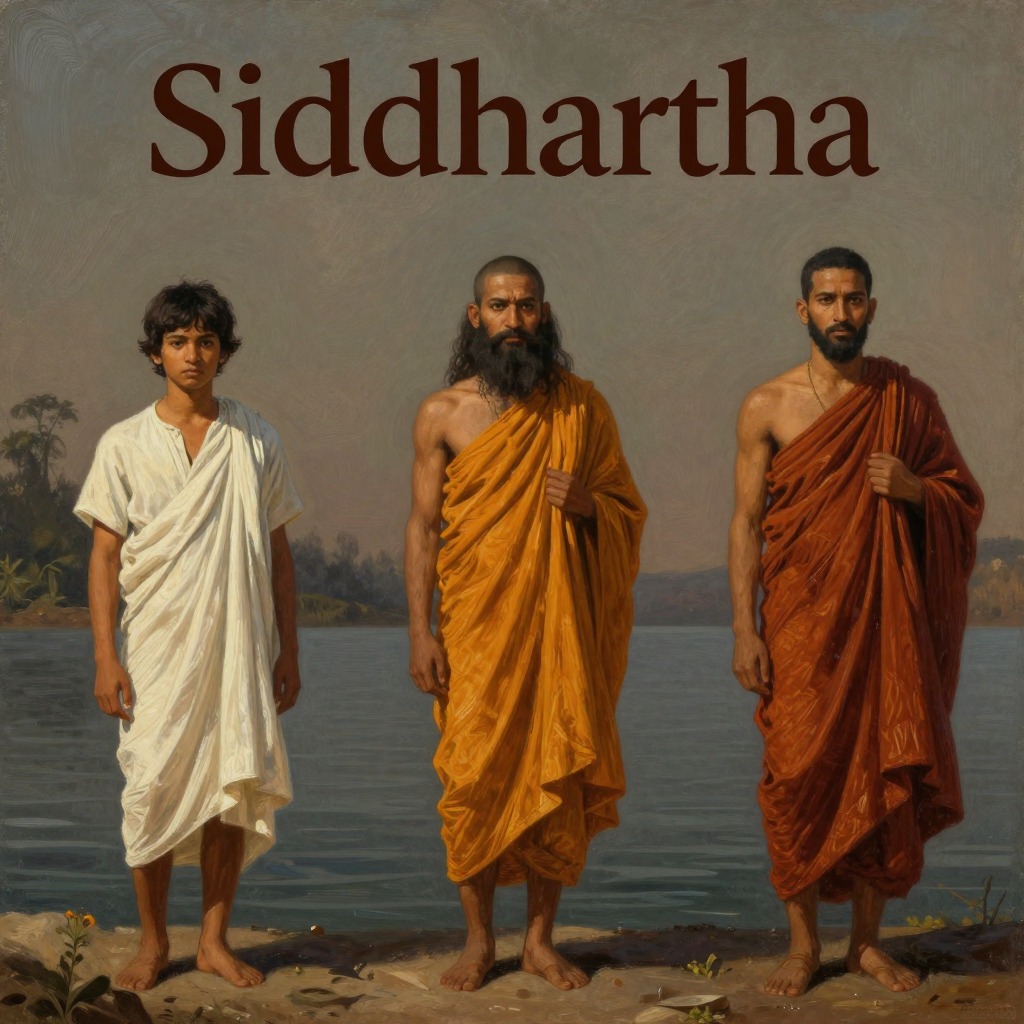
Siddhartha Joins the Samanas
SiddharthaSiddhartha Joins the Samanas is the pivotal event in which the young Brahman, driven by an unquenchable spiritual thirst and a growing conviction that his father's teachings and the sacred rituals cannot satisfy his soul, abandons his home, his family, and his privileged caste to become a wandering ascetic. This decision, taken after a night of silent vigil that breaks his father's will, sets in motion the first major transformation of his life: a three-year immersion in the most extreme practices of self-mortification and meditation, undertaken alongside his devoted friend Govinda. The period with the Samanas is not merely a phase of suffering but a rigorous education in the techniques of escaping the self, an education that ultimately reveals its own limitations and prepares Siddhartha for the next stage of his quest.
Causes and Background
Siddhartha's decision to join the Samanas is the culmination of a long-brewing discontent. Though he is loved by everyone—his father sees in him a future prince among Brahmans, his mother delights in his graceful movements, the young daughters of Brahmans are drawn to his luminous forehead and kingly eye, and Govinda loves him above all others—Siddhartha himself finds no joy in his heart. Dreams and restless thoughts flow into him from the river, the stars, the sun, and the verses of the Rig-Veda, and he nurses a growing suspicion that the love of his parents and his friend will never satisfy him. He has begun to feel that the wise Brahmans have already poured into him the best of their wisdom, yet his vessel is not full; the ablutions are only water, the sacrifices do not heal the spirit's thirst, and the gods themselves may be mere creations, subject to time and mortality. The true object of his search, the Atman—the indestructible, innermost self—remains elusive, and he realizes that none of his teachers, not even his venerable father, has succeeded in living the deepest knowledge rather than merely knowing it. When a group of Samanas passes through his town—three skinny, withered men with dusty and bloody shoulders, almost naked, scorched by the sun, surrounded by loneliness—Siddhartha sees in them a path beyond the rituals and books. He tells Govinda of his decision with an unstoppable resolve, like an arrow shot from a bow, and Govinda, reading the fear and submission in his friend's soul, turns pale like a dry banana-skin. Siddhartha then confronts his father in a silent vigil that lasts through the night: he stands motionless with folded arms while his father paces, looks through the window, and returns hour after hour, seeing him still standing in the moonlight, by the light of the stars, in the darkness. The father's heart fills with anger, unrest, anguish, and sadness, but at dawn, seeing Siddhartha trembling softly in his knees yet with eyes fixed on a distant spot, he realizes his son has already left him. He gives his blessing, and Siddhartha, after kissing his mother, leaves the still-quiet town at first light, joined by Govinda who has been crouching like a shadow near the last hut.
Life Among the Samanas: Practices and Experiences
On the evening of that same day, the two young men catch up with the ascetics and offer their companionship and obedience; they are accepted. Siddhartha immediately strips himself of his former identity: he gives his garments to a poor Brahman in the street, wears nothing but a loincloth and an earth-colored, unsown cloak, eats only once a day and never anything cooked, and undertakes extreme fasts—fifteen days, then twenty-eight days. His flesh wanes from his thighs and cheeks, feverish dreams flicker from his enlarged eyes, long nails grow on his parched fingers, and a dry, shaggy beard covers his chin. His glance turns icy when he encounters women, and his mouth twitches with contempt when he walks through a city of nicely dressed people. He sees merchants trading, princes hunting, mourners wailing, whores offering themselves, physicians helping the sick, priests determining the best day for seeding, lovers loving, mothers nursing—and all of it seems to him to stink of lies, to be merely concealed putrefaction. The world tastes bitter; life is torture. His single goal is to become empty: empty of thirst, empty of wishing, empty of dreams, empty of joy and sorrow, dead to himself, so that the ultimate part of his being, the great secret, may awake. To achieve this, he subjects himself to brutal physical ordeals: he silently exposes himself to the burning rays of the sun, glowing with pain and thirst, until he feels neither; he stands in the rainy season with water dripping from his hair over freezing shoulders and hips until he can no longer feel the cold; he cowers in thorny bushes, blood and pus dripping from festering wounds, until nothing stings or burns any more. He learns to breathe sparingly, to stop breathing, to calm the beat of his heart until it is almost silent. Instructed by the oldest of the Samanas, he practices self-denial and meditation according to new rules. He learns to project his soul into other forms: he becomes a heron flying over the bamboo forest, eating fish, feeling a heron's hunger, speaking its croak, dying its death; he slips into the body of a dead jackal lying on the sandy bank, bloating, stinking, decaying, being dismembered by hyenas and skinned by vultures, turning to dust and being blown across the fields. He kills his senses, kills his memory, slips out of his self into thousands of forms—animal, carrion, stone, wood, water—and awakens every time to find his old self again, the sun or moon shining, his self returned, turning in the cycle, feeling thirst, overcoming it, feeling new thirst.
The Limits of Asceticism: Siddhartha's Growing Doubt
Despite mastering these techniques, Siddhartha comes to a profound realization: though the ways of the Samanas lead away from the self, their end always leads back to the self. He flees from himself a thousand times, stays in nothingness, in the animal, in the stone, but the return is inevitable, and he finds himself once again in the sunshine or moonlight, once again Siddhartha, feeling the agony of the cycle. Govinda, who lives by his side as his shadow, believes they are progressing, that the circle is a spiral and they have ascended many levels. But Siddhartha grows increasingly skeptical. He tells Govinda that what he has learned among the Samanas—meditation, holding his breath, insensitivity to hunger and pain—he could have learned more quickly and by simpler means, even in a tavern among carters and gamblers. He argues that the Samana's escape from the self is no different in kind from the drunkard's numbing of the senses: both are short escapes from the agony of being a self, and the drunkard, when he returns from his delusion, finds everything unchanged, has not become wiser, has gathered no enlightenment. Siddhartha confesses that he finds only a short numbing of the senses in his exercises and meditations, and that he is just as far removed from wisdom and salvation as a child in the mother's womb. He observes that the oldest Samana, now about sixty years old, has not reached nirvana and will not reach it at seventy or eighty; he believes that out of all the Samanas, perhaps not a single one will find the path of paths. They find comfort, numbness, and feats to deceive others, but not the most important thing. His thirst for knowledge remains as strong as ever, and he begins to suspect that there is nothing to be learned—that knowledge has no worse enemy than the desire to know it, than learning itself. Govinda is deeply disturbed by these words, which stir up fear in his heart, and he recites a verse from an Upanishad about the blissfulness of meditating on Atman, but Siddhartha remains silent, thinking the words through to their end, and shakes his head.
The Turning Point: The Myth of Gotama and the Departure
After about three years among the Samanas, a rumor reaches them: a man named Gotama, the exalted one, the Buddha, has appeared. He is said to have overcome the suffering of the world in himself, halted the cycle of rebirths, and now wanders through the land teaching, surrounded by disciples, without possession, without home, without a wife, in the yellow cloak of an ascetic, with a cheerful brow, a man of bliss. Brahmans and princes bow down before him and become his students. The myth spreads like a plague, with believers reporting that he possesses the highest enlightenment, remembers his previous lives, has reached nirvana, and never returns into the cycle; his enemies say he is a vain seducer who lives in luxury and knows neither exercises nor self-castigation. The rumor reaches the Samanas in the forest slowly, drop by drop, laden with both hope and doubt. The oldest Samana dislikes the myth, having heard that Gotama was once an ascetic but turned back to luxury. Govinda, having met a Brahman's son who saw the Buddha with his own eyes, urges Siddhartha to go and hear the teachings. Siddhartha, though distrustful of teachings and learning, agrees, and they inform the oldest Samana of their decision. When the old man becomes angry and uses crude swearwords, Siddhartha demonstrates what he has learned: he positions himself in front of the Samana, captures his glance with his own, deprives him of his power, makes him mute, and subdues him under his own will. The old man becomes motionless, his will paralysed, and he performs gestures of blessing and speaks a stammering wish for a good journey. Govinda is astonished, saying that Siddhartha has learned more than he knew, and that he could soon learn to walk on water. But Siddhartha replies that he does not seek to walk on water, and that old Samanas may be content with such feats. They leave the Samanas and set out to find Gotama, carrying with them the hard-won knowledge of what asceticism can and cannot achieve.
Consequences and Aftermath
Siddhartha's three years with the Samanas leave an indelible mark on his character and equip him with three enduring abilities: thinking, waiting, and fasting. These skills will later serve him in the worldly life of a merchant and lover, and ultimately in his final transformation by the river. The period also crystallizes his fundamental insight that no teaching, no teacher, and no technique can convey the ultimate truth—a conviction that leads him to reject even the Buddha's teachings and to embark on his own solitary path. For Govinda, the Samana years are the foundation of a lifelong devotion to the Buddhist path; he will take refuge in Gotama's teachings immediately after hearing them, while Siddhartha will walk away. The friendship between the two men, though strained by their divergent choices, is never broken, and their shared experience of asceticism becomes a reference point for their final reunion decades later. The Samana period also plants the seeds of Siddhartha's later understanding: the techniques of self-denial, which he will eventually see as a form of flight from the self, prepare him for the deeper realization that the self cannot be overcome by force but must be understood and transcended through love and acceptance of the world as it is.