Siddhartha's Conversation with Gotama
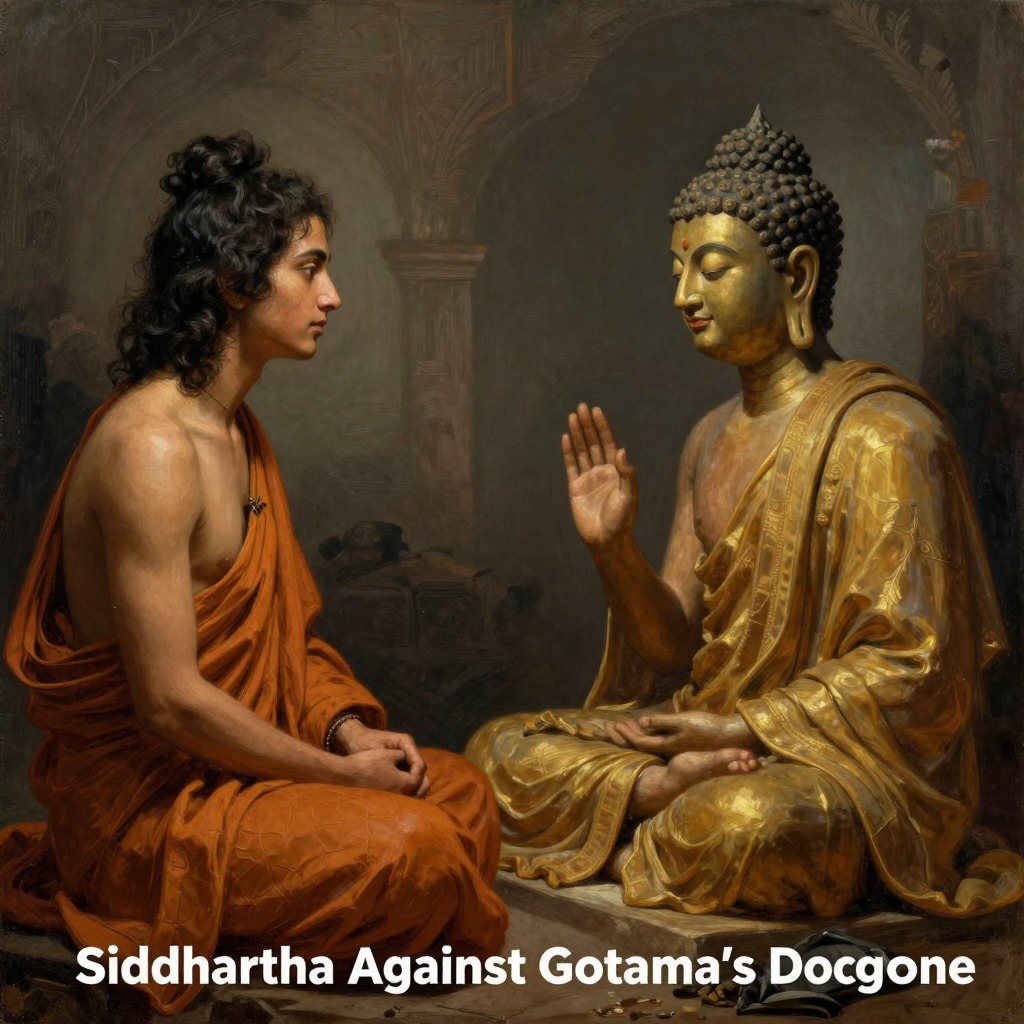
Siddhartha's Conversation with Gotama is the decisive intellectual and spiritual turning point of the novel, the moment when the young Brahman and former Samana, having heard the Buddha's celebrated sermon in the Jetavana grove, refuses to take refuge in the teachings and instead articulates his own radical critique of all doctrine. The encounter does not produce a conversion but a clarification: Siddhartha leaves not as a disciple but as a man who has seen a holy man face to face and understood that what is most essential cannot be taught.
Background and Setting
The conversation takes place in the Jetavana grove near Savathi, the pleasure garden given to Gotama and his community by the rich merchant Anathapindika. Siddhartha and his childhood friend Govinda have traveled from the forest of the Samanas to hear the Buddha, drawn by the myth that has spread through the land like a fragrant rumor of a perfected one who has overcome suffering and halted the cycle of rebirths. After hearing Gotama's teaching of the Four Noble Truths and the Eightfold Path, Govinda steps forward and takes refuge, becoming a monk. Siddhartha, however, remains apart. The next morning, after Govinda has left with the novices to receive the yellow robe, Siddhartha walks through the grove lost in thought and happens to meet Gotama himself. He greets the exalted one with respect, and the Buddha's glance is so full of kindness and calm that the young man summons his courage to ask for permission to speak.
Siddhartha's Objection: The Gap in the Chain
Siddhartha begins by acknowledging what he admires most in Gotama's teachings: their perfect clarity and irrefutable presentation of the world as an unbroken chain of causes and effects, a crystal-clear unity that has never before been seen. But then he names what he considers a fatal flaw. According to Gotama's own doctrine, this unity is broken in one place by a small gap through which something alien and new invades the world: the teaching of salvation, of overcoming the world. This breach, Siddhartha argues, makes the entire eternal and uniform law of the world void. He asks forgiveness for expressing this objection, but he does not withdraw it. Gotama listens quietly, unmoved, and then responds with a kind, polite, and clear voice. He warns Siddhartha against the thicket of opinions and arguing about words, explaining that his teachings are not an opinion meant to explain the world but a practical path whose goal is salvation from suffering. He does not refute the objection; he simply redirects the purpose of the teaching.
Siddhartha's Declaration of Independence
Siddhartha presses further, insisting that he has not doubted for a single moment that Gotama is the Buddha, that he has reached the highest goal through his own search, thoughts, meditation, and enlightenment—not by means of teachings. This is the core of Siddhartha's insight: nobody will obtain salvation by means of teachings. The teachings, however clear and venerable, cannot convey the mystery of what the exalted one experienced for himself in the hour of enlightenment, something he alone among hundreds of thousands has known. Therefore, Siddhartha declares, he will continue his travels—not to seek better teachings, for he knows there are none, but to depart from all teachings and all teachers and to reach his goal by himself or to die. He tells Gotama that if he were merely a disciple, he would fear that his self would only seem to be calmed and redeemed, while in truth it would live on and grow, having simply replaced the self with the teachings, with duty to the teacher, with love for him, and with the community of monks.
The Buddha's Response and the Farewell
Gotama looks at Siddhartha with half a smile, with unwavering openness and kindness, and bids him leave with a hardly noticeable gesture. He speaks two final sentences: "You are wise, oh Samana. You know how to talk wisely, my friend. Be aware of too much wisdom!" The Buddha turns away, and his glance and half-smile remain forever etched in Siddhartha's memory. Walking away, Siddhartha reflects that he has never before seen a person glance and smile, sit and walk in such a way—so free, so venerable, so concealed yet open, so childlike and mysterious. He realizes that only a person who has succeeded in reaching the innermost part of his self could glance and walk this way, and he resolves to seek that innermost part himself. He also recognizes that the Buddha has deprived him of his friend Govinda, who was his shadow and is now Gotama's shadow, but has given him something greater: Siddhartha himself.
Consequences and Significance
The conversation immediately triggers Siddhartha's awakening. As he leaves the grove, he feels that his past life has stayed behind and parted from him. He realizes he is no longer a youth but a man, and that one thing has left him like a snake sheds its old skin: the wish to have teachers and to listen to teachings. He has left even the highest and wisest teacher, the most holy one, because he could not accept his teachings. This leads directly to his discovery that he knows nothing about himself, that he has been fleeing from himself while searching for Atman, and to his decision to learn from himself, to be his own student. The encounter thus sets the entire second half of the novel in motion, sending Siddhartha into the world of the senses, into love with Kamala, into commerce with Kamaswami, into the despair of Sansara, and ultimately back to the river where he will finally learn to listen. The conversation also establishes the novel's central philosophical tension: the insufficiency of words and teachings to convey wisdom, a theme that Siddhartha will later articulate to Govinda in their final meeting, when he says that wisdom cannot be passed on and that the opposite of every truth is just as true.