Sterile insect technique
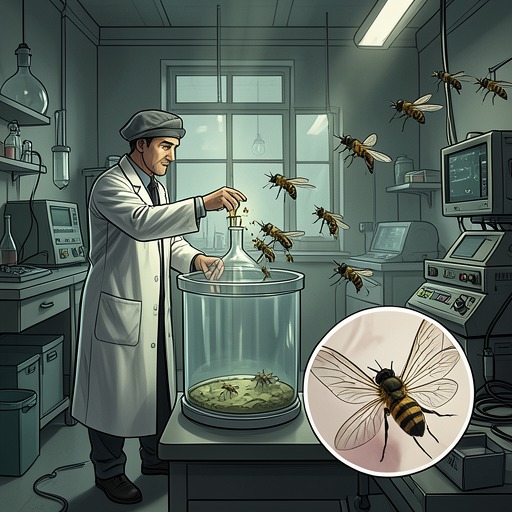
Silent SpringSterile insect technique is a biological method of pest control that turns a species’ reproductive drive against its own population. Instead of relying on lethal chemicals spread across landscapes, it releases sterilized males to compete for mates; when the method works under the right conditions, repeated releases leave the population producing infertile eggs. Rachel Carson presents the technique through the screw-worm fly campaign as an unusually dramatic demonstration that control need not mean poisoning the surrounding world.
Principle and Development
The method begins with a paradox: the released insects are alive and able to compete, but cannot father viable offspring. Edward Knipling, chief of the United States Department of Agriculture’s Entomology Research Branch, proposed that large numbers of sterilized males could outcompete normal wild males. Repeated releases, he reasoned, would eventually make the population’s eggs infertile and bring its numbers down. The technique thus sought to use an insect’s own life forces against it rather than simply attack it with a broadly lethal agent.
The proposal initially seemed remote from practical use. Earlier work had opened new avenues in the late 1920s, and by mid-century researchers had reported sterilizing at least a dozen insect species with X-rays or gamma rays. But these remained laboratory experiments, not operational pest-control programs. Around 1950, Knipling began a serious effort to apply insect sterilization against the screw-worm fly, a major livestock pest in the South. The method’s development therefore depended on moving from a biological theory and laboratory results to repeated, large-scale releases in the field.
The Curaçao Field Test
Scientists in the Agriculture Department had accumulated extensive knowledge of screw-worm biology in Texas. After preliminary trials on Florida islands, Knipling arranged a full-scale test on Curaçao, a Caribbean island at least 50 miles from the mainland. Its isolation made it possible to test whether repeated releases could suppress the local population without continual immigration undermining the result.
Beginning in August 1954, screw-worms reared and sterilized in an Agriculture Department laboratory in Florida were flown to the island and released from airplanes at a rate of about 400 per square mile each week. The response appeared quickly: the number of egg masses laid on experimental goats began to fall, and their fertility declined as well. Seven weeks after releases began, every observed egg was infertile. Soon researchers could find no egg masses at all, sterile or otherwise. The account treats the result as eradication on Curaçao, not merely a temporary reduction in the pest’s abundance.
Expansion in the United States
The Curaçao result encouraged a much larger undertaking against screw-worms in the United States. In Florida, an unexpected opportunity arose to begin while populations were reduced and confined to a small area. The program was considered complete after 17 months. Over that period, 3.5 billion artificially reared, sterilized flies were released across Florida and parts of Georgia and Alabama.
The campaign’s scale made the technique’s operational demands plain: success depended not on a single treatment but on producing and releasing enormous numbers of insects over time. The last known animal-wound infestation attributable to screw-worms occurred in February 1959. Several adult flies were caught in traps during the following weeks, but thereafter no trace of the screw-worm could be found. Carson presents this disappearance as the culmination of a sustained reproductive-control program.
Ecological and Narrative Significance
The technique enters Carson’s account amid growing doubts about the aerial distribution of lethal chemicals over millions of acres. Elsewhere, broad chemical campaigns are linked to losses that extend beyond their intended targets: spray can kill other plants and animals, residues can persist in wildlife, and damage can unsettle public confidence in agencies directing the programs. Against that record, sterile insect technique offers a vivid contrast. Its target is still deliberately driven toward disappearance, but the means described are specific to the target’s reproduction rather than a poison dispersed through shared habitat.
That contrast does not make the method an argument against every form of pest control. The screw-worm was treated as a serious threat to livestock, and the account gives the intervention a defined objective and a measurable ending: first infertile eggs, then no egg masses, and finally no detectable flies. The episodes on Curaçao and in the southeastern United States establish the method’s promise through concrete outcomes, while the enormous number of released insects shows the scale of organization required. In Carson’s broader argument, sterile insect technique is compelling because it suggests that understanding an organism’s biology can offer a route to control more discriminating than blanket chemical destruction.