After the fall of Troy and before Arthur’s reign
Britain After Troy
The poem opens by tracing [Britain](entity:location-recall-location-01048caf1f48)’s legendary origins to the fall of [Troy](entity:location-recall-location-troy-3f2543b3876b). Through a chain of migrations and new kingdoms, the story places Arthur’s Britain within a history shaped by war, wonder, prosperity, and reversal.
Arthur emerges as the finest of Britain’s kings, and his court becomes the setting for a new adventure. The inherited grandeur of Troy and Britain gives the [Christmas](entity:time-recall-time-christmas-a573265d0167) story a long historical horizon.
At Christmas in Arthur’s court
Christmas at Camelot
At [Camelot](entity:location-recall-location-a05ab1007f8b), [King Arthur](entity:character-recall-character-99c08ee3ed72) celebrates [Christmas](entity:time-recall-time-christmas-a573265d0167) with the [Knights of the Round Table](entity:organization-recall-organization-knights-of-the-r-626ae11ef2d8), their ladies, and a succession of feasts and festivities. [Guinevere](entity:character-recall-character-112dfc46734b) sits in the hall’s place of honor as the court enjoys music, games, and the customs of the season.
Arthur refuses to begin his feast until he has heard of some marvel or adventure. His youthful appetite for excitement leaves the court poised for an interruption.
Christmas Day at Camelot
The Green Knight Arrives
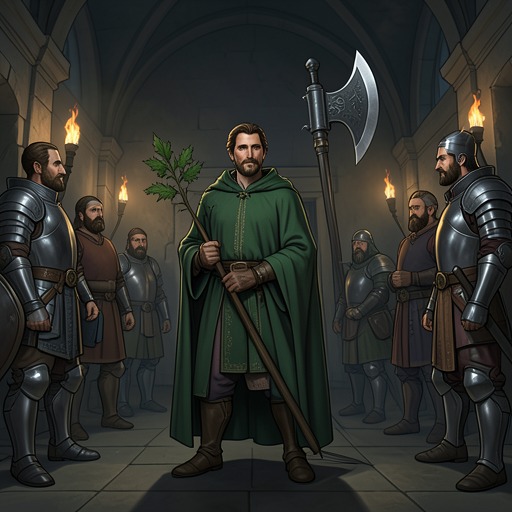
A towering stranger rides into the hall on a green horse, dressed in green from head to foot. He carries a holly branch and a massive axe, but no armor or shield, and demands to speak with the ruler of the company.
The stranger’s uncanny color and composure astonish the court. He declares that he has come in peace, yet challenges the knights to prove the courage and reputation for which Arthur’s court is renowned.
Immediately after the Green Knight’s arrival
The Beheading Challenge
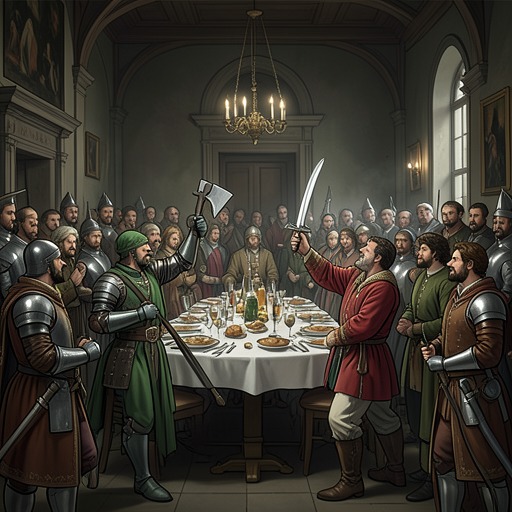
The [Green Knight](entity:character-recall-character-bbc4aa7c5068) proposes a [Christmas](entity:time-recall-time-christmas-a573265d0167) game: any knight may strike him once with his axe, provided that he may return the blow a year and a day later. He offers his axe as the prize and insists that the volunteer accept the future stroke in return.
The challenge turns the court’s reputation into a test with a deadly-looking cost. When no one answers, the Green Knight taunts the company for its silence, and Arthur steps forward to take up the weapon.
During the Christmas challenge
Gawain Takes Arthur’s Place
[Sir Gawain](entity:character-recall-character-sir-gawain-13e24e84ada8) asks [King Arthur](entity:character-recall-character-99c08ee3ed72) to let him accept the challenge instead. He argues that the risk is more fitting for a lesser knight than for the king, and the court agrees that he should take the game upon himself.
King Arthur hands him the axe and blesses him. Sir Gawain gives his name and promises to seek out the [Green Knight](entity:character-recall-character-bbc4aa7c5068) when the appointed time comes, wherever the stranger may be found.
Christmas Day, moments after Gawain accepts
The Green Knight Loses His Head
The [Green Knight](entity:character-recall-character-bbc4aa7c5068) bares his neck, and [Sir Gawain](entity:character-recall-character-sir-gawain-13e24e84ada8) delivers a powerful stroke that severs his head. The head rolls across the floor, but the headless stranger remains standing, retrieves it, and mounts his horse.
Holding his head aloft, the Green Knight reminds Sir Gawain to keep their agreement and meet him at the [Green Chapel](entity:location-recall-location-ffc80ed44168) on [New Year](entity:time-recall-time-new-year-3081c4d3858f)’s morning. He rides out of the hall, leaving the court to absorb the wonder of his survival.
Immediately after the Green Knight rides away
The Court Resumes Its Feast
[King Arthur](entity:character-recall-character-99c08ee3ed72) conceals his astonishment and encourages the court to return to its [Christmas](entity:time-recall-time-christmas-a573265d0167) revels. He tells [Guinevere](entity:character-recall-character-112dfc46734b) not to be troubled and orders the axe hung in the hall as a reminder of the extraordinary encounter.
[Sir Gawain](entity:character-recall-character-sir-gawain-13e24e84ada8) has accepted a promise that cannot be postponed indefinitely. The merriment resumes, but the appointed meeting shadows the year ahead.
From the Christmas challenge to Michaelmas the following year
The Year Turns
The poem follows the year through its seasons: [Lent](entity:time-recall-time-lent-829027562545), spring, summer, and the decline of autumn. The passing cycle transforms the apparent holiday game into an approaching obligation, and [Sir Gawain](entity:character-recall-character-sir-gawain-13e24e84ada8) increasingly remembers the meeting he must keep.
At All Hallows’ Day, the court holds a final celebration for him. Sir Gawain tells [King Arthur](entity:character-recall-character-99c08ee3ed72) that he must set out the next morning to find the [Green Knight](entity:character-recall-character-bbc4aa7c5068) and fulfill the agreement.
The morning after All Hallows’ Day
Gawain Arms for the Journey
[Sir Gawain](entity:character-recall-character-sir-gawain-13e24e84ada8) is dressed in richly worked armor and hears Mass before taking leave of the court. His shield bears a red-and-gold pentangle, a sign of truth and the virtues that the poem associates with him.
The poet explains its fivefold meaning through his senses, fingers, faith, devotion to the Virgin, and knightly virtues, including courtesy and compassion. The ideal represented by the design will soon be tested against the dangers of fear and self-preservation.
The morning after All Hallows’ Day
Gawain Leaves Camelot
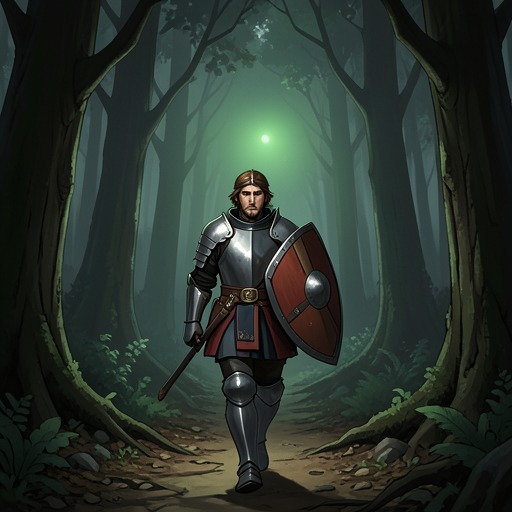
Mounted on [Gryngolet](entity:character-recall-character-8a822d40a462), [Sir Gawain](entity:character-recall-character-sir-gawain-13e24e84ada8) departs while the court mourns the danger ahead. He travels through [Logres](entity:location-recall-location-45c5b4a23606) and onward into the northern wilderness, asking everyone he meets whether they know of the [Green Chapel](entity:location-recall-location-ffc80ed44168) or its keeper.
No one can direct him to the place. His solitary search makes the promise at [Camelot](entity:location-recall-location-a05ab1007f8b) a physical ordeal as well as a moral one.
During the winter journey toward Christmas Eve
Hardship in the Wilderness
[Sir Gawain](entity:character-recall-character-sir-gawain-13e24e84ada8) crosses difficult country and faces hostile creatures, including wolves, bears, and other dangers. Winter brings bitter cold, frozen streams, and nights spent exposed among rocks, while his destination remains unknown.
His survival depends on endurance and faith. As [Christmas Eve](entity:time-recall-time-christmas-eve-4c9949af68dd) approaches, he prays to the Virgin for a place where he can hear Mass and keep the holy day.
Christmas Eve, after Sir Gawain’s prayer
The Castle Appears
After making his prayer, [Sir Gawain](entity:character-recall-character-sir-gawain-13e24e84ada8) sees a splendid castle set within a wooded park. Its strong walls, towers, and bright buildings seem an unlikely refuge in the wilderness, and he gives thanks for what he takes as an answer to his plea.
He rides to the gate and asks for lodging. The porter welcomes him, and the household receives him with ceremony and leads him inside.
Christmas Eve at Bertilak’s Castle
A Generous Welcome
The lord of the castle greets [Sir Gawain](entity:character-recall-character-sir-gawain-13e24e84ada8) warmly and offers him the household’s hospitality. Sir Gawain is provided with fine clothes, a comfortable chamber, and an elaborate meal, while the company learns that he is the celebrated knight from [King Arthur](entity:character-recall-character-99c08ee3ed72)’s court.
The lord and his people are pleased to host him, and they look forward to observing the courtesy for which he is famous. Their welcome gives Sir Gawain a brief refuge before the final stage of his quest.
Christmas Eve at Bertilak’s Castle
The Two Ladies
At the castle chapel, [Sir Gawain](entity:character-recall-character-sir-gawain-13e24e84ada8) meets the lord and two women: a beautiful young lady and an older woman whose appearance sharply contrasts with hers. He greets both according to their rank and courtesy, and the young lady soon becomes his companion in conversation.
The differences between the women invite the poem’s readers to look beyond appearance and courtly display. Their presence also establishes the intimate household in which Sir Gawain will soon face a test of his conduct.
At the feast after Christmas Day
The Exchange Agreement
After the [Christmas](entity:time-recall-time-christmas-a573265d0167) festivities, [Sir Gawain](entity:character-recall-character-sir-gawain-13e24e84ada8) explains that he must find the [Green Chapel](entity:location-recall-location-ffc80ed44168) before [New Year](entity:time-recall-time-new-year-3081c4d3858f). The lord assures him that it is nearby and invites him to remain at the castle until the appointed day.
The lord proposes a game to fill the remaining days: whatever he wins while hunting will be given to Sir Gawain, who must in turn hand over whatever he gains at the castle. Sir Gawain agrees, establishing the terms that will make his private encounters part of the same test as the hunts.
The first day of the exchange game
The First Deer Hunt
The lord rides out with his hunters and hounds, driving deer through the forest. The hunting party pursues its quarry with disciplined skill, while the lord observes the rules governing which animals may be taken.
At the castle, [Sir Gawain](entity:character-recall-character-sir-gawain-13e24e84ada8) rests in bed, unaware of the hunt’s progress. The poem begins to set the lord’s public pursuit of game beside the private encounter waiting for Sir Gawain indoors.
The first day of the exchange game, morning
The First Bedroom Visit
[Lady Bertilak](entity:character-recall-character-4a96b5d3ce5b) enters [Sir Gawain](entity:character-recall-character-sir-gawain-13e24e84ada8)’s chamber and teases him for pretending to sleep. She praises his reputation and presses him to respond to her attention, leaving him to balance her advances against his obligation to behave courteously.
Sir Gawain answers with modesty and wit, avoiding both a discourteous rebuff and a clear surrender to her flirtation. Before she leaves, she kisses him, making the first day’s test a contest between courtesy and fidelity to the lord who has welcomed him.
The evening of the first day
The First Exchange
The lord returns with the deer he has hunted and shows his household the results of the day. [Sir Gawain](entity:character-recall-character-sir-gawain-13e24e84ada8) praises the catch and, according to their agreement, gives the lord the kiss he received from [Lady Bertilak](entity:character-recall-character-4a96b5d3ce5b).
He does not reveal who gave him the kiss or how it was won. The lord accepts the exchange without pressing for an explanation, and their game continues into the next day.
The second day of the exchange game
The Second Boar Hunt
The lord and his hunters pursue a fierce boar through the forest. The animal wounds the hounds and resists its pursuers until the lord confronts and kills it at the water’s edge.
While this dangerous chase unfolds, [Sir Gawain](entity:character-recall-character-sir-gawain-13e24e84ada8) remains at the castle. The parallel hunts and bedroom encounters continue to measure different kinds of courage and control.
The second day of the exchange game, morning
The Second Bedroom Visit
[Lady Bertilak](entity:character-recall-character-4a96b5d3ce5b) returns to [Sir Gawain](entity:character-recall-character-sir-gawain-13e24e84ada8)’s chamber and challenges his reputation as a courtly lover. She argues that a knight renowned for courtesy should know how to respond to a lady’s advances, while Sir Gawain tries to preserve good manners without yielding to her desire.
He maintains that pressure cannot create a true gift, yet allows her to kiss him. Her skillful appeal to the rules of courtship makes the test more difficult than a simple choice between acceptance and refusal.
The evening of the second day
The Second Exchange
After returning from the boar hunt, the lord presents his quarry and receives a second kiss from [Sir Gawain](entity:character-recall-character-sir-gawain-13e24e84ada8). Sir Gawain again complies with the exchange agreement but does not disclose the source of his winnings.
The lord praises his guest’s honesty in giving up what he has received. The unspoken distinction between surrendering the kisses and concealing the circumstances will become decisive on the final day.
The third day of the exchange game
The Fox Hunt
The lord’s party follows a fox through the woods, where the animal repeatedly slips away from the hounds and hunters. The pursuit is prolonged and noisy, and the lord eventually joins the chase himself.
The fox’s evasions echo the complicated choices unfolding at the castle. As the hunt presses on, [Lady Bertilak](entity:character-recall-character-4a96b5d3ce5b) makes her most consequential visit to [Sir Gawain](entity:character-recall-character-sir-gawain-13e24e84ada8).
The third day of the exchange game, morning
The Green Girdle
[Lady Bertilak](entity:character-recall-character-4a96b5d3ce5b) tells [Sir Gawain](entity:character-recall-character-sir-gawain-13e24e84ada8) that a knight should understand the language of love, then asks him to accept a token from her. He refuses a valuable ring, but when she offers a green girdle, she claims that its wearer cannot be killed while it is kept close.
Aware that he is bound for a dangerous meeting, Sir Gawain accepts the girdle and agrees to keep it secret from her husband. Fear for his life has now led him to withhold something from the exchange game, despite the knightly honesty he has tried to preserve.
The evening of the third day
The Third Kiss Exchange
The lord returns with the fox and presents it as his winnings. [Sir Gawain](entity:character-recall-character-sir-gawain-13e24e84ada8) gives him three kisses, matching the three kisses he received from [Lady Bertilak](entity:character-recall-character-4a96b5d3ce5b), but keeps the green girdle concealed.
The two men appear to have completed their agreement, yet the exchange is incomplete in its most important respect. Sir Gawain’s silence about the girdle sets up the revelation at the [Green Chapel](entity:location-recall-location-ffc80ed44168).
New Year’s Eve
Confession Before the Journey
Before the day of his appointment, [Sir Gawain](entity:character-recall-character-sir-gawain-13e24e84ada8) goes to the castle chapel, confesses his sins to a priest, and receives absolution. He then rejoins the household’s festivities and behaves as though his conscience is clear.
He does not confess that he has accepted and hidden the green girdle. The contrast between religious absolution and concealed fear sharpens the moral problem he will face at the [Green Chapel](entity:location-recall-location-ffc80ed44168).
New Year’s morning
Gawain Leaves the Castle
[Sir Gawain](entity:character-recall-character-sir-gawain-13e24e84ada8) rises before dawn, arms himself, and secretly binds the green girdle around his body beneath his clothing. He thanks his hosts for their kindness and departs on [Gryngolet](entity:character-recall-character-8a822d40a462) with a guide who has promised to lead him toward the [Green Chapel](entity:location-recall-location-ffc80ed44168).
His armor declares the ideals he has long represented, while the concealed token records the fear that those ideals have not erased. The coming meeting will reveal how he responds when survival and integrity are placed in direct opposition.
New Year’s morning, near the Green Chapel
The Guide’s Warning
As they approach the appointed place, the guide warns [Sir Gawain](entity:character-recall-character-sir-gawain-13e24e84ada8) that the [Green Knight](entity:character-recall-character-bbc4aa7c5068) is exceptionally dangerous and that no one who meets him there is likely to survive. He offers to help Sir Gawain escape and promises to keep his flight secret.
Sir Gawain refuses. To flee would make him a coward and break the promise he made at [Camelot](entity:location-recall-location-a05ab1007f8b), so he chooses to continue even though he expects the encounter may cost him his life.
New Year’s morning, shortly before the meeting
The Chapel in the Valley
[Sir Gawain](entity:character-recall-character-sir-gawain-13e24e84ada8) rides into a bleak valley and finds no ordinary chapel. Instead, he sees a grass-covered mound with openings cut into its sides, which he recognizes as a strange and unsettling place for the [Green Knight](entity:character-recall-character-bbc4aa7c5068) to worship.
A grinding and sharpening sound comes from beyond the stream. Sir Gawain calls out that he has arrived to keep his appointment, and the Green Knight answers from above before appearing with a newly honed axe.
New Year’s morning at the Green Chapel
The First Axe Feint
The [Green Knight](entity:character-recall-character-bbc4aa7c5068) reminds [Sir Gawain](entity:character-recall-character-sir-gawain-13e24e84ada8) of their agreement and prepares to strike. As the axe descends for the first time, Sir Gawain flinches slightly, and the Green Knight stops short.
The Green Knight rebukes him for shrinking from a blow after having faced the challenge at [Camelot](entity:location-recall-location-a05ab1007f8b). Sir Gawain acknowledges the flinch but insists that he will not recoil again, setting his courage against the shame of appearing afraid.
Moments after the first feint
The Second Axe Feint
The [Green Knight](entity:character-recall-character-bbc4aa7c5068) raises the axe again and makes a second threatening stroke, but once more he checks the blow before it can harm [Sir Gawain](entity:character-recall-character-sir-gawain-13e24e84ada8). This time Sir Gawain stands still, demanding that the Green Knight finish what he began.
The repeated restraint turns the encounter into more than a test of physical bravery. Sir Gawain must face the anxiety of waiting for a blow whose meaning he does not yet understand.
Moments after the second feint
The Third Blow
On the third stroke, the [Green Knight](entity:character-recall-character-bbc4aa7c5068) cuts [Sir Gawain](entity:character-recall-character-sir-gawain-13e24e84ada8) lightly on the neck. Sir Gawain immediately springs away, draws his sword, and declares that the promised blow has been delivered and the agreement fulfilled.
The wound is slight, but it marks the difference between the Green Knight’s restraint and Sir Gawain’s failure to surrender the girdle. The encounter is about to become a judgment on the choices made during the three days at the castle.
Immediately after the third blow
The Green Knight Reveals the Test
The [Green Knight](entity:character-recall-character-bbc4aa7c5068) explains that the first two strokes were withheld because [Sir Gawain](entity:character-recall-character-sir-gawain-13e24e84ada8) faithfully gave him the two kisses he had received. The third stroke nicked him because he concealed the green girdle, which [Lady Bertilak](entity:character-recall-character-4a96b5d3ce5b) had given him as protection.
He identifies himself as the lord of the castle and says that the tests were arranged to examine Sir Gawain’s truthfulness. [Morgan le Fay](entity:character-recall-character-0d893db640ab) had devised the larger marvel to unsettle [Guinevere](entity:character-recall-character-112dfc46734b) and challenge the renown of [King Arthur](entity:character-recall-character-99c08ee3ed72)’s court.
At the Green Chapel, after the revelation
Gawain Confesses His Fault
[Sir Gawain](entity:character-recall-character-sir-gawain-13e24e84ada8) condemns his own cowardice and desire to preserve his life, recognizing that these had led him to conceal the girdle and compromise the truth. The [Green Knight](entity:character-recall-character-bbc4aa7c5068) accepts his remorse and treats the small wound as fitting penance rather than a reason for further punishment.
The Green Knight offers the girdle back as a token of the encounter and invites Sir Gawain to return to the castle. Sir Gawain accepts the token, but declines the invitation, choosing to carry the reminder of his weakness with him.
As Sir Gawain leaves the Green Chapel
The Girdle as Reminder
[Sir Gawain](entity:character-recall-character-sir-gawain-13e24e84ada8) says that he will keep the green girdle not for its beauty or value, but as a reminder of the fault that fear exposed in him. The encounter has shown that the virtues celebrated by the pentangle can be strained by the human instinct for self-preservation.
The [Green Knight](entity:character-recall-character-bbc4aa7c5068) and Sir Gawain part in reconciliation. Sir Gawain leaves with his wound and the girdle, carrying a more chastened understanding of the difference between an ideal and the person who tries to live by it.
After New Year, following the meeting at the Green Chapel
Gawain Returns to Camelot
[Sir Gawain](entity:character-recall-character-sir-gawain-13e24e84ada8) rides back to [Camelot](entity:location-recall-location-a05ab1007f8b) with his wound healed and the green girdle worn across his body. He tells [King Arthur](entity:character-recall-character-99c08ee3ed72) and the court what happened, including the exchanges at the castle, his concealment of the token, and the [Green Knight](entity:character-recall-character-bbc4aa7c5068)’s revelation.
He describes the girdle as a sign of his failure and says he will keep it to remember how readily fear led him away from truth. His confession turns a private test into a lesson for the court.
At Camelot, after Sir Gawain’s return
The Court Adopts the Girdle
[King Arthur](entity:character-recall-character-99c08ee3ed72) and the assembled court comfort [Sir Gawain](entity:character-recall-character-sir-gawain-13e24e84ada8) rather than condemning him. The [Knights of the Round Table](entity:organization-recall-organization-knights-of-the-r-626ae11ef2d8) decide to wear green girdles in solidarity with him, transforming his personal reminder of shame into a communal emblem.
The gesture honors Sir Gawain while leaving the moral tension intact: the court celebrates the sign even as he wears it to remember an imperfection. The poem closes by returning to the legendary history of [Britain](entity:location-recall-location-01048caf1f48) and commending its audience to Christ.