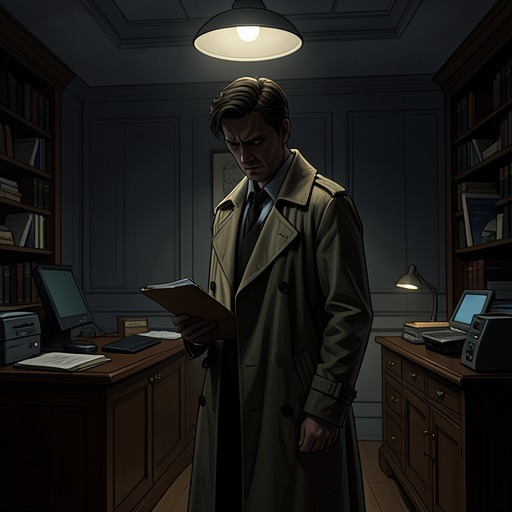
Duan Jeffries and Landon Chestnut
SpontaneousDuan Jeffries and Landon Chestnut are friends and investigative colleagues whose bond is shaped by a case Landon could not solve. When Duan learns that Edward Villarosas is about to marry the mother of a woman connected to his family, he turns to Landon, whose old frustration with the disappearances of Villarosas’s two wives becomes the impetus for reopening the investigation. Their relationship joins personal loyalty to professional trust: Landon brings specialized investigative experience, while Duan values his judgment but insists that suspicion must still be tested against evidence.
Shared Work and Complementary Skills
Landon works with Duan at the Peachtree Private Investigative Firm, where their colleagues include Antron Blair, Brett Newman, and Chevis Fleming. The investigators handle individual cases but rely on one another’s distinct strengths. Duan is analytical and skilled at finding leads in investigative reports; Landon is particularly effective at locating missing people. Chevis excels at interrogations, Brett is the firm’s technical expert, and Antron’s undercover abilities and contacts with the Federal Bureau of Investigation add another investigative resource. Their collaboration is not merely a roster of specialties: it gives Duan a way to assemble a team around a difficult case whose leads had previously gone cold.
The working relationship rests on an established friendship. When Duan calls the office after learning Villarosas’s name, Landon recognizes that the case reaches back to a failure he has not forgotten. He had been a detective when the second disappearance came to him; Duan had already left the police department and was building the firm. Landon’s response makes clear that the name remains charged for him, while Duan remembers the frustration and grief that accumulated through repeated dead ends. Landon’s eventual move from the force to Duan’s firm was partly connected to that unsuccessful investigation.
The Villarosas Cases and Their Unresolved Questions
Villarosas’s two wives disappeared five years apart. Investigators found no bodies and no firm connection between Villarosas and either disappearance. He maintained that both women had left him for other men, and his alibis were strong: at the times the women disappeared, he and his wives were not even in the same cities. The absence of a body, a provable motive, or evidence linking the cases had kept them classified as missing-person investigations rather than homicides. For Landon, the combination of two similar disappearances and a suspect he distrusted was troubling, but unease was not enough to make a case.
When Duan tells Landon that Villarosas is now the intended husband of a woman connected to Duan’s family, the old case acquires an immediate present-day consequence. Landon wonders whether the future bride knows that Villarosas had been suspected in connection with both former wives. He wants to revisit the files and determine whether the first investigation missed something. Duan agrees to help, and the team’s initial plan is methodical: contact a detective at the Atlanta Police Department about reopening the cases, trace Villarosas’s activities since leaving Atlanta, and speak with the missing women’s relatives and friends to learn whether either had been seen or heard from after disappearing. The possibility that both women left voluntarily remains open, even as the repeated pattern strains that explanation.
Evidence, Doubt, and Professional Trust
Duan does not present Landon’s instincts as proof. When Kimani Cannon challenges him about withholding the connection between Villarosas and the old cases, Duan explains that he first needed to confirm that they meant the same person. He emphasizes that two investigations had failed to produce evidence sufficient to implicate Villarosas, and that even the alibis placed the husbands and wives in different cities. Landon’s intuition may justify another look, but it cannot substitute for corroboration. That distinction reflects the way Duan and Landon’s partnership functions: the unresolved feeling that something was wrong keeps the inquiry alive, while evidence determines what can responsibly be concluded.
Kimani presses the same issue from a different professional perspective. She notes that the cases offered no apparent insurance motive if, as Villarosas claimed, the women were missing rather than dead, and asks whether the investigators have anything beyond gut instinct. Duan confirms the lack of an established motive. Kimani’s insistence on scientific data sharpens the contrast between her evidence-centered outlook and a detective’s intuition, without making intuition itself the answer. Their discussion also forces the investigation to keep alternative explanations in view. When photographs from a reunion are being sought to identify a man associated with Mandy Villarosas on the night she disappeared, Duan acknowledges that a third party could have been responsible. Villarosas remains under suspicion, not declared guilty.
Renewed Investigation and Emerging Corroboration
Landon’s work helps turn the old suspicions into lines of inquiry. He follows up with Villarosas’s former girlfriend, whose account supports a pattern of jealousy and threats from more than twenty years earlier. She said Villarosas accused her falsely of infidelity and threatened to get rid of her; she eventually left because she feared he might carry out those threats. A police report concerning another girlfriend likewise recorded a threat of bodily harm if she moved her belongings from their shared apartment, and noted that police recommended she seek a restraining order, which she did. These accounts do not by themselves establish what happened to the wives, but they give the investigators material to compare with the original case evidence.
The investigation also reaches Stein Green, whom Chevis visits in a Florida prison. Landon reports that, after Chevis’s intense questioning, Green admitted that Villarosas hired him to get rid of both wives because Villarosas believed they were unfaithful. The admission marks a decisive shift from a case sustained by suspicion, old records, and competing explanations toward a specific account of hired violence. It does not erase the earlier evidentiary failures; rather, it supplies the kind of direct investigative lead the original inquiries lacked. Landon’s persistence, Chevis’s interrogation, and Duan’s coordination show the firm working through its complementary roles to revisit what the police had been unable to resolve.
Personal Cost and Narrative Function
Landon’s dedication to the work is also linked to grief outside the Villarosas investigation. He is still mourning Simone, who died with two bridesmaids when a drunk driver ran a traffic light and their vehicles burst into flames, two days before Landon’s wedding. Nearly four years later, Duan finds him working late at the office and gently challenges how little life he seems to have beyond work. The detail gives Landon’s professional commitment a personal cost, while Duan’s concern shows that their friendship extends beyond assigning cases and exchanging information.
Their relationship therefore carries both the procedural and emotional weight of the investigation. Landon supplies the memory of an unsolved failure and the determination to return to it; Duan supplies leadership, analysis, and a continuing insistence on the presumption of innocence. As the evidence changes, their partnership shifts from revisiting an old frustration to helping expose a concrete allegation against Villarosas. The investigation’s progress depends not on one man’s certainty, but on colleagues who trust one another enough to pursue a suspicion while continuing to ask what can actually be proved.