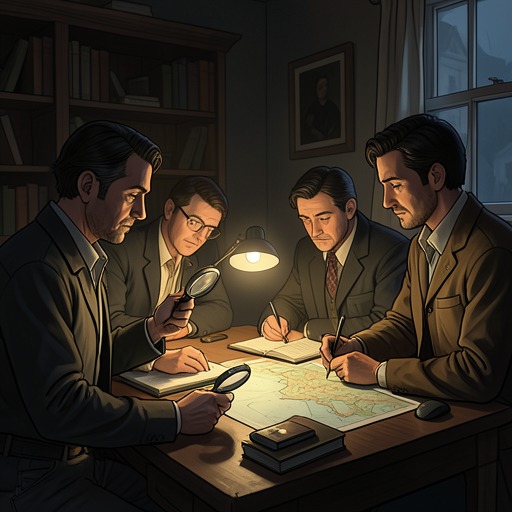
Peachtree Private Investigative Firm
SpontaneousPeachtree Private Investigative Firm is Duan Jeffries’s private-investigation business, founded after he left police work and staffed by colleagues whose paths had first converged in law enforcement. The firm’s response to the unresolved disappearances of Edward Villarosas’s two wives shows both its cooperative method and its central investigative tension: suspicion can justify renewed inquiry, but it is not proof of guilt.
Formation and Personnel
Duan had worked as a police officer in Atlanta before setting out on his own to establish a private-investigation business. Four men who would become his colleagues had started the police academy with him and, like him, eventually advanced to detective work. Landon Chestnut was the first to follow Duan into private investigation. Within another year, Brett Newman and Chevis Fleming joined them as partners, giving the new firm an experienced core drawn from the same professional background.
Antron Blair joined later, after a different turn in his career. He had followed his father into the FBI and was serving as an agent when an undercover sting operation nearly cost him his life. He then chose to join the firm. The resulting group of five brought together Duan, Landon, Brett, Chevis, and Antron, though their shared past did not mean they were always together: their caseload and the travel it required made it unusual for all five to be in one place at the same time.
Team and Investigative Work
The firm handles multiple cases while coordinating among its investigators. Landon usually comes into the office on Sunday afternoons, and his call to Duan becomes the first step in reviving an old investigation. When the Villarosas matter resurfaces, Landon alerts the others that Duan may need help. Duan accepts their assistance and lays out tasks for the inquiry, drawing on the group rather than treating the case as a solo investigation.
The plan spans several lines of research. The investigators intend to contact a detective they know at the Atlanta Police Department about reopening the two cases, examine what Villarosas had done since leaving Atlanta, and ask the missing women’s relatives and friends whether either had been seen or heard from after disappearing. The inquiry also pursues specific leads: investigators seek photographs from a reunion that might show a man reportedly connected to one wife, while Antron checks Villarosas’s cell-phone records from five years earlier, landline records from ten years earlier, and bank statements covering the same period. These measures put witness accounts alongside records that can be checked, rather than relying on one kind of information alone.
The Villarosas Investigation
The case had frustrated Landon when he was still a detective. Villarosas’s two wives had disappeared five years apart, and the earlier investigation had come to Landon after Duan had already left the department and begun building the firm. The detectives had found no bodies and no firm connection between Villarosas and either disappearance. Villarosas maintained that both women had left him for other men; his alibis were considered ironclad, and he and his wives were in different cities when they vanished. With no solid basis to move the cases from missing persons to homicide, the investigation had reached repeated dead ends.
That unresolved failure stayed with Landon and was one reason he eventually left the force to work with Duan. When Duan learns that Villarosas is now engaged to Kimani Cannon’s mother, he brings the old case back to the team. The personal urgency does not erase the evidentiary problem. Duan insists that a suspect remains innocent until proven guilty, and recognizes that previous detectives had not produced evidence sufficient to establish a crime. At the same time, the repeated pattern of two missing wives gives the investigators reason to test Villarosas’s explanation rather than accept it unexamined.
New inquiries add testimony to the older record. Landon speaks with Villarosas’s former girlfriend, who supports her account that, more than twenty years earlier, Villarosas had a jealous streak and threatened to get rid of her when he suspected infidelity. She says she eventually left because she feared he might act on those threats. Separately, Chevis persuades a prison warden to allow an interview with Stein Green. After questioning him, Chevis obtains Green’s admission that Villarosas hired him to get rid of both wives because he believed they had been unfaithful. The confession changes the investigation’s evidentiary position: the firm has moved beyond the original suspicion and alibi problem to a direct account of alleged involvement, though the narrative still distinguishes an investigative finding from a final legal judgment.
Collaboration and Significance
The firm’s work remains connected to public law enforcement. Its initial plan includes asking an Atlanta detective to reopen the cases, and a later visit to Kimani Cannon brings together a Shreveport police detective, an Atlanta police detective, and Landon. The investigators’ role is therefore not presented as a substitute for police authority, but as a means of revisiting leads, locating witnesses, and assembling information that can be shared with detectives.
Across the case, the firm’s method is defined by collaboration and verification: old suspicions prompt renewed work, but records, witness accounts, and Green’s admission supply distinct forms of support. The case also gives the organization a personal stake, since Duan wants to establish whether Villarosas killed his former wives before Kimani’s mother marries him. That motive drives the inquiry without resolving its legal standard. The firm’s significance lies in the work between those poles—taking an old, stalled case seriously again while keeping suspicion, evidence, and proof distinct.