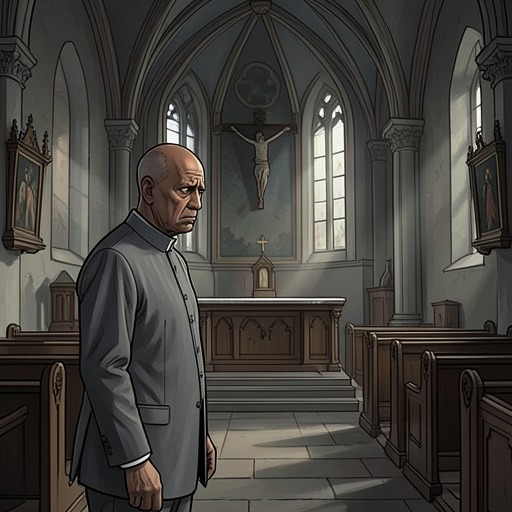
“Golden light”
StrangersThe golden light is the mysterious radiance that calls Brendan Cronin toward an unknown revelation and, eventually, toward Elko County, Nevada. It is not simply a comforting dream image: Brendan feels drawn back to it, wakes from an interrupted encounter still longing to continue, and treats its summons as a reason to return to a place from his past. Yet its significance remains unresolved. The light is never identified as divine or otherwise, and the moon’s later transformation into a blood-red beam makes the promise of illumination inseparable from fear.
The Dream and Its Interrupted Return
The golden light first takes shape as a place Brendan experiences in dreams, rather than as an object he can explain. When the hammering that has awakened Father Stefan Wycazik stops, Brendan is still caught in the dream’s emotional aftermath. He says, "I was so close," and wishes he had not been wakened. The unfinished encounter matters: Brendan is not reporting a completed vision or a message whose meaning he can recount. He remembers the pull of the experience and his proximity to something, but not what he was about to see.
When Father Stefan Wycazik asks what was calling him, Brendan struggles to describe it. He says he does not know what it was, only that it was calling him back. Asked where, he answers, "Back into the light. The golden light of the dream I told you about." The wording makes return central to the image: the light is somewhere he has apparently been in a dream and toward which he can be summoned again. But Brendan cannot establish who or what is calling, or why. His expectation that perhaps he will get a better look next time underlines how little the dream has disclosed even as it has made its attraction unmistakable.
The priests try to give the experience a religious interpretation. Father Stefan Wycazik wonders whether God could be calling Brendan back to His fold, but Brendan does not affirm that explanation. He describes the caller only as "something" and the light as the destination of an unknown summons. Father Michael Gerrano, less accustomed to the miraculous than the other priests, asks for an explanation and is ignored while they focus on Brendan. The exchange establishes both the religious setting in which the dream is discussed and the limits of what its witnesses can confidently say: the light invites theological speculation, but the scene supplies no confirmation that it is God.
A Summons to Elko County
The dream acquires a practical consequence when Brendan tells Father Stefan Wycazik that he wants to go to Nevada. In a later dream, he still sees only brilliant light, but suddenly knows that the place he must return to is Elko County, Nevada. He connects that destination to a question he cannot leave alone: the explanation for Emmy Halbourg’s cure and Winton Tolk’s resurrection. The light therefore does more than recur in private visions; it helps direct Brendan toward an investigation of extraordinary events in his own life and community.
Brendan’s use of the word return has a concrete history. He tells Father Stefan Wycazik that he was in the area during the summer before last, shortly before coming to St. Bernadette’s. This prior visit gives the summons a destination rooted in his biography, though the supplied account does not explain what happened to him there or how that earlier stay relates to the light. Brendan is certain of where he must go, not of what he will find. The dream furnishes direction without supplying an answer, turning the journey into a search for the explanation behind both the healings and the call itself.
The Moonlight as Counterimage
The January window apparition gives the golden light a disturbing visual counterpart. Looking at frost and moonlight, Brendan first whispers about the moon; the frost then melts from the edges of the glass until a perfect circle of ice remains. As he reaches toward it, he longs to be inside the light—not the light belonging to the frost, but the other, golden light of his dreams. The distinction is explicit. The dream’s radiance and the moon-image are connected in Brendan’s attention, but he does not experience them as identical.
The frost circle brightens, and a shaft of light falls across the bed. Its color changes from pale red through darker red to crimson and scarlet; in the glare, Brendan’s outstretched hand appears wet with blood. The scene brings him a sense of déjà vu and the conviction that he has once stood beneath a scarlet moon. He wants to understand how this red light relates to the dream’s golden one, but fear overwhelms his desire to pursue the vision. When he pulls his hand back, the colored light recedes until the circle reflects only the January moon. The image remains on the window after the extraordinary illumination has faded.
That contrast complicates the dream’s promise. The golden light draws Brendan toward revelation, while the moon’s red beam makes the act of looking feel dangerous. Both experiences are marked by attraction and uncertainty, but the window apparition ends not in understanding: Brendan switches on a lamp and finds himself shaken, facing a physical frost circle he cannot explain. The scene supplies no proof that the two lights share a source; it shows instead how strongly the moon-image awakens his desire to reach the golden radiance and how quickly that desire can become terror.
Meaning Without an Explanation
The phrase names an attraction before it names a meaning. Brendan can describe the light as brilliant and can say that it calls him back, but he cannot identify the caller. Nor does the apparent certainty of the Elko County destination settle the matter. Knowing where to go is not the same as knowing what the light is, what it wants, or whether its summons should be understood as religious, supernatural, or something else. The account preserves that gap between felt conviction and available explanation.
The light’s force lies partly in this incompletion. Brendan awakens from the dream regretting that he has been pulled away before he can see more; later, he accepts a location revealed in another dream as a reason to return to Nevada. At the window, he reaches toward an image he cannot touch, and then withdraws when the light turns scarlet. Across these moments, yearning and retreat alternate: the radiance promises access to an answer, but contact with its related imagery offers no secure interpretation. The golden light thus links Brendan’s private dream life to his search for the causes of healing and resurrection while keeping the central mystery open.