Brendan Cronin's crisis of faith
StrangersBrendan Cronin’s crisis of faith is not a passing doubt but a conflict tested against suffering that theological explanations cannot make bearable. His vocation remains bound to the Catholic Church even as he struggles to believe in its merciful God: illness among children, gunfire, and the death of Father Stefan Wycazik each expose the distance between religious promise and bodily reality. The crisis does not end with a simple conversion or a single proof. Instead, it changes shape as Brendan encounters care, loss, and a universe larger than the one he had imagined.
Origins and the struggle to believe
Brendan’s doubts take hold alongside a recurring nightmare in which gloved hands touch and menace him. He suspects the gloves may not be symbolic: perhaps, he tells Wycazik, they recall a real childhood experience, such as a frightening medical examination during one of his serious illnesses. He also allows that the dream and his loss of faith may be unrelated. Wycazik resists that separation, reasoning that two serious afflictions arising together may share a cause. Brendan’s uncertainty about the dream therefore becomes part of a wider uncertainty about what his suffering means; the story does not establish that he has recovered a definite memory or resolved the connection.
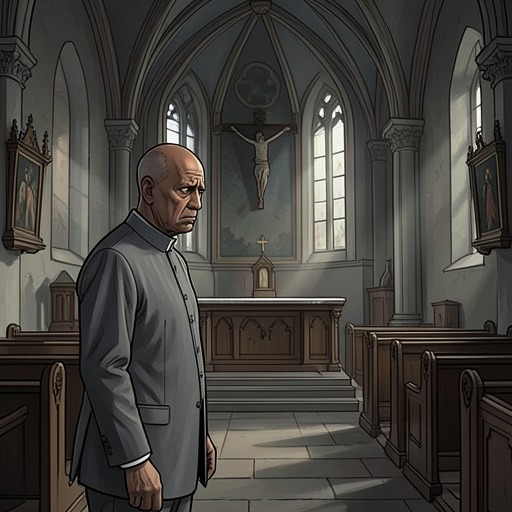
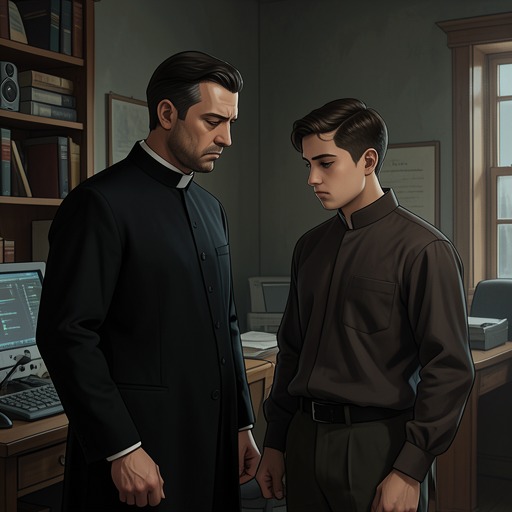
Wycazik treats the crisis as both a spiritual and psychological danger. He warns that the Prefect of Discipline could scrutinize Brendan for years if his conduct came under suspicion, limiting his prospects in the Church. Though Brendan dismisses the idea that he might rise high in the hierarchy, Wycazik insists that he has the ability to serve the Church and wants to preserve that possibility. He asks Brendan to give him until Christmas to help, promising no more pep talks or abstract debates about good and evil, but an attempt at amateur psychological treatment; if Brendan remains deeply distressed and no answer is nearer, Wycazik will refer him to a Jesuit psychiatrist. The arrangement reveals the rector’s determination to care for Brendan without reducing the crisis to a purely theological argument.
The hospital as an answer—and a challenge
As part of Wycazik’s unconventional therapy, Brendan works as an orderly at St. Joseph’s Hospital for Children. Only the physician who arranged his placement knows that he is a priest. He is given ordinary, often distressing duties rather than protected from them: changing urine-soaked sheets, assisting bed-ridden patients with exercises, feeding a partially paralyzed eight-year-old boy, and cleaning up after children made sick by chemotherapy. He encounters the effects of rheumatoid arthritis, muscular dystrophy, burns, and parental abuse. Twice on his first day he locks himself in a men’s-room stall and weeps.
The sight of children in pain does not restore his belief. Brendan knows the Church’s explanation that humanity brings evil upon itself by turning away from God, but finds that account inadequate when faced with innocent children enduring terrible illness and injury. Their suffering sharpens, rather than settles, his question about how a merciful God could allow such things. The therapeutic assignment thus puts lived pain ahead of arguments he already knows, and gives his crisis a concrete moral test.
The children nevertheless draw out a capacity in Brendan that the hospital’s routine work alone might not have revealed. After he shares an old nickname, they begin calling him Pudge; his stories, jokes, rhymes, and puns earn their laughter and smiles. He still cries, but by his third day he can entertain and encourage the patients, and the children and staff greet him by that nickname. Their trust and his usefulness offer a form of human connection, not a theological solution.
Many of the children retain strong faith despite their conditions. Emmy Halbourg, whose limbs have been severely affected by disease, believes in God’s goodness and in the rightness of creation. Brendan is moved by the children’s courage, but this does not persuade him that a caring God exists. When he puts Emmy to bed, his anger surges again; her faith and resilience can coexist with his doubt without dislodging it. The distinction matters: the children teach him something about courage in adversity, but they do not function as proof that suffering has been justified.
Violence, miracles, and the limits of consolation
Brendan’s inability to pray becomes acute during the Uptown sandwich-shop shootout. Curled on the car floor as shots strike nearby, he tries to pray but cannot find words; he feels alone, with God still absent to him. The violence does not become more comprehensible when the immediate danger passes. Brendan concludes that Wycazik’s intended lesson, whatever it may be, cannot make God as real to him as bullets. Death is tangible, while the promise of reward after death has no persuasive force in that moment. The scene intensifies the crisis by setting religious consolation against the physical immediacy of lethal force.
Wycazik, by contrast, sees a possible presence behind extraordinary events involving Brendan. When Winton Tolk questions why a good man should be saved when so many others die, Wycazik explains that he senses a force concerned not primarily with Winton but with Brendan. He connects that intuition to at least one other miraculous event: Emmy Halbourg’s limbs mending after they had been crippled by disease. The interpretation places Brendan at the center of events that Wycazik understands spiritually, but it does not mean Brendan has accepted that explanation. Winton later asks whether Father Cronin is a saint; Wycazik answers that he is a good man, not a saint, leaving the manner of the healing unresolved in the conversation.
The later revelation of an extraterrestrial civilization gives Wycazik another way to interpret Brendan’s crisis, but it remains his hypothesis rather than a confirmed account of Brendan’s past. He suspects Brendan may carry a subconscious memory of an encounter with beings so different and so advanced that it unsettled his belief in humanity’s special place in creation. Wycazik argues that being made in God’s image concerns souls, minds, reason, compassion, love, and friendship, not physical resemblance. In his view, the capacity to care and to meet the challenges of the universe can itself express the divine. He rejects the Contact Impact Study Group’s assumption that first contact must be concealed and disclosed to the public only gradually, insisting that humanity is ready. His confidence contrasts with Brendan’s unresolved struggle: the same encounter that Wycazik reads as evidence of a generous creation cannot simply be prescribed as Brendan’s answer.
Wycazik’s death and the return of prayer
The clearest return of Brendan’s faith comes not when he witnesses the alien ship but when Wycazik lies dead. Grief does not spare him doubt: he knows he cannot raise the dead, yet refuses to surrender and continues trying. He begins praying to the Virgin Mary, and the narration marks the prayer as neither habit nor unconscious reflex but an ardent act of belief. For this dark interval, Brendan trusts that his new power and Mary’s intercession can restore Wycazik’s ruined body and return him to life.
The prayer fails. Kneeling in the snow with his hands on Wycazik’s wound, Brendan recites the Litany of the Blessed Virgin, but the rector remains motionless. Brendan finally accepts that Wycazik’s death is God’s will. This sequence makes the recovery of faith real without turning it into a power that cancels mortality: prayer is again possible, but it cannot secure the outcome Brendan begs for. His acceptance comes through grief and the recognition of loss, not through a miraculous resurrection.
First contact and an unfinished answer
At the ship, Brendan tells Faye that the arrival is wonderful but not God, and admits that in his heart he had hoped it would be. His remark preserves the distinction between discovering other life and finding the religious certainty he wants. Faye reminds him of the message Wycazik had sent through Parker Faine and suggests that the event may eventually reaffirm faith for him as it did for Wycazik. She also tells Brendan that he resembles the rector more than he realizes. Her assurance gives him fragile hope; it does not report that he has already adopted Wycazik’s interpretation.
The ship nevertheless changes the scale on which the characters can imagine human suffering and history. Jorja Monatella experiences its arrival as the lid being torn from a dark box, while Sandy Sarver describes her abusive father’s hold over her losing its power in the presence of a vast universe. For Brendan, those responses provide a human consequence of contact, not a proof of God. The possibility of a shared future and of healing beyond ordinary medicine offers hope, while leaving open the question that has troubled him throughout: whether extraordinary care and extraordinary life can answer the reality of pain and death.
The crisis therefore remains more complex than a simple loss followed by a complete restoration of belief. Brendan’s prayers return in the moment of Wycazik’s death, and Faye’s words let him imagine growing into the kind of priest his mentor was. Yet the arrival of extraterrestrial life does not automatically satisfy his longing for God, and the narrative does not give a final declaration that every doubt has disappeared. His arc holds together belief and anger, compassion and helplessness: the children’s courage matters even without justifying their pain, and love persists even when prayer cannot bring the dead back.