Moon-Related Nightmares
StrangersMoon-Related Nightmares are a recurring disturbance in which the moon enters sleep, waking perception, and damaged memory as both a source of fear and an irresistible focus. Their appearances differ from person to person: Marcie whispers about the moon, Dom repeatedly wakes shouting about it, Alan speaks in his sleep, and Brendan experiences a moonlit vision that seems to call him toward something beyond ordinary dreams. The pattern gains wider significance when a witness’s recollection of the night at the motel begins to break through the group’s imposed memory block: what had seemed like isolated symptoms becomes part of a shared, suppressed experience.
Recurring Signs in Sleep
Marcie’s moon fixation emerges alongside her fear of doctors. After seeing Dr. Coverly, she sleeps in her own bed with only her teddy bear, Murphy, for company. During the night, Jorja checks on her three times. On one visit she hears Marcie whispering a repeated chant about the moon, its mingled fear and delight unsettling her. The next day, Marcie fills butcher’s paper with scores of moon drawings in every imaginable hue. Her nighttime words and daytime images make the fixation visible across both sleep and waking life, even as she returns to ordinary care and routine.
Dom’s episodes are more disruptive and recurrent. During a clandestine call with Parker, he reports a nightmare about the moon, then walks back to the motel through cold, damp wind. He wakes three times before dawn, each time surfacing from a nightmare he cannot remember and shouting about the moon. The pattern echoes an earlier stay in Portland, where he had also woken repeatedly from unremembered nightmares. The missing contents matter: Dom retains the lunar cry, not a coherent account of what he has dreamed. His inability to recover the dream’s details leaves the repeated words as a symptom without an explanation.
A Pattern Across Separate Lives
Jorja is troubled by the similarities between Marcie and her father, Alan. Their psychological problems take opposite forms—Marcie’s obsessive fear of doctors and Alan’s compulsive sexual urges—but both involve an obsession. Jorja is especially unsettled because the moon fixation also appears in each of them. Alan had not seen Marcie for six months, and their last phone conversation occurred weeks before either became fascinated by the moon. Jorja can find no contact through which one could have passed the fixation to the other; its apparently independent emergence is what makes the resemblance troubling.
When Jorja asks Pepper about Alan’s dreams, Pepper recalls that he had been dreaming about the moon since around late October, although he could remember no details after waking. She distinguishes these episodes from straightforward nightmares: she heard him talking in his sleep, sometimes sounding afraid and at other times smiling. That mixture resembles the fear and delight Jorja hears in Marcie’s whisper. The parallel is not simply that both father and daughter dream of the same image; in each case, the image carries contradictory emotional force, and neither person can give a clear account of its meaning.
Brendan’s experience gives the recurring image a further form. At his parents’ house in Bridgeport on Christmas night, he apparently dreams of the moon and wakes them with loud, panicky cries, but remembers nothing of the dream. Later, he lies in bed watching indirect moonlight refracted through frost on a window. The image holds his attention and draws him toward the glass, while he longs for the golden light associated with his other dreams. In this episode the moon is not merely recalled after sleep: it becomes a sign whose source and meaning he cannot identify. The scene joins attraction to alarm without settling into a clear explanation.
Memory, Suspicion, and Shared Experience
The lunar episodes unfold against evidence that the motel witnesses’ memories of the I-80 emergency have been altered. When Dom examines the registry, he recognizes his signature and the Mountainview, Utah, address he was moving toward, but cannot remember leaving in response to the supposed evacuation order. Ernie and Faye repeat an account of the chemical spill and evacuation in a strangely artificial, scripted manner. Dom recognizes the same quality in both of them and tells them that they have been programmed with the same script. The gap between a tangible record of his presence and his absent memory makes the group’s account of the past newly suspect.
Ginger also cannot remember the toxic-spill episode, although the Blocks and the Servers recall it clearly. After Dom challenges the Blocks’ account, they conclude that their memories of evacuating to a mountain ranch are false; Ned and Sandy likewise doubt their recollections of sheltering in their trailer. They believe they were kept at the motel, drugged, and brainwashed, like the people shown in the Polaroids. In this setting, a moon dream is not proof of what happened, but its recurrence among people with incomplete or altered memories becomes part of a larger pattern the group is trying to understand.
The characters consider whether an experiment at Thunder Hill could have affected them despite the distance, but they cannot supply an answer. The unresolved question preserves the tension between explanations: psychological symptoms, a shared experience, and interference with memory remain entangled. The narrative does not treat every lunar episode as an identical dream or provide a single immediate account of its cause.
The Night Recalled
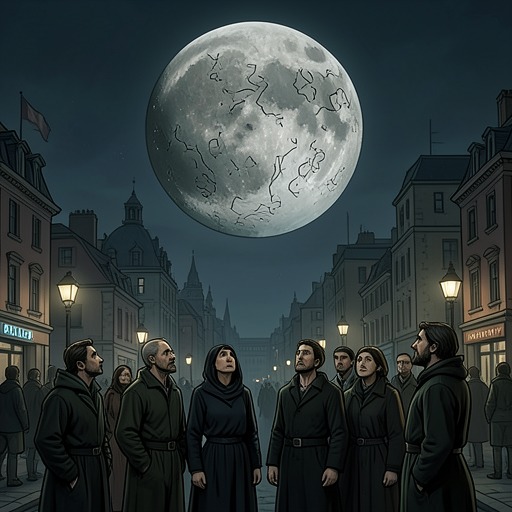
A decisive connection comes when Parker’s revelation prompts Sandy to recover large pieces of the forbidden night. She remembers jets passing over the motel, one flying so low that it seemed almost to take the roof, while the ground and air continued to vibrate. Then she remembers Dom turning from the jets and shouting about the moon. The witnesses looked up and saw it as unusually bright, seeming for a moment to fall toward them. Ernie, hearing Sandy’s account in the dark, quietly confirms that he remembers.
This recovered scene gives the recurring cries and dreams a collective horizon without making their earlier details identical. Marcie’s whispers, Dom’s repeated awakenings, Alan’s speech in sleep, and Brendan’s vision remain distinct experiences; Sandy’s recollection reveals that the moon was also part of a night witnessed by the motel group and subsequently obscured in memory. The motif thus works as a return: first an image that intrudes into separate lives, then a cue that helps reopen a shared past. Its power lies in the contrast between how little each dreamer can explain alone and how much the witnesses can begin to remember together.