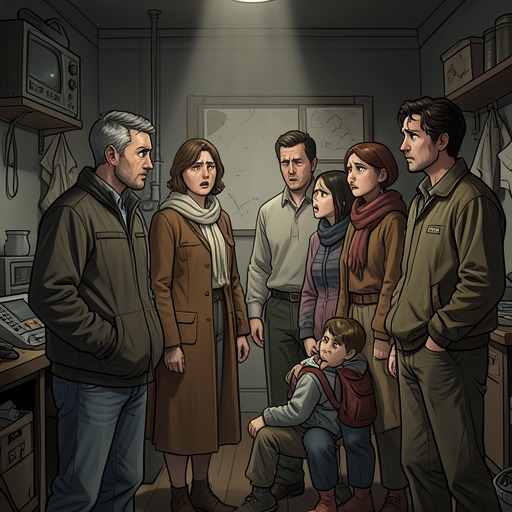
Ginger Weiss's fugue episodes
StrangersGinger Weiss’s fugue episodes turn a sudden medical crisis into a profound rupture in her life as a surgeon: exhaustive tests find no bodily cause, specialists offer a grim psychological prognosis, and a later attack in traffic leaves Rita Hannaby injured. The episodes are marked not only by lost time and terror but by the uncertainty surrounding them. Medicine can rule out many physical explanations, yet cannot promise Ginger that she will recover or return to the work for which she has trained.
The first crisis and the search for a cause
On the Friday after the catastrophic fugue that followed her aortal graft on Viola Fletcher, Ginger remains a patient at Boston Memorial. George Hannaby had led her from a snowy alleyway after she regained consciousness there. For three days, her colleagues subject her to a wide-ranging investigation: EEG studies, cranial X-rays, sonograms, pneumoventriculography, a lumbar puncture, and an angiogram. They repeat procedures to cross-check the results, except for the lumbar puncture, and search for tumors, cysts, abscesses, clots, aneurysms, infections, abnormal pressure, and other possible causes.
The eventual answer is a complete absence of findings. The doctors identify no disease, injury, congenital defect, or discernible pathological cause for her fugues. This negative result does not reassure Ginger. A correctable physical illness might have permitted her to resume surgery after treatment; instead, the tests leave her facing an illness described as psychological and beyond the reach of surgery, antibiotics, or controlling drugs.
The prognosis makes that distinction consequential. Psychotherapy is presented as the only hope of ending repeated fugues, but even the finest psychiatrists cannot promise a high cure rate for patients with this condition. The specialists warn that fugue can indicate incipient schizophrenia, that managing the condition and living a normal life may be difficult, and that institutionalization is a serious possibility. The diagnosis therefore threatens more than Ginger’s immediate health: it places the future she has worked toward beyond her control.
Recurrence in the city
After the hospital crisis, Rita takes an active role in Ginger’s recovery and rehabilitation. She approaches the work with determined care, though Ginger feels depressed by having to depend on it. That support becomes vital when another episode strikes at a crowded intersection. They are stopped in a Mercedes, surrounded by cars, buses, trucks, taxis, and delivery vehicles, when Ginger notices a large motorcycle. Its rider turns toward her, his face hidden behind a tinted visor.
The attack comes more quickly than the earlier episodes associated with Black gloves, an ophthalmoscope, or an operating-room sink drain. Ginger looks into the visor and is suddenly overwhelmed by terror. When awareness returns, the horns of surrounding traffic fill her attention. The Mercedes is still at the intersection, but several minutes have passed; the car has moved ten feet nearer the crosswalk and is angled into another lane, prompting other drivers to sound their horns as they maneuver around it.
Rita is leaning across the console, gripping both of Ginger’s hands and holding her in place. She explains that Ginger panicked and tried to get out of the car, and that she restrained her because Ginger might have been struck by traffic. Rita has only scratches, but Ginger is horrified by the thought that her actions have hurt someone who was trying to protect her. The episode makes the danger of the fugues concrete: during a lapse, Ginger may move through a hazardous public space without understanding what she is doing.
From helplessness to resolve
Rita uses handfuls of tissues to grip the steering wheel and gearshift so that she will not spread the blood from her scratched hands. Ginger, her own hands wet with Rita’s blood, slumps back into her seat and weeps. The physical traces of the episode sharpen its emotional consequence: the attack has endangered them both and turned care into a source of guilt for Ginger.
By Monday, December 16, the episode count stands at four in five weeks. Ginger can no longer wait passively for another attack or for a psychiatrist to explain what is wrong. The turn is not a recovery; the evidence gives no indication that the fugues have stopped or that their cause has been found. It is a change in her response. At what she recognizes as her lowest point, she decides to act before a fifth episode, even though she cannot yet say what that action will be. Her determination to climb back toward the light replaces the earlier posture of helpless waiting with an effort to regain agency.
Place in the wider story
Ginger’s symptoms remain medically unexplained in these episodes, even as the larger story develops competing ways of thinking about suffering, healing, and extraordinary events. At St. Joseph’s Hospital, children retain their faith despite severe illness and disability; Brendan Cronin is moved by their courage, though their example does not restore his own faith. Elsewhere, Father Stefan Wycazik tells a surgeon that he senses a Presence concerned with Brendan, whom he connects to miraculous healings. Winton Tolk later asks whether Brendan is a saint and how he healed him; Stefan answers that Brendan is a good man, not a saint, and that red rings appear on Brendan’s hands when such events occur. These developments complicate the novel’s account of what medicine and ordinary explanations can establish, but they do not supply a demonstrated cause for Ginger’s fugues.
The story eventually places Ginger among the witnesses caught up in the Thunder Hill crisis. At the entrance to Thunder Hill Depository, she is brought out of a transport with the other witnesses and Parker Faine; Lieutenant Horner’s machine gun prevents flight or resistance. This later captivity does not resolve the earlier diagnosis. Instead, it places Ginger’s unexplained episodes within a wider narrative in which people face both the limits of available knowledge and dangers that exceed the medical crisis with which her story began.