Interstellar traveler species
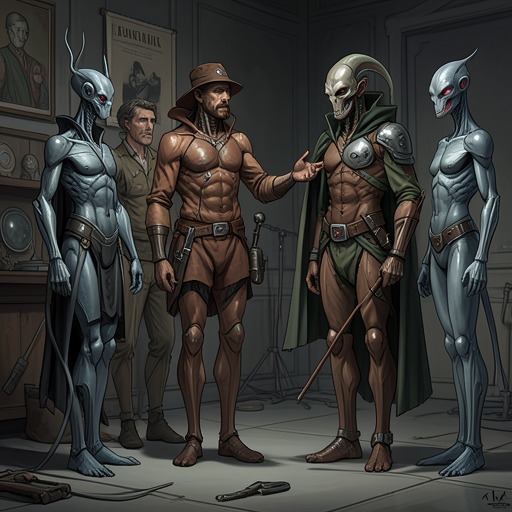
StrangersThe Interstellar traveler species is an ancient civilization that made the search for other intelligent life a religious duty and a collective purpose. Its Earthbound ship arrived with its crew already dead, but its records revealed a culture devoted to connecting minds across the immensities of space. The travelers’ most consequential gift was not merely knowledge: they could heal and use telekinesis, and they had learned to pass such abilities to other intelligent species. Their arrival becomes both a revelation about life beyond Earth and a challenge to human ideas about faith, mortality, and humanity’s place in creation.
Identity and Knowledge
The species is described as unimaginably ancient and capable of interstellar travel. Its surviving ship contained a vast visual encyclopedia covering its builders’ culture, biology, and psychology, along with material that gradually taught its language. The records were not immediately legible to the humans who found them: they first had to identify the playback device, then learn to operate it. Even as the project continued to interpret the archive, its visual explanations gave the researchers a way to approach a society radically different from their own.
The information available to the human investigators is substantial but incomplete. Miles Bennell explains that the encyclopedia describes physical matters more readily than philosophies, so the travelers’ religious ideas can only be inferred. Their appearance is understood to be profoundly different from humanity’s, and their civilization vastly advanced; the record does not reduce them to those differences. Instead, its account of their choices and purpose makes their ethical character central to how the humans understand them.
A Sacred Mission Across the Stars
By the time the ship left its home port, the travelers had located five other intelligent species in other solar systems. The distances made each discovery almost impossibly remote: all five known civilizations lay within 15,000 light-years of the travelers’ world, and news of a contact could take as long as that distance in years to return. The achievement is therefore measured not only in places reached, but in the patience required to learn that a meeting has occurred at all.
The travelers apparently regarded seeking other intelligences as a sacred obligation. Humans infer that they saw themselves as servants of a supreme force responsible for creating the universe, though the available records do not make the precise theology certain. Their mission was not to carry a religious message to other peoples. It was to help intelligent beings find one another and bind them across the otherwise separating vastness of space. That distinction matters: the species’ faith is expressed through service and connection rather than conversion.
The scale of the undertaking makes the commitment more striking. Miles Bennell estimates that the travelers may have dispatched hundreds, perhaps thousands, of ships each year, and may have maintained the practice for more than 100,000 years before this vessel departed. Most craft would presumably never return; some would continue through space without finding another intelligence, their crews dying far from home. The Earthbound ship belongs to that costly pattern of exploration, not to a brief expedition undertaken with any assurance of success.
Bodies, Lifespans, and the Gift
The crew’s deaths reveal the physical cost of such a mission. Although the ship and its devices continued to function through its descent and landing along Interstate 80, the travelers had died of old age long before reaching Earth. Their species ages far more slowly than humans: the human characters learn that its members age roughly one year for every fifty years that pass, and that an average lifespan is about 500 years. Even that longevity could not spare this crew from time during an immense journey.
The travelers had also evolved abilities that humans classify as psychic, including healing and telekinesis. More unusually, they had learned not only to develop those capacities within their own species but to infuse them into other intelligent beings. Miles Bennell tells Dominick Corvaisis and the others that this is what was done to Dominick and Brendan Cronin: they have received powers that they can in turn pass on. The abilities thus extend the species’ connective mission beyond communication or shared knowledge; the recipients can become transmitters of the gift.
The travelers’ influence is consequently visible in human lives even though the crew cannot speak for itself. Their healing capacity helps explain the extraordinary recoveries associated with Brendan, while the red rings that appear in Brendan’s and Dominick’s hands are echoed by raised rings on the tops of the containers holding the travelers. That physical correspondence links the human experience of the gift to the ship’s occupants without explaining every mechanism behind it. The evidence establishes transmission and resemblance, while leaving the process itself only partly understood.
First Contact and Human Meaning
For Father Stefan Wycazik, the possibility of intelligent life elsewhere in the universe strengthens rather than undermines faith. He reasons that a universe containing countless stars and planets would seem strangely empty if none held life, and argues that physical resemblance is not the measure of being made in God’s image. Reason, compassion, love, and friendship matter more than appearance or technological superiority. He suspects that Brendan’s crisis of faith is connected to a remembered encounter with a race so different and advanced that it seemed to unsettle familiar teachings about humanity. The travelers’ capacity to care offers Stefan another way to read that difference: advancement need not negate moral kinship.
Their arrival also changes the scale against which human fear and conflict are measured. When the luminous ship is seen on the Nevada plains, the witnesses experience its presence as the opening of a world that had seemed shut away. Sandy Sarver describes how the sight altered the hold of her childhood terror; beside the ship and the vastness it implied, the man she had feared became, in her perspective, a speck. Jorja recognizes a related consequence in the possibility that human divisions and struggles for domination might appear smaller when humanity understands itself as one intelligent species among others. The encounter does not erase suffering, but it offers a context large enough to loosen some of its power.
The Long Return of the Call
The travelers’ mission points beyond the immediate encounter. Bennell imagines humanity first learning to apply the knowledge and technology brought by the ship, then taking perhaps another thousand years to mature into the same kind of commitment. A human crew might eventually leave in suspended animation, seeking to answer the travelers’ call; if the journey took tens of thousands of years, distant descendants could make contact with a civilization that had not yet received any message from Earth. This is a projected future, not an accomplished expedition, but it follows the travelers’ own model: contact is an act whose consequences may outlast those who begin it.
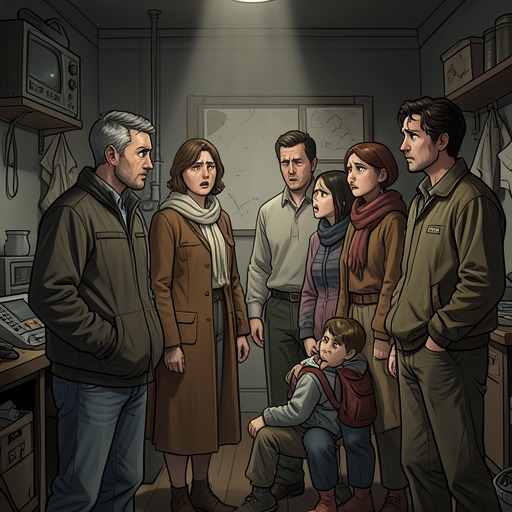
The possibility of disclosure gives that future a present consequence. Ginger Weiss looks at the Tranquility family and imagines a world in which people no longer regard one another as strangers, while healing abilities might spread from person to person. The species’ example makes first contact more than proof that humanity is not alone. Its long, costly effort suggests that intelligence can be directed toward care, and that a civilization may define its purpose by helping others endure, heal, and join a wider community. The travelers reached Earth too late to witness what their voyage would mean there; their mission nevertheless becomes a model humanity may one day choose to continue.