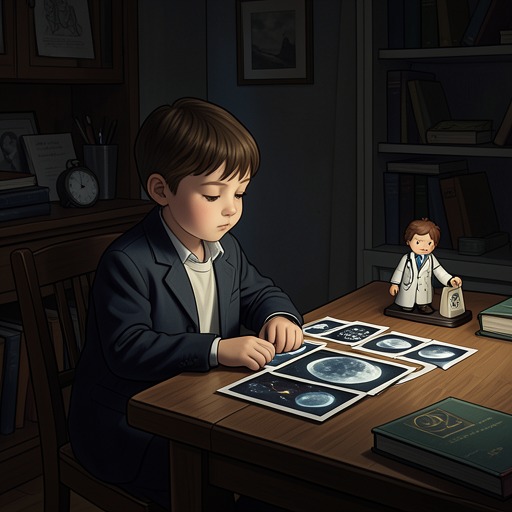
Marcie's semicatatonic withdrawal
StrangersMarcie's semicatatonic withdrawal is marked by a painful split between physical presence and apparent inward retreat. During the journey in a troop truck, she clings to Jorja and seeks the comfort of being held, yet remains disconnected from reality; later, beside the spacecraft, she recognizes her mother and briefly begins to speak about what she saw. The change offers hope without establishing that she has recovered: after this moment of recognition, her attention turns inward again.
The State in the Truck
As the truck jolts through the windy night, Jorja holds Marcie with one arm and grips a strap with the other. Marcie clings fiercely to her. The semicatatonic limpness that had characterized her earlier retreat has given way to a strong need for affection and bodily contact. Jorja takes this change as a hopeful sign, but the narration qualifies that hope: Marcie is still by no means connected with reality. Her need to be hugged is real and immediate, even while her grasp of the surrounding situation remains impaired.
That distinction matters to how the state is presented. Marcie is not simply absent: she responds through touch and seeks closeness, allowing Jorja to recognize a change in her daughter. But contact does not itself restore shared awareness. Jorja's hope rests on a small alteration in Marcie's behavior, not on a sudden return to ordinary communication. The truck scene thus establishes both the persistence of Marcie's withdrawal and the first sign that it may not be total or unchanging.
The Ship and the Memory of the Moon
Later, Jorja carries Marcie to the spacecraft resting on trestles. Jorja is already prepared for the sight by the collapse of her own memory block and the returning recollections, but the ship still overwhelms her. She touches its mottled, scorched, abraded hull, experiencing fear, wonder, and delight together. Marcie reaches toward it too, whether in response to her mother's example or from an impulse of her own. Her small hand moves across the metal as she calls it the moon.
Jorja tells her that the object is not the moon falling, but a ship: the thing they had seen descend, glowing white like the moon before turning red and amber. Marcie repeats that the moon fell down, and Jorja gently corrects her. The exchange gives the child's earlier moon-language a concrete context. What had appeared to be a fixation or confusion is now connected to the spacecraft and to an event whose memory had been obscured. The scene does not establish that Marcie can recall the whole event clearly; it shows her approaching it through a few words and through contact with the vessel itself.
A Brief Return to Recognition
Marcie turns and looks directly at Jorja, with eyes no longer unfocused or turned inward. Asked to understand the ship through familiar stories, she compares it to Captain Kirk and Mr. Spock. Jack Twist adds Luke Skywalker and Han Solo, and Marcie repeats Luke. The cultural references give the adults a way to describe an unfamiliar and overwhelming object in terms the child can engage with. More significantly, she is briefly participating in an exchange: looking at Jorja, responding to a question, and repeating a name.
The return is temporary. Her eyes blur out of focus again, and she withdraws into her private place to contemplate what she has just been told. The scene therefore resists a simple account of awakening. Recognition has become possible, but attention does not stay steadily with the people around her. Marcie moves from inwardness to connection and back again within the same encounter, making the progress visible without suggesting that the withdrawal has ended.
Interpretation and Limits
Jack interprets Marcie's moon obsession as a struggle to remember. Because she has begun to remember, he believes she no longer needs to struggle in the same way, and he reassures Jorja that Marcie will be all right, though it may take time. His explanation links the child's repeated image to the return of a buried memory; it is his interpretation and prediction, not proof that her condition has resolved. Jorja is reassured by Jack's presence, but answers that Marcie's future depends in part on their own survival and on keeping their memories intact.
Marcie's withdrawal consequently has two connected effects in the story. It makes the cost of erased memory intimate, visible not only as a missing account of the past but as a barrier to contact between a child and her mother. At the same time, Marcie's words help give the remembered sight of the spacecraft a human scale: the ship first reappears to her as the moon that fell. Her moment of recognition is meaningful precisely because it remains partial. The narrative offers a tentative sign of return, followed by renewed inward retreat, rather than a cure or a settled ending.