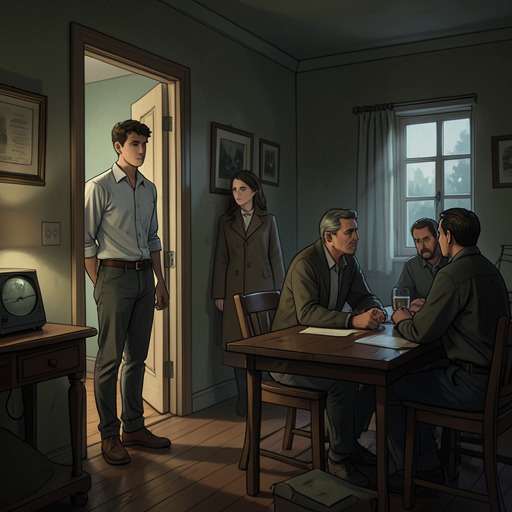
Marcel and Brad
TemptationMarcel and Brad is the relationship between Marcel and his former partner, whose betrayal continues after their breakup in the form of unwanted encounters, public confrontation, and attempts to shift responsibility. Its decisive turn comes when Brad invokes Marcel’s blindness to undermine what he knows; Marcel rejects that tactic, refuses reconciliation, and leaves for a home and a relationship that are no longer organized around Brad’s choices.
Background and Imbalance
Before their separation, Brad knew that Marcel faced barriers at work because businesses often did not know how to accommodate him. Marcel had been rejected from jobs for which he was qualified, and studios had cut his teaching hours until he was left with only one class a week because students were uncomfortable with his blindness. Brad understood these circumstances, yet held Marcel’s difficulty finding work against him. That contradiction gives their history an unequal quality: Brad knows the obstacles are not simply personal failings, but treats their consequences as Marcel’s fault.
The relationship also sits within the decisions that brought Marcel to Fairfield. Brad asked him to move across the country for a well-paid opportunity, presenting the move as a fresh market while Marcel was looking for work. Marcel recognized that relocation was a major decision, one he was used to making only with his brother and parents as contacts and support. The surviving scenes establish the move and its pressure on Marcel’s independence, but do not reduce the relationship to a single cause or disclose every detail of their life together.
Betrayal and the Breakup’s Afterlife
After the relationship had ended, Brad appeared at Ruby’s bar while Marcel was with Colton. Colton recognized him as the ex who had cheated on Marcel and left him out in the cold. Marcel, meanwhile, gripped Colton’s arm hard enough to bruise him before turning to address Brad. The encounter makes the breakup physically present: Brad is not merely a past injury but someone whose arrival still produces an immediate, bodily reaction.
Brad later confronted Marcel again, this time framing Marcel’s new intimacy with Colton as evidence that the breakup had gone wrong. He mocked Marcel for being upset that Brad had kicked him out of the townhouse, then accused him of getting involved with a younger man in a bar and asked whether he had damaged Marcel so badly. The accusation turns Brad’s own conduct into Marcel’s supposed emotional defect. Marcel’s laughter and question about why Brad cared expose the contradiction: Brad had wanted out, yet resents Marcel for moving on.
Confrontation and Refusal
Brad’s apology does not arrive as a clean acknowledgment of harm. He first suggests that Marcel could not know what had happened because he is blind, challenging the reliability of Marcel’s perception of the infidelity. Marcel answers that Brad cannot use his blindness against him: he knows what was happening when he came home, and Brad had not even been careful. He also identifies the unresolved inconsistency in Brad’s behavior: Brad had wanted to bring him there while wanting the relationship to end, and still had not explained why.
Only after this confrontation does Brad say he is sorry. His explanation—that he was angry, stupid, and upset when Marcel moved on—centers his own reaction, while his claim that Marcel never gave him a chance to make things right continues to cast Marcel’s refusal as the problem. Marcel does not treat an apology as an automatic entitlement to forgiveness. He distinguishes between pain he can live with and move on from and harm he cannot, and tells Brad that Brad cannot decide whether he is worth another chance.
Separation and Significance
Marcel leaves rather than continue negotiating the breakup on Brad’s terms. His cane is part of the confrontation’s concrete action: he sweeps it outward as he tries to move around Brad, and Brad grabs his arm to stop him. When Brad finally lets him go, Marcel knows Brad is watching him walk away, but that observation no longer determines what happens next. Marcel has a home waiting and hopes that Colton will meet him there with care and comfort.
The relationship’s ending is therefore not a renewed partnership but a boundary made explicit. Brad’s apology does not erase his infidelity, his insults, or his attempt to turn Marcel’s blindness into evidence against him. Marcel’s refusal preserves his authority over both his experience and his future: he can acknowledge that the past hurts without allowing Brad to dictate whether that hurt should be forgiven. Leaving Brad behind also marks the difference between being kept close out of fear of being alone and choosing companionship freely—a distinction Marcel later describes in relation to his life with Colton.